
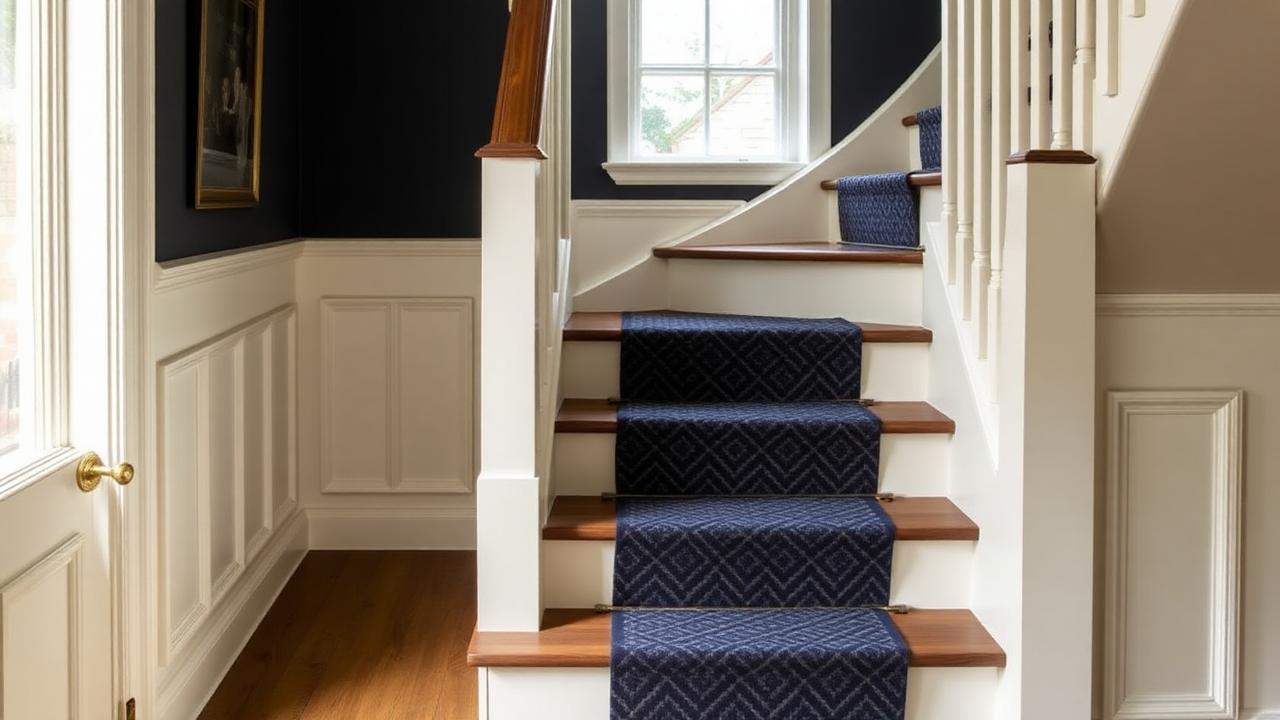
Categorizing Stair Runner Styles
Stair runners are no longer limited to the red oriental rugs of the past. Today, they are a primary design feature that sets the tone for the entire home. Generally, styles can be broken down into four main categories: Modern/Minimalist, Traditional/Classic, Transitional, and Eclectic/Bold. Each style has its own set of 'rules' regarding material, pattern, and installation method.
When selecting a style, consider the 'eye line' of your home. The stairs are often the first thing people see when they walk through the front door. A stair runner length calculator is an essential tool at this stage to ensure your chosen style—especially if it involves complex patterns—is ordered in the correct quantity to maintain pattern continuity.
1. The Modern Minimalist Style
Modern runners focus on texture and clean lines rather than complex patterns. Think flatweaves, low-pile wools, and solid colors. Grey, charcoal, and soft taupe are the dominant palettes here. The 'waterfall' installation method—where the carpet flows straight down from the nosing to the next tread without being tucked into the riser—is often used to enhance the minimalist feel.
- Materials: Wool loops, nylon blends, felted wool.
- Key Feature: Subtle texture over bold pattern.
- Hardware: Often installed without rods for a cleaner look.
2. The Traditional & Classic Style
Traditional styles often draw from Persian, Oriental, or Victorian motifs. These runners usually feature ornate borders and central medallions. Rich colors like deep reds, navy blues, and forest greens are common. This style is best suited for older homes or for adding a sense of history and 'gravity' to a new build.
3. The Transitional Style (The Most Popular)
Transitional style is the 'sweet spot' for most homeowners. It combines the comfort of traditional materials with updated, simpler patterns. The most common examples are stripes, herringbone, and simple geometric grids. It works equally well in a modern farmhouse as it does in a suburban semi-detached home.
| Style | Common Patterns | Best Architecture |
|---|---|---|
| Modern | Solid, Speckled, Micro-stripe | Industrial, Contemporary |
| Traditional | Floral, Medallion, Paisley | Victorian, Colonial, Georgian |
| Transitional | Herringbone, Wide Stripe, Chevron | Modern Farmhouse, Craftsman |
| Eclectic | Animal Print, Bold Geometric, Ombre | Mid-Century, Maximalist |
4. The Eclectic and Bold Style
For those who want their stairs to be a conversation piece, bold styles are the way to go. This includes animal prints (like leopard or antelope), vibrant colors, and oversized geometric shapes. These styles require careful planning, as a very loud pattern can be overwhelming in a small, dark hallway.
Style vs. Geometry
Not all styles work on all stairs. For example, a wide horizontal stripe can look disjointed on a winding staircase. Always consider how the pattern will 'break' at the turns of your stairs.
Technical Considerations for Different Styles
Style isn't just about looks; it's also about construction. A flatweave runner (common in modern and transitional styles) is much thinner than a plush pile runner (common in traditional styles). This affects the type of underlay you need and how the runner is secured to the floor. In the UK, 'grippers' (tack strips) are the standard for most styles, while in the US, a combination of staples and specialized adhesives is frequently used for low-profile styles.
| Style Attribute | Flatweave (Modern) | Plush Pile (Traditional) |
|---|---|---|
| Profile Height | 5mm - 8mm | 10mm - 15mm |
| Durability | High (but shows snags) | Moderate (can mat down) |
| Installation Difficulty | Moderate | High (requires more stretching) |
| Cost (UK/US) | £30/$35 per unit | £50/$60 per unit |
Matching Hardware to Your Style
Finally, don't forget the jewelry for your stairs: the rods. A modern runner might look best with sleek, black square-profile rods, while a traditional oriental runner practically begs for polished brass rods with acorn finials. The hardware should reinforce the style you've chosen for the carpet itself.
How much runner do I need for a chosen style?
Style choice affects quantity more than most people expect, mainly through pattern repeat and directional layout rather than the base fibre. Take a US example: a 13-step flight with a 10 in tread run and 7.5 in riser height needs roughly 17.5 in of runner per step once the nosing wrap is included, giving a base length of about 227.5 in, or just under 19 ft, before any allowance for style-specific waste. A plain modern flatweave in a solid colour can often get away with a 5% waste margin on top of that base figure, landing around 19.5-20 ft, because there is no pattern to align. A traditional medallion or a directional herringbone, by contrast, typically needs a 12-15% margin to allow the repeat to land cleanly at each nosing, pushing the same 13-step flight closer to 21-22 ft.
In UK metric terms, the same flight uses a 25 cm going and 19 cm riser, giving about 44.5 cm per step and a base length of roughly 5.8 m for 13 steps. A plain, non-directional style with a 5% waste allowance lands around 6.1 m, while a bold directional pattern with a 12-15% allowance for repeat matching comes out closer to 6.5-6.7 m. The lesson either way is that a stair runner calculator gives you the base tread-and-riser figure quickly, but you still need to add a style-appropriate waste margin on top before ordering, since a bold traditional or eclectic pattern eats noticeably more material than a plain modern flatweave of identical dimensions.
| Style | Waste margin to allow | 13-step estimate (US) | 13-step estimate (UK) |
|---|---|---|---|
| Modern/minimalist (solid or micro-texture) | 5% | ≈19.5-20 ft | ≈6.1 m |
| Transitional (herringbone, stripe) | 8-10% | ≈20.5-21 ft | ≈6.3-6.4 m |
| Traditional/eclectic (medallion, large repeat) | 12-15% | ≈21-22 ft | ≈6.5-6.7 m |
Know your numbers in 30 seconds
Enter your step count, tread depth and riser height — the stair runner calculator gives you the exact length to order, in metres and feet, with waste included.
Open the stair runner calculatorFrequently asked questions
What is the most popular stair runner style right now?
Transitional styles, specifically herringbone and striped patterns in neutral tones, are currently the most popular. They offer a balance of visual interest and timeless appeal that fits most modern home aesthetics without feeling dated too quickly.
Should a stair runner match the hallway carpet?
It doesn't have to match perfectly, but it should coordinate. Many designers use a patterned runner on the stairs and a solid, matching color in the hallway. This creates a 'zoning' effect that makes the staircase feel like a special architectural feature.
Can I use a traditional style in a modern home?
Yes! This is often called 'eclectic' or 'transitional' design. A traditional Persian-style runner can add warmth and character to a very stark, modern white-walled home. The contrast between the old-world pattern and the modern space can be very striking.
Are striped runners out of fashion?
No, stripes are a perennial favorite because they help to elongate the staircase and add a sense of order. However, the trend has shifted from multi-colored 'deckchair' stripes to more subtle, two-tone stripes or 'pinstripe' textures.
Does style affect the cost of installation?
Yes. Complex patterns like large geometrics or traditional medallions require more time for 'pattern matching', which increases labor costs. Simple, non-directional styles like loops or twists are generally faster and cheaper to install.
How do I choose a style for a narrow staircase?
For narrow stairs, avoid very large or busy patterns which can make the space feel cramped. Instead, opt for vertical stripes (to draw the eye up) or a simple, textured solid color with a contrasting border to define the edges.
Know your numbers in 30 seconds
Enter your step count, tread depth and riser height — the stair runner calculator gives you the exact length to order, in metres and feet, with waste included.
Stair Runner Length CalculatorReady for real prices?
Get quotes from vetted stair runner suppliers and fitters near you. Free, no account, no obligation.
Every guide is written from hands-on measuring and fitting experience, checked against the calculator’s own maths, and re-reviewed whenever prices or methods change. Read our editorial standards.