

The mechanics of pile flattening on stairs
When we talk about a stair runner flattening, we are usually referring to 'pile crushing' or 'matting' on the nosing of the tread. This is the point where the weight of a descending person is most concentrated. Unlike flat floors where weight is distributed across the sole of the foot, on stairs, the ball of the foot pivots on the very edge of the step. This shearing motion twists the individual yarns and compresses the air gaps between the fibres. Over time, these fibres lose their spring and lay flat, making the runner look thin, shiny, or worn, even if the actual material is still there.
The severity of flattening depends heavily on the fibre type. Wool has a natural 'crimp'—a spring-like structure that helps it bounce back after being stepped on. Synthetic fibres like polypropylene, however, lack this natural resilience. Once the plastic filaments in a polypropylene runner are bent past a certain point, they tend to stay bent, leading to permanent flattening much faster than wool. Nylon sits somewhere in the middle, offering good resilience but still eventually succumbing to the high-pressure environment of a busy family staircase. Understanding these material properties is crucial for any stair runner calculator user who wants a long-lasting installation.
The trade secret: The steam-and-lift technique
In the trade, we often use controlled moisture and heat to 'reset' the pile of a crushed wool runner. This isn't just about cleaning; it’s about using the hygroscopic nature of wool to our advantage. By introducing a small amount of steam, you penetrate the core of the wool fibre, allowing it to relax and return to its original shape. You don't need a heavy industrial steam cleaner for this—a high-quality garment steamer can often do the job if used correctly. The key is to avoid soaking the backing, as excessive moisture can lead to shrinkage or delamination of the primary and secondary backings.
To perform this fix, start by vacuuming the area thoroughly to remove any grit that might be holding the fibres down. Hold the steamer about two inches away from the flattened nosing and move it slowly across the width of the runner. You want the pile to feel warm and slightly damp, not wet. Immediately follow the steam with a stiff-bristled carpet brush or a specialized carpet rake. Work the brush against the grain of the pile, lifting the fibres upward. This mechanical action, combined with the heat-softened fibres, helps them stand back up. Leave the area to dry completely before allowing anyone to walk on it, as walking on damp, soft pile will just crush it back down again, potentially more permanently.
Agitation tools and their uses
Not all brushes are equal when it comes to pile restoration. For a dense wool twist, a firm nylon-bristled brush is usually best. For a loop pile runner, however, you must be extremely careful. Using a stiff brush on loops can lead to 'fuzzing' or 'pilling,' where individual filaments are pulled out of the yarn structure. In these cases, a softer grooming brush or even a clean, dry microfiber cloth can be used to gently nudge the loops back into position after steaming. The goal is restoration, not destruction, so always start with the gentlest method possible and only increase the pressure if you aren't seeing results.
How much runner do I need?
If the flattening is so severe that the fibres have actually started to break or pull away from the backing, no amount of steaming will fix it. In this scenario, you are looking at a partial or full replacement. Let’s look at the numbers for a standard project. For a 13-step flight with a 10 in (25 cm) tread depth and a 7.5 in (19 cm) riser height, you also need to account for the nosing wrap, which is typically 0.75 in (1.9 cm) on a standard bullnose stair.
In US measurements, each step requires 18.25 inches of material. Multiplying this by 13 steps gives a subtotal of 237.25 inches, or 19.77 feet. You must then add a finishing allowance of 12 inches at the top and 12 inches at the bottom to ensure the runner can be tucked under the landing carpet and finished cleanly at the floor. This brings the total to 21.77 feet. Finally, we always add a 10% waste margin for cutting, alignment, and unforeseen errors, resulting in a total order of approximately 24 feet.
In the UK, the same flight (25 cm tread, 19 cm riser, 1.9 cm wrap) requires 45.9 cm per step. For 13 steps, that’s 596.7 cm. Adding a 60 cm total finishing allowance (30 cm top and bottom) brings the length to 656.7 cm. With a 10% waste margin, the final requirement is approximately 7.22 metres. Whether you are buying by the foot or the metre, these precise measurements ensure you don't run short halfway up the flight, which is a disaster for any installation.
| Measurement | US (in/ft) | UK (cm/m) |
|---|---|---|
| Tread depth | 10 in | 25 cm |
| Riser height | 7.5 in | 19 cm |
| Nosing wrap | 0.75 in | 1.9 cm |
| Total per step | 18.25 in | 45.9 cm |
| 13 steps subtotal | 19.77 ft | 5.97 m |
| Plus allowances | 21.77 ft | 6.57 m |
| With 10% waste | 24 ft | 7.22 m |
Know your numbers in 30 seconds
Enter your step count, tread depth and riser height — the stair runner calculator gives you the exact length to order, in metres and feet, with waste included.
Open the stair runner calculatorThe role of underlay in preventing pile crush
If you're fixing a flattened runner, you should also look at what's underneath it. Underlay is the unsung hero of carpet longevity. Its primary job is to act as a shock absorber. When you step on the runner, the underlay compresses first, absorbing the kinetic energy of your footfall before it reaches the carpet fibres. If the underlay is old, thin, or made of a low-density foam, it will bottom out almost instantly, leaving the carpet fibres to take the full force against the hard timber of the stair nosing.
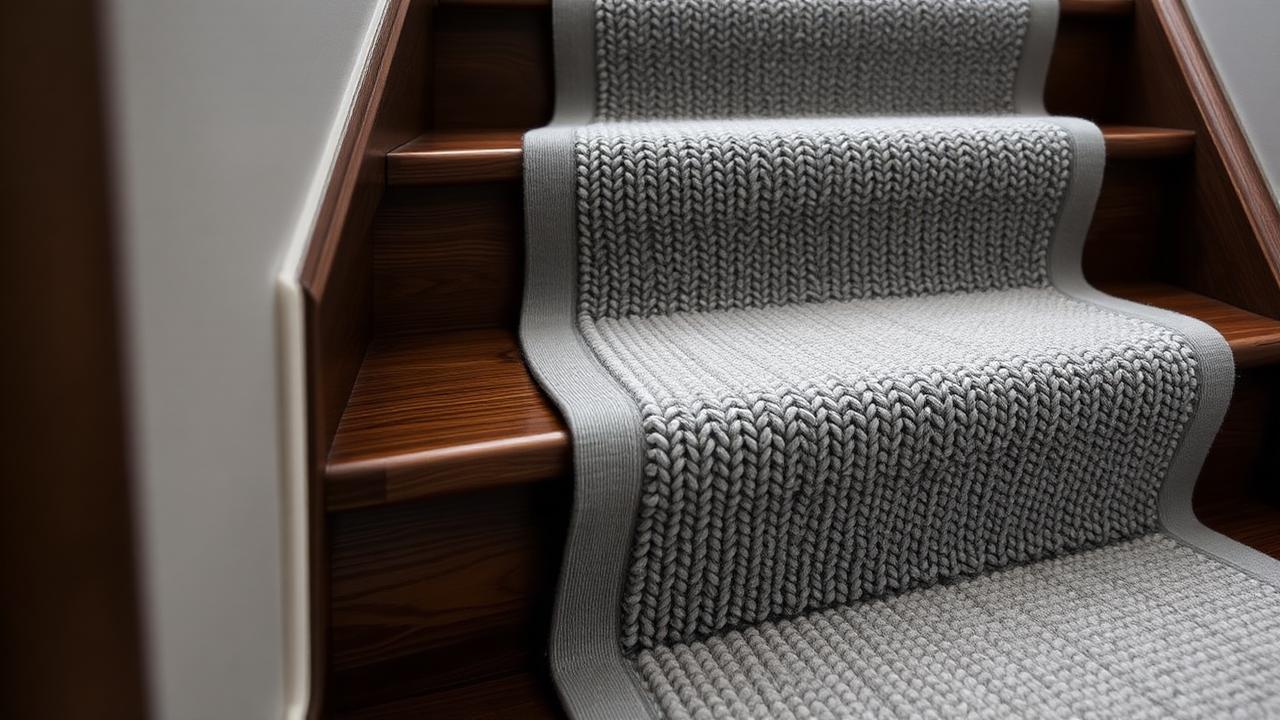
For stairs, I always recommend a high-density, firm underlay rather than a thick, soft one. A soft underlay might feel nice for a few weeks, but it allows too much movement in the runner, which can lead to stretching and premature pile crushing. A dense rubber or a high-tog polyurethane (PU) foam specifically designed for high-traffic areas is your best bet. If you find your runner flattening within just a year or two of installation, the culprit is almost certainly the underlay rather than the carpet itself. When calculating your stair runner length, don't forget that you'll need the same amount of underlay (though it's usually cut into individual pads for the treads and risers).
Identifying failed underlay
You can check your underlay by feeling the nosing through the carpet. If the edge feels sharp and hard, the underlay has likely flattened completely. If it feels slightly cushioned and you can't easily feel the hard timber underneath, the underlay is still doing its job. In my experience, if the carpet is flattened, the underlay in that specific spot is usually compromised as well. If you are going to the trouble of lifting the runner to fix the pile, consider replacing the underlay pads on the most heavily used steps.
When flattening becomes a safety issue
Flattening isn't just an aesthetic problem; it can be a safety concern. As the pile mats down, the surface of the runner can become slick. This is particularly true for synthetic fibres like polyester or polypropylene, which can develop a 'glaze' when the plastic filaments are crushed and smoothed. On a staircase, a loss of grip is a recipe for a slip, especially for those wearing socks. If you notice that the nosing of your steps feels unusually slippery compared to the rest of the tread, it's time to take action.
Furthermore, severe flattening can hide the actual edge of the step. Our brains use the visual and tactile feedback from the stair nosing to judge where to place our feet. When that edge becomes rounded and matted, it can lead to missteps. Regular maintenance, including the steam-and-lift method mentioned earlier, helps keep the edges defined and the surface textured for better grip. Safety should always be the priority when maintaining or installing stair runners.
Testing for permanent damage
If you've steamed and brushed the pile but it still looks flat or shiny once it dries, the fibres have likely reached their 'elastic limit' or have been heat-damaged. At this point, no DIY fix will restore the look, and you should consider a new runner.
Long-term maintenance for a plush look
The best way to fix flattening is to prevent it from getting severe in the first place. This means a regular maintenance schedule that includes more than just a quick vacuum. Once a month, use a carpet brush to manually lift the pile on the nosings of the bottom three steps, as these usually see the most 'pivoting' traffic. This simple two-minute task can add years to the life of your runner.
Also, consider your footwear. Walking on a stair runner in heavy outdoor shoes with hard heels is the fastest way to destroy the pile. Soft-soled indoor slippers or just socks are much gentler. If you have a busy household where outdoor shoes are the norm, you must accept that pile flattening will occur much faster, and you may need to perform the steam-and-lift fix every few months to keep the runner looking its best.
In summary, while stair runner flattening is a natural part of the product’s lifecycle, it is not something you have to live with. With the right tools, a bit of trade knowledge, and a quality underlay, you can keep your staircase looking plush and feeling safe for many years. And when the time finally comes for a change, the stair runner calculator is always here to help you get the measurements right for your next project.
- Vacuum regularly with a high-quality machine to remove abrasive grit.
- Use a garment steamer on wool runners to reset fibre memory.
- Always brush the pile upward after steaming.
- Ensure your underlay is high-density and in good condition.
- Avoid walking on the runner with heavy, hard-heeled footwear.
Whatever you decide, get the numbers first: the stair runner calculator doubles as a stair runner length calculator, adding nosing wrap, landings, winders, pattern repeat and waste so you order the right length the first time.
Frequently asked questions
Can I fix flattened pile on a synthetic stair runner?
It is much harder than with wool. Synthetic fibres like polypropylene are basically plastic; once they are crushed, they often stay that way. You can try very gentle heat, but be extremely careful as they can melt or glaze if you use too much.
Is steam cleaning the same as the steam-and-lift method?
No. Professional steam cleaning uses hot water extraction. The steam-and-lift method is a targeted maintenance technique using a garment steamer and a brush to restore pile height without soaking the carpet.
How often should I try to lift the pile?
For high-traffic stairs, a quick brush once a month is great. A full steam-and-lift should only be done as needed, perhaps every 6–12 months.
Will a carpet rake help with flattening?
Yes, a carpet rake is a fantastic tool for lifting crushed fibres, especially on longer pile or shag-style runners. For short-pile stair runners, a stiff-bristled brush is often more effective.
Does all wool carpet bounce back?
Most wool has excellent resilience, but very cheap wool blends with high synthetic content will not perform as well as 100% pure new wool.
Why does my runner look shiny where it's flat?
This is usually 'glazing' or 'shading.' The flattened fibres reflect light differently than the upright ones, creating a shiny or dark patch depending on the angle of the light.
Can I use an iron to steam my carpet?
Never touch an iron directly to the carpet. You can use the steam function of an iron held several inches away, but a garment steamer is safer and more effective.
Does the thickness of the runner affect flattening?
Not necessarily. A thin, very dense runner often resists flattening better than a thick, airy one because there is less 'room' for the fibres to collapse.
Know your numbers in 30 seconds
Enter your step count, tread depth and riser height — the stair runner calculator gives you the exact length to order, in metres and feet, with waste included.
Work out replacement lengths with the stair runner calculatorReady for real prices?
Get quotes from vetted stair runner suppliers and fitters near you. Free, no account, no obligation.
Every guide is written from hands-on measuring and fitting experience, checked against the calculator’s own maths, and re-reviewed whenever prices or methods change. Read our editorial standards.