

How much runner do I need for this job?
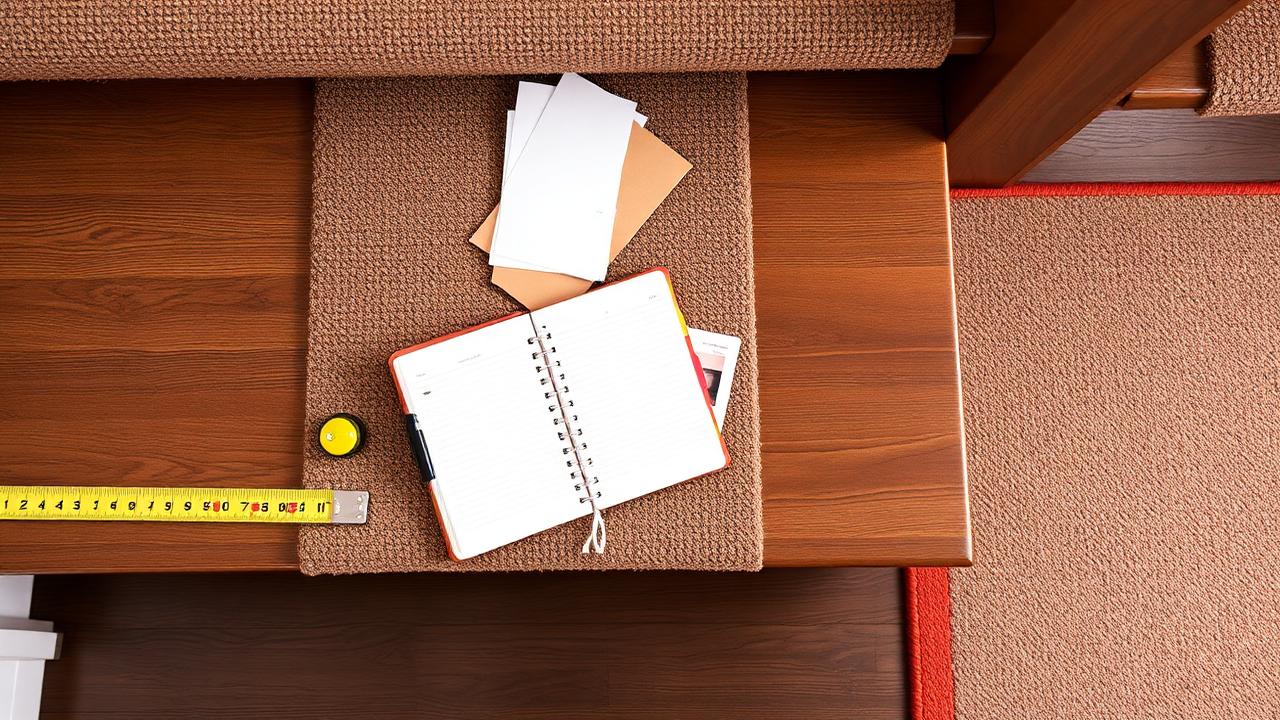
Before you tackle any care task, it helps to know how much material you are actually working with. For a standard 13-step flight with 10 in (25 cm) treads, 7.5 in (19 cm) risers, and a 0.75 in (1.9 cm) nosing wrap, each step consumes 18.25 in (45.9 cm) of runner. Multiplied across 13 steps that is 19.77 ft (5.97 m), and once you add the 24 in (60 cm) finishing allowance at top and bottom you reach 21.77 ft (6.57 m). A 10% waste margin for cutting and pattern matching brings the total order to roughly 24 ft (7.3 m).
These numbers matter for maintenance too: knowing the exact yardage helps you order matching offcuts for repairs, budget for cleaning by the linear foot or metre, and plan any partial replacement without guesswork. The stair runner length calculator handles all of this automatically once you enter your own tread, riser, and step count, so you are never left estimating on a ladder with a tape measure.
| Measurement | US (in/ft) | UK (cm/m) |
|---|---|---|
| Tread depth | 10 in | 25 cm |
| Riser height | 7.5 in | 19 cm |
| Nosing wrap | 0.75 in | 1.9 cm |
| Total per step | 18.25 in | 45.9 cm |
| 13 steps subtotal | 19.77 ft | 5.97 m |
| Plus allowances | 21.77 ft | 6.57 m |
| With 10% waste | 24 ft | 7.22 m |
Know your numbers in 30 seconds
Enter your step count, tread depth and riser height — the stair runner calculator gives you the exact length to order, in metres and feet, with waste included.
Open the stair runner calculatorWhy stair runners wear unevenly
Every staircase has hot spots. The bottom three or four steps see the heaviest traffic because that is where people pivot on and off the flight, often while carrying bags, laundry, or children. The middle of the run typically wears more evenly, and the top steps closest to the landing usually stay in the best condition of all. Because the wear is so concentrated, a runner can look tired and thin at the bottom while the top half is still practically new. Rotating the runner end-to-end, or flipping it if it is reversible, moves that heavily worn section to a lower-traffic zone and lets the barely used section take over the punishing bottom steps.
Which runners can actually be rotated
Not every installation is a candidate. A runner that has been cut, bound, and fitted with a fixed pattern direction, such as a directional stripe or a floral repeat with an obvious top and bottom, cannot simply be flipped without looking odd. However, many solid-colour and tonal-textured runners, along with some symmetrical geometric patterns, can be reversed with no visual penalty. Runners held with stair rods rather than glued or fully tacked down are the easiest to rotate because the rods can be lifted, the runner slid along, and the rods reset without damaging the carpet or the treads.
The rod-and-slide method
For rod-fastened runners, rotation is refreshingly simple. Start at the top of the flight and lift each rod out of its bracket, working your way down. Once the rods are free, you can slide the entire runner down the staircase by one or two steps, effectively shifting the whole pattern of wear. Because you usually have a few inches of spare length tucked under the landing carpet or folded at the bottom, this shift is often possible without any cutting. Reset the rods into their brackets, working from the top down again so the runner lies flat and taut against each nosing.
If your runner was cut to an exact length with no slack, a true slide is not possible, but you can still achieve a partial rotation by lifting the whole runner, turning it end for end, and re-laying it so the top becomes the bottom. This is more involved and usually needs two people, since the runner must be re-tensioned and re-fastened at every rod position, but it delivers the biggest wear-reversal benefit because the least-used section of carpet now takes the brunt of the traffic.
Timing your rotation
The best time to rotate is before the wear becomes visually obvious, typically at the two-to-three-year mark on a busy family staircase, or every four to five years on a lightly used flight. Waiting until the bottom steps are visibly bald defeats the purpose, because you will simply be moving a damaged section to a new spot rather than evening out gradual wear. Mark a rotation date on your household calendar alongside your annual maintenance checklist so it becomes a routine task rather than an afterthought.
Check pattern direction first
Before rotating any patterned runner, lay a spare offcut or fold back a corner to preview how the design will look upside down. Some patterns, especially anything with an arrow-like motif or shaded ombre effect, will look distinctly wrong reversed.
Whatever you decide, get the numbers first: the stair runner calculator doubles as a stair runner length calculator, adding nosing wrap, landings, winders, pattern repeat and waste so you order the right length the first time.
Still deciding on material, width or pattern? Our hub on stair runners compares weaves, widths, backings and fitting styles side by side, then hands the numbers straight to the calculator.
Frequently asked questions
Can I rotate a runner that has been glued down?
No, a fully glued runner cannot be rotated without damaging the backing. Rotation only works with rod-fastened or loose-laid installations.
How much life does rotation actually add?
On a well-worn family staircase, rotation can add two to four extra years before a full replacement is needed, since it redistributes wear onto fresher pile.
Will rotating fix flattened pile?
Rotation prevents further concentrated wear but does not restore already-crushed fibres; pair it with the steam-and-lift technique for existing flat spots.
Do I need a professional to rotate a stair runner?
For rod-fastened runners, most confident DIYers can do it in an afternoon. Fully tacked or glued installations should be handled by a fitter.
How do I know if my pattern is safe to flip?
Symmetrical stripes, tonal textures, and many geometric repeats flip well. Directional florals, borders, and ombre designs usually do not.
Should I clean the runner before rotating it?
Yes, a thorough vacuum and spot clean before rotation makes it easier to spot any hidden damage and gives you a fresh start on the newly exposed section.
Can rotation be done on a runner with winders or a turn?
It is much harder on turning staircases because the winder pieces are custom-cut for their exact position, so full end-to-end rotation is rarely practical there.
What tools do I need to rotate a stair rod runner?
A flathead screwdriver or rod-lifting tool for the brackets, a stair tool for tucking edges, and a knee pad for comfort are usually all you need.
Know your numbers in 30 seconds
Enter your step count, tread depth and riser height — the stair runner calculator gives you the exact length to order, in metres and feet, with waste included.
Plan your runner with the stair runner calculatorReady for real prices?
Get quotes from vetted stair runner suppliers and fitters near you. Free, no account, no obligation.
Every guide is written from hands-on measuring and fitting experience, checked against the calculator’s own maths, and re-reviewed whenever prices or methods change. Read our editorial standards.