
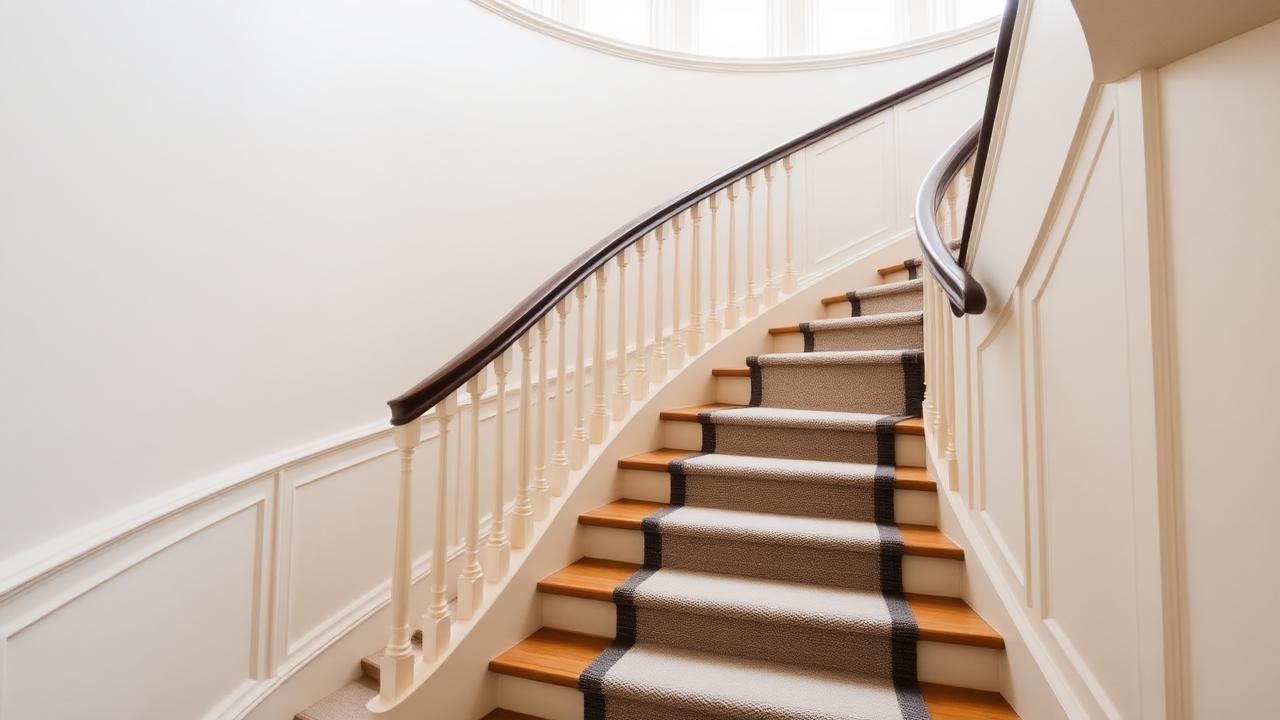
Two ways a 90-degree turn is built
A quarter turn staircase does the 90 degrees in one of two ways: a flat quarter landing (a small square platform between two straight flights) or a set of winder treads (pie-shaped steps that twist through the corner with no flat platform). Which one you have determines how the runner is measured and cut.
Quarter landing method
- Measure each straight flight in the usual way, tread plus riser per step.
- Measure the landing itself as a flat rectangle, following the path the runner will actually travel across it.
- Decide whether the runner turns 90 degrees on the landing itself or whether it is cut and re-started on the far flight.
- Add the three lengths together, then add waste and pattern-matching allowance.
Winder tread method
Winders have no flat landing; each pie-shaped tread is measured individually, and the critical dimension is taken along the walk line, roughly two-thirds of the way across the tread's width from the narrow end, not at the pinch point at the inside corner. Measuring at the narrow point badly underestimates the carpet needed and leaves the runner too short to wrap the wide end of each winder.
Extra length by turn type
| Turn type | Extra length allowance | Difficulty | DIY-able |
|---|---|---|---|
| Square quarter landing | 0.3–0.5 m (12–20 in) | Moderate | Yes |
| 2 winder treads | 0.5–0.8 m (20–32 in) | Hard | Experienced DIY only |
| 3 winder treads (tight turn) | 0.8–1.1 m (32–43 in) | Hard | Fitter recommended |
| Turn plus pattern matching | Add 10–15% on top | Hard | Fitter recommended |
Patterned runners need extra at a turn
A striped or herringbone runner will visibly kink at a 90-degree turn unless the pattern is deliberately mitred or restarted square. Budget extra length for the offcuts this creates.
Know your numbers in 30 seconds
Enter your step count, tread depth and riser height — the stair runner calculator gives you the exact length to order, in metres and feet, with waste included.
Open the stair runner calculatorSeam placement on a turn
Where a seam is unavoidable on a turn, place it on the flattest, most concealed tread rather than on the sharpest angle, and always at a riser-to-tread junction rather than mid-tread.
Troubleshooting common problems
Even a carefully planned job related to fitting a stair runner with a 90-degree turn can go wrong in a handful of predictable ways. Most issues trace back to a measurement taken at the wrong point, a substrate that was not properly checked before work began, or a step skipped to save time early on. Catching these early is far cheaper than correcting them after the runner is fixed in place.

| Symptom | Likely cause | Fix |
|---|---|---|
| Runner sits crooked after a few steps | Centre line not re-checked partway down the flight | Re-mark the centre line every 4-5 steps and adjust |
| Fabric bags or ripples at the nosing | Insufficient tension when fixing at the riser base | Pull taut before fixing and re-do that section |
| Edges fray within weeks | Binding not sealed or wrong backing for the fibre | Reseal edges or have a fitter re-bind |
| Runner shifts underfoot | Pad or gripper not anchored to solid timber | Check substrate and re-fix into sound wood |
Timeline and cost impact
Decisions around fitting a stair runner with a 90-degree turn affect both how long the job takes and its final bill. As a rule, anything that adds measuring or cutting complexity adds labour hours, and labour is usually the larger share of an installed price once the carpet itself is accounted for.
| Scenario | Typical added time | Typical added cost (US / UK) |
|---|---|---|
| Straightforward straight flight | No change | $0 |
| Extra measuring or templating step | 30-60 minutes | $40-90 / £30-70 |
| Substrate repair needed first | 1-3 hours | $75-250 / £60-200 |
| Fitter call-out for a second opinion | N/A, usually free or low cost | $0-75 / £0-60 |
Winder count and how it changes the geometry
A 90-degree turn can be built from two winders (a sharper, more compact turn) or three winders (a gentler, more gradual turn using more floor space). Two-winder turns have a noticeably tighter pinch point at the inside corner and a wider swing at the outside edge, which increases both the difficulty of getting a clean template and the amount of offcut waste. Three-winder turns spread the twist over an extra step, easing the angle at each individual tread and generally producing a better result for a first-time DIY attempt, if the floor plan allows the extra space.
Balancing the runner width through the turn
On a straight flight the runner sits with equal margins to each wall or stringer. Through a 90-degree turn those margins cannot stay equal at every tread, since the walk line curves while the walls form a right angle. Fitters typically taper the margin slightly tread by tread through the turn so the runner still reads as centred to the eye even though the literal measurement to each wall changes. Skipping this step is one of the most common reasons a turned runner looks slightly crooked even when every individual measurement was technically correct.
| Winder configuration | Turn difficulty | Typical floor space used |
|---|---|---|
| 2 winders | Hardest, sharpest pinch point | Compact |
| 3 winders | Moderate, gentler twist | More generous |
| Quarter landing (no winders) | Easiest, flat platform | Most generous |
Ordering material for a turned staircase
Because winder treads are cut individually rather than from one continuous repeating length, order runner in a single continuous roll long enough to cover the whole flight plus the turn allowance, rather than ordering the straight sections and the turn as separate pieces. This lets the fitter choose exactly where the least noticeable offcuts fall and keeps colour and dye lot fully consistent across the whole run.
Lighting and visual cues through the turn
A 90-degree turn is also where poor lighting causes the most missteps, since the change of direction breaks the natural rhythm a person's feet expect on a straight flight. Adding a wall light or LED strip lighting close to the turn, and choosing a runner colour with enough contrast against the tread nosing, both help occupants judge the edge of each step correctly at the point where the direction changes. This matters even more on winder treads, where the tread width varies from narrow to wide across the same step.
Whatever you decide, get the numbers first: the stair runner calculator doubles as a stair runner length calculator, adding nosing wrap, landings, winders, pattern repeat and waste so you order the right length the first time.
Still deciding on material, width or pattern? Our hub on stair runners compares weaves, widths, backings and fitting styles side by side, then hands the numbers straight to the calculator.
Frequently asked questions
How much extra carpet does a 90-degree stair turn need?
Roughly 0.3 to 0.5 metres extra for a flat quarter landing, or 0.5 to 1.1 metres for winder treads, depending on how many winders make up the turn.
Where do you measure a winder tread for a stair runner?
Along the walk line, about two-thirds of the way across the tread's width from its narrow end, not at the pinch point where the treads converge.
Can a striped stair runner go around a 90-degree turn?
Yes, but expect visible pattern distortion unless the fitter mitres the stripe or plans a deliberate break at the turn. Solid or subtly patterned runners hide turns far more easily.
Is a quarter landing or winder tread turn easier to carpet?
A flat quarter landing is easier since it is measured like a small floor. Winder treads require individual templates for each pie-shaped step and are harder to fit well.
What is the biggest mistake people make with this?
Rushing the measuring or prep stage. Most poor outcomes with fitting a stair runner with a 90-degree turn trace back to a single measurement taken at the wrong point, or a substrate check skipped to save a few minutes, both far cheaper to fix before the runner is cut than after.
Are two or three winders better for a 90-degree turn?
Three winders spread the twist more gently and are generally easier to fit well, but need more floor space. Two winders are more compact but have a sharper pinch point and more offcut waste.
Why does a turned runner sometimes look crooked even when measured correctly?
If the margin to the wall is not gradually tapered tread by tread through the turn, the runner can look off-centre even though each individual measurement was accurate. This tapering needs to be planned before cutting.
Know your numbers in 30 seconds
Enter your step count, tread depth and riser height — the stair runner calculator gives you the exact length to order, in metres and feet, with waste included.
Calculate my turned staircaseReady for real prices?
Get quotes from vetted stair runner suppliers and fitters near you. Free, no account, no obligation.
Every guide is written from hands-on measuring and fitting experience, checked against the calculator’s own maths, and re-reviewed whenever prices or methods change. Read our editorial standards.