
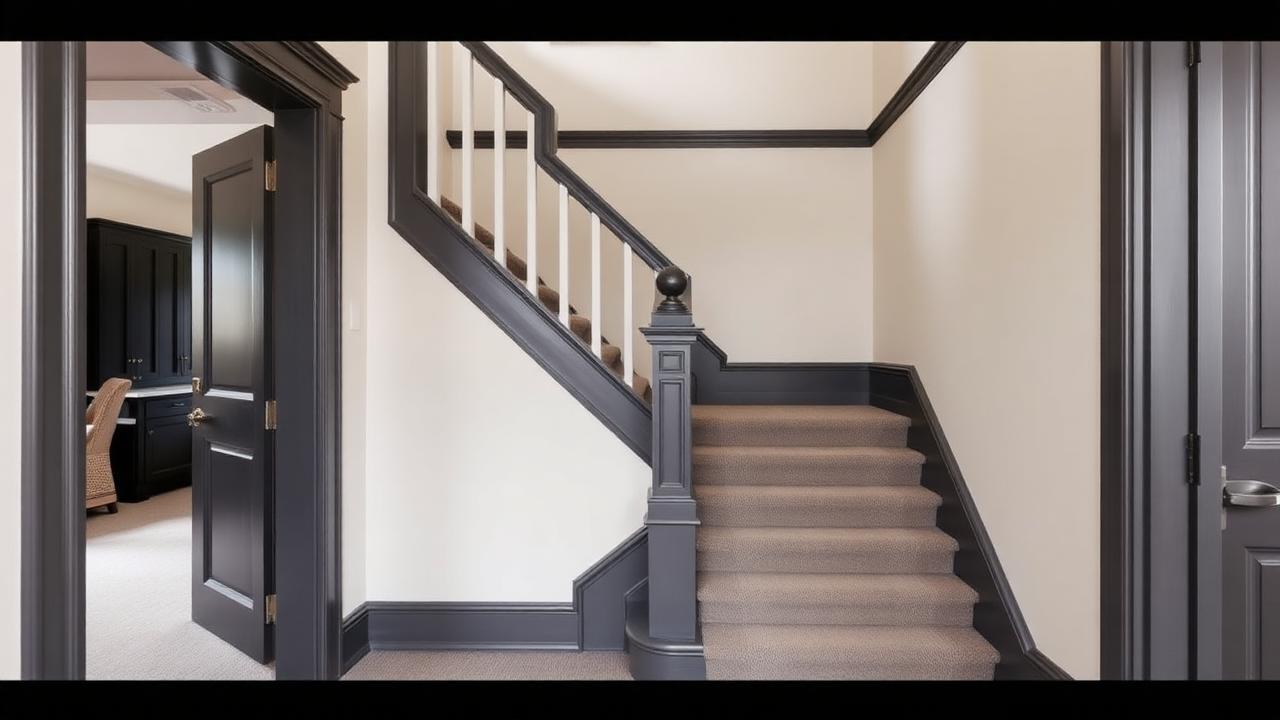
Every tread is a winder
Unlike a curved staircase, which may include some straighter sections, a true spiral staircase has no straight treads at all: every step is pie-shaped, narrow at the centre post and wide at the outer wall. This means the winder measuring method applies to the entire flight, not just a turn.
Measuring the walk line
The critical measurement is taken along the walk line, roughly two-thirds of the way from the narrow inner edge to the wide outer edge, since that is where most foot traffic actually falls. Measuring at the centre post badly underestimates depth, and measuring at the outer wall overestimates it.
Is a full runner even practical?
- Full-width runners are possible but need a template for every single tread, since no two are identical if the pitch changes.
- Some owners choose individual bordered stair pads on each tread instead of one continuous runner, which is easier to fit and replace.
- A narrower runner or a centred fitted carpet section reduces waste on the sharply tapered inner edge.
- Metal or timber spiral stairs sometimes suit a tread-cap material more than soft carpet at all.
Cost and difficulty
| Approach | Extra length allowance | Difficulty | DIY-able |
|---|---|---|---|
| Continuous runner, full spiral | 50%+ over straight-flight equivalent | Very hard | No |
| Individual stair pads per tread | Material per tread + 15% waste | Moderate | Yes |
| Narrow centred runner strip | 30–40% | Hard | No |
| Carpet tread caps (no runner) | Per-tread kit pricing | Moderate | Yes |
Get a fitter to survey before ordering material
Spiral staircases vary enormously in radius and pitch. A short phone measurement is not reliable; have a fitter template at least a few representative treads before committing to a quantity.
Know your numbers in 30 seconds
Enter your step count, tread depth and riser height — the stair runner calculator gives you the exact length to order, in metres and feet, with waste included.
Open the stair runner calculatorSafety considerations
Whatever approach is used, the inner edge of each tread is very narrow and safety codes in many areas set a minimum tread depth at the walk line; carpet or padding must not reduce that usable depth or bunch at the inner point where feet are most likely to catch.
Timeline and cost impact
Decisions around fitting a stair runner on a spiral staircase affect both how long the job takes and its final bill. As a rule, anything that adds measuring or cutting complexity adds labour hours, and labour is usually the larger share of an installed price once the carpet itself is accounted for.

| Scenario | Typical added time | Typical added cost (US / UK) |
|---|---|---|
| Straightforward straight flight | No change | $0 |
| Extra measuring or templating step | 30-60 minutes | $40-90 / £30-70 |
| Substrate repair needed first | 1-3 hours | $75-250 / £60-200 |
| Fitter call-out for a second opinion | N/A, usually free or low cost | $0-75 / £0-60 |
Troubleshooting common problems
Even a carefully planned job related to fitting a stair runner on a spiral staircase can go wrong in a handful of predictable ways. Most issues trace back to a measurement taken at the wrong point, a substrate that was not properly checked before work began, or a step skipped to save time early on. Catching these early is far cheaper than correcting them after the runner is fixed in place.
| Symptom | Likely cause | Fix |
|---|---|---|
| Runner sits crooked after a few steps | Centre line not re-checked partway down the flight | Re-mark the centre line every 4-5 steps and adjust |
| Fabric bags or ripples at the nosing | Insufficient tension when fixing at the riser base | Pull taut before fixing and re-do that section |
| Edges fray within weeks | Binding not sealed or wrong backing for the fibre | Reseal edges or have a fitter re-bind |
| Runner shifts underfoot | Pad or gripper not anchored to solid timber | Check substrate and re-fix into sound wood |
Cost ranges for a spiral staircase
Fitting a spiral staircase is priced almost entirely on labour and templating time rather than material quantity, since even a modest spiral of eight to ten treads takes a full day or more to template and fit properly. Get a firm quote for the whole job rather than a per-step estimate.
| Job scope | Typical cost (US) | Typical cost (UK) |
|---|---|---|
| Individual tread pads, 10 treads | $250-600 | £200-480 |
| Full continuous runner, spiral | $800-2,000+ | £640-1,600+ |
| Fitter survey/template visit only | $60-150 | £50-120 |
Central pole clearance and tread overlap
Spiral staircases are built around a central pole, and treads often overlap slightly with the one above to maintain adequate headroom, meaning the true usable walking depth at the inner edge can be smaller than the tread's total depth suggests. When measuring or templating for carpet, always confirm the actual clear walking depth at the inner point rather than the tread's nominal size, since a runner or pad that is cut to the full tread depth can bunch under the overlap of the step above.
Choosing carpet fibre for a spiral stair
Because spiral treads are narrow at the inner edge and see concentrated wear along the walk line, a durable, tightly constructed fibre matters more here than on a straight flight. Nylon and wool-nylon blends tend to outperform soft wool-only or loose-weave natural fibres on a spiral stair's tighter curve, since the backing needs to hold its shape around a sharp radius without distorting or lifting at the inner point.
Alternatives to a full runner on a spiral
Given the expense and difficulty of a continuous runner on a true spiral, many owners choose an alternative: a stair nosing carpet or rubber tread cover fitted individually to each step, a painted or stained timber finish with a slip-resistant coating, or a set of matching but separately replaceable stair pads. All three sidestep the need for one continuous templated piece and make future repair or replacement of a single worn tread far simpler.
| Alternative | Pros | Cons |
|---|---|---|
| Rubber/carpet tread covers | Cheap, easy to replace individually | Less decorative, more utilitarian look |
| Painted/stained timber + coating | No carpet cost at all | Harder underfoot, less warm |
| Individual stair pads | Matches carpet look, easy per-tread swap | Higher labour cost than covers |
Whatever you decide, get the numbers first: the stair runner calculator doubles as a stair runner length calculator, adding nosing wrap, landings, winders, pattern repeat and waste so you order the right length the first time.
Still deciding on material, width or pattern? Our hub on stair runners compares weaves, widths, backings and fitting styles side by side, then hands the numbers straight to the calculator.
Frequently asked questions
Can you put a stair runner on a spiral staircase?
Yes, but every tread must be individually templated since all of them are pie-shaped with no straight section. It is considerably more labour-intensive than a standard runner installation.
Is it cheaper to use individual stair pads instead of a full runner on a spiral staircase?
Often yes. Individual pads sized to each tread are easier to template, fit and replace individually, and reduce waste compared with cutting one continuous runner.
Where do you measure a spiral staircase tread for carpet?
Along the walk line, about two-thirds of the way from the narrow inner edge to the wide outer edge, matching where feet actually land.
How much more does carpeting a spiral staircase cost?
Expect roughly two to three times the cost per step compared with a straight flight, due to individual templating and higher material waste on the tapered treads.
What is the biggest mistake people make with this?
Rushing the measuring or prep stage. Most poor outcomes with fitting a stair runner on a spiral staircase trace back to a single measurement taken at the wrong point, or a substrate check skipped to save a few minutes, both far cheaper to fix before the runner is cut than after.
Why does the inner edge of a spiral tread feel narrower than expected?
Spiral treads often overlap the step above to maintain headroom, so the true clear walking depth at the inner edge can be less than the tread's nominal depth. Always confirm actual clear depth before ordering carpet.
What carpet fibre works best on a spiral staircase?
Nylon or wool-nylon blends generally hold their shape better around a spiral's tight radius than soft wool-only or loosely woven natural fibres, which can distort or lift at the narrow inner point.
Know your numbers in 30 seconds
Enter your step count, tread depth and riser height — the stair runner calculator gives you the exact length to order, in metres and feet, with waste included.
Estimate my staircaseReady for real prices?
Get quotes from vetted stair runner suppliers and fitters near you. Free, no account, no obligation.
Every guide is written from hands-on measuring and fitting experience, checked against the calculator’s own maths, and re-reviewed whenever prices or methods change. Read our editorial standards.