

Why the walk line is the critical measurement
Every winder tread is wide at the outer wall and narrows to almost nothing at the inside corner post. Measuring at the narrow point gives a figure far too small to cover the tread properly, and measuring at the outer wall wastes material and produces a runner that sits oddly on the tread. The walk line, the natural path a foot takes, roughly two-thirds of the way across from the narrow end, is the standard reference point fitters use.
Step-by-step winder measuring
- Identify the walk line on each winder tread, typically 18 to 24 inches (450 to 600 mm) in from the outer wall.
- Measure tread depth and riser height along that line for every winder individually, since they are rarely identical to each other.
- Note the angle of twist between consecutive winders to help plan tapering of the runner width.
- Template each winder in card if the pattern or fitter's experience suggests measurements alone will not be precise enough.
How many winders and how much extra
| Winder configuration | Extra length allowance | Difficulty | DIY-able |
|---|---|---|---|
| 2 winders (90-degree turn) | 0.5–0.8 m over straight equivalent | Hard | Experienced DIY only |
| 3 winders (90-degree turn, tighter) | 0.8–1.1 m | Hard | Fitter recommended |
| 3 winders (180-degree turn) | 1.2–1.6 m | Very hard | Fitter recommended |
| Kite winder (single winder, dog-leg stair) | 0.4–0.6 m | Moderate | Experienced DIY only |
Tapering avoids a runner that floats or crushes
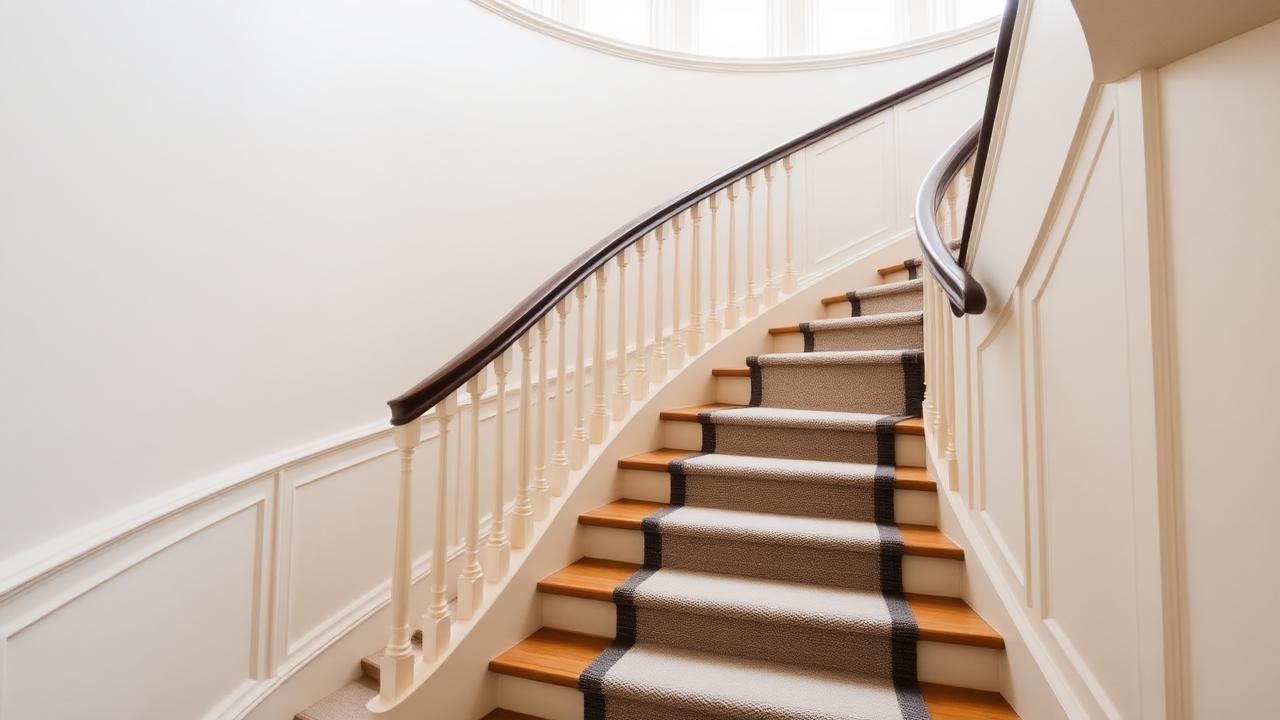
Because winder treads are wider at the outer edge, a constant-width runner either floats away from the wall on the inside or crowds the outer wall. Slight tapering, done tread by tread, keeps the runner tracking the walk line consistently.
Know your numbers in 30 seconds
Enter your step count, tread depth and riser height — the stair runner calculator gives you the exact length to order, in metres and feet, with waste included.
Open the stair runner calculatorSeam and pattern considerations
Where possible, avoid placing a seam on a winder tread itself; seam at the straight tread immediately before or after the winder set instead. Patterned runners will visibly compress on the narrow inside edge of each winder, so solid or fine-texture runners fit winders far more cleanly than bold repeating patterns.
Timeline and cost impact
Decisions around fitting a stair runner on winder steps affect both how long the job takes and its final bill. As a rule, anything that adds measuring or cutting complexity adds labour hours, and labour is usually the larger share of an installed price once the carpet itself is accounted for.
| Scenario | Typical added time | Typical added cost (US / UK) |
|---|---|---|
| Straightforward straight flight | No change | $0 |
| Extra measuring or templating step | 30-60 minutes | $40-90 / £30-70 |
| Substrate repair needed first | 1-3 hours | $75-250 / £60-200 |
| Fitter call-out for a second opinion | N/A, usually free or low cost | $0-75 / £0-60 |
Troubleshooting common problems
Even a carefully planned job related to fitting a stair runner on winder steps can go wrong in a handful of predictable ways. Most issues trace back to a measurement taken at the wrong point, a substrate that was not properly checked before work began, or a step skipped to save time early on. Catching these early is far cheaper than correcting them after the runner is fixed in place.
| Symptom | Likely cause | Fix |
|---|---|---|
| Runner sits crooked after a few steps | Centre line not re-checked partway down the flight | Re-mark the centre line every 4-5 steps and adjust |
| Fabric bags or ripples at the nosing | Insufficient tension when fixing at the riser base | Pull taut before fixing and re-do that section |
| Edges fray within weeks | Binding not sealed or wrong backing for the fibre | Reseal edges or have a fitter re-bind |
| Runner shifts underfoot | Pad or gripper not anchored to solid timber | Check substrate and re-fix into sound wood |
Templating each winder individually
Even within a single set of winders, no two treads are usually identical since the pitch and width both change as the stair twists through the turn. Rather than measuring one winder and assuming the rest match, template every individual winder tread with card or thin plywood, label each template with its position number, and dry-fit each one against its actual step before cutting the runner. This avoids the common problem of a runner that fits the first winder well but progressively misaligns by the last one.
Aligning the runner pattern through a run of winders
A patterned runner, particularly one with straight-across stripes, will visibly twist and distort through a run of winder treads because each tread's leading edge sits at a different angle to the one before it. Fitters manage this either by choosing a subtler pattern that hides the distortion, deliberately mitring the pattern at each winder so it appears intentional, or accepting a small amount of visible pattern shift as the trade-off for a continuous runner rather than a series of separately capped treads.
| Winder run length | Typical extra allowance | Recommended pattern type |
|---|---|---|
| 1-2 winders | 0.3-0.6 m (12-24 in) | Subtle pattern or solid colour |
| 3-4 winders | 0.6-1.0 m (24-40 in) | Solid colour strongly recommended |
| 5+ winders (rare, tight stairwell) | 1.0 m+ (40 in+) | Solid colour or individually capped treads |
When winders are better capped individually
On a very tight stairwell with five or more consecutive winders, or where the pattern is a strong priority and cannot be compromised, some fitters recommend abandoning a single continuous runner through the winders altogether in favour of individually cut and bound stair pads on each winder tread, matched in colour but accepted as visually distinct pieces. This is more labour to fit but sidesteps the pattern distortion problem entirely.
Why winders wear differently to straight treads
The wide end of a winder tread carries far more foot traffic than the narrow end, since most people naturally walk the wider, safer part of the step rather than hugging the inside pinch point. Expect visible wear to show up first on the outer third of each winder tread, and consider a slightly heavier-duty fibre or a higher twist-level wool blend specifically on winder sections if the rest of the budget allows only a mid-range runner elsewhere.
Whatever you decide, get the numbers first: the stair runner calculator doubles as a stair runner length calculator, adding nosing wrap, landings, winders, pattern repeat and waste so you order the right length the first time.
Still deciding on material, width or pattern? Our hub on stair runners compares weaves, widths, backings and fitting styles side by side, then hands the numbers straight to the calculator.
Frequently asked questions
Where do you measure a winder step for a stair runner?
Along the walk line, roughly two-thirds of the way across the tread's width from the narrow inside point, matching where feet naturally travel. Measuring at the narrow point undersizes the runner badly.
How much extra carpet do winder steps need?
Typically 0.5 to 1.6 metres extra depending on how many winders make up the turn and whether it is a 90-degree or 180-degree turn, compared with the same rise handled by straight steps.
Can winder steps be fitted with a patterned stair runner?
They can, but patterns will visibly compress on the narrow inside edge of each tread. Solid colours or subtle textures fit winders more cleanly than bold stripes or large repeats.
Is fitting a stair runner on winders a DIY job?
A small set of two winders is achievable for an experienced DIYer with careful templating, but three or more winders, especially on a 180-degree turn, are best fitted professionally.
What is the biggest mistake people make with this?
Rushing the measuring or prep stage. Most poor outcomes with fitting a stair runner on winder steps trace back to a single measurement taken at the wrong point, or a substrate check skipped to save a few minutes, both far cheaper to fix before the runner is cut than after.
Should every winder tread be templated separately?
Yes. Even within one run of winders, pitch and width usually vary tread to tread, so templating each one individually avoids a runner that fits the first winder but misaligns by the last.
What happens to a striped runner pattern through winder treads?
It visibly twists and distorts because each winder's leading edge sits at a different angle. Solid colours or subtle patterns handle winders far more gracefully than bold stripes.
Do winder treads need extra underlay?
Yes, cut underlay individually to each winder shape rather than one continuous piece, since a poorly fitted pad on an irregular tread is one of the most common causes of an uneven, lumpy-looking winder run.
Know your numbers in 30 seconds
Enter your step count, tread depth and riser height — the stair runner calculator gives you the exact length to order, in metres and feet, with waste included.
Measure my winder stepsReady for real prices?
Get quotes from vetted stair runner suppliers and fitters near you. Free, no account, no obligation.
Every guide is written from hands-on measuring and fitting experience, checked against the calculator’s own maths, and re-reviewed whenever prices or methods change. Read our editorial standards.