
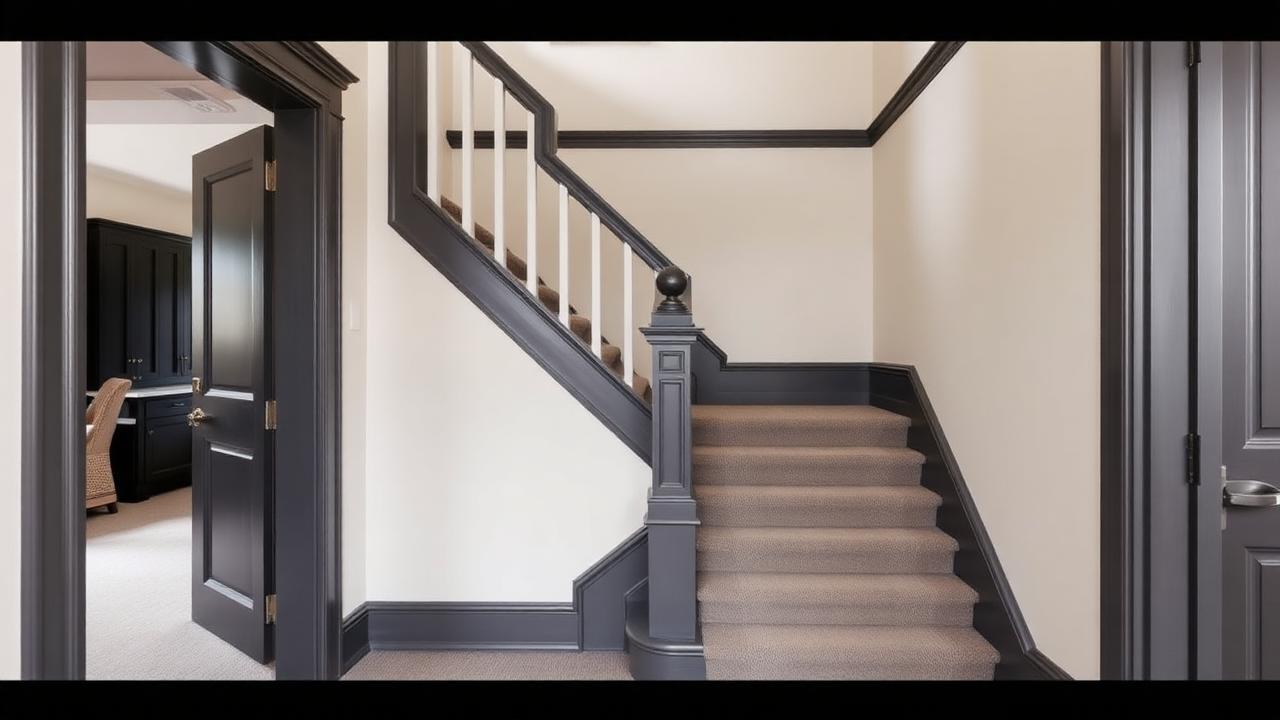
Why curves cannot be measured step-by-step with a tape
On a straight flight, every tread and riser is the same size, so one measurement multiplied by the step count works. On a curve, the inside edge is much shorter than the outside edge and the angle of twist changes at every tread, so no single number describes the staircase. Fitters instead make a physical or paper template of each individual tread.
How templates are made
- Card or thin plywood is cut and scribed to the exact shape of each tread and riser junction.
- The template is checked against the actual step, adjusted, and labelled with its position number.
- Templates are laid over the runner material to mark cutting lines that follow the curve.
- Each piece is cut individually rather than from one continuous roll length.
Tapering the runner width
A constant-width runner does not sit well on a curve because the walk line and the wall line diverge; a taper allows the runner to visually track the centre of the tread even as the tread's overall shape changes. This tapering is done tread by tread and is one of the reasons curved runner fitting is priced per step, not per linear metre.
Extra length and cost by curve type
| Curve type | Extra length allowance | Difficulty | DIY-able |
|---|---|---|---|
| Gentle sweeping curve, few steps | 20–30% over straight equivalent | Hard | No |
| Full quarter-circle curve | 30–40% | Very hard | No |
| Continuous curved flight (no straight run) | 40%+ | Very hard | No |
| Curve with pattern matching | Add 10% further | Very hard | No |
Budget for cutting waste, not just extra length
Curved templates rarely nest efficiently on a roll, so offcut waste on a curved staircase can be double that of a straight one even before pattern matching is considered.
Know your numbers in 30 seconds
Enter your step count, tread depth and riser height — the stair runner calculator gives you the exact length to order, in metres and feet, with waste included.
Open the stair runner calculatorMaterial choice
Solid-colour or subtly patterned runners are far easier to fit well on a curve than bold stripes or repeating geometric patterns, which visibly distort as the tread shape changes. Wool and wool-blend broadloom also handle the tension of a curved fit better than stiffer synthetic backings.
When to call a professional instead
Plenty of homeowners handle fitting a stair runner on curved stairs themselves on a straightforward straight flight, but certain conditions tip the balance firmly towards hiring a fitter. Getting a second opinion before committing materials often costs nothing and can save an expensive mistake on a job that cannot easily be undone.

- The staircase has a turn, winders, a curve or a split level rather than one straight run.
- The existing substrate is damaged, damp, or its condition is genuinely unclear.
- The runner is an expensive natural fibre or bespoke pattern where a cutting mistake is costly.
- You have no experience with a staple gun, knee kicker or carpet seaming on stairs.
- The staircase is the main one in the home and downtime or an unfinished look is not acceptable.
Worked example with real numbers
To see how fitting a stair runner on curved stairs plays out on an actual staircase, take a common 13-step flight with a 10 in (25 cm) tread depth and a 7.5 in (19 cm) riser height. That gives 17.5 in (44 cm) per step, or 227.5 in (5.78 m) of raw length before any waste allowance is added, a figure worth keeping in mind whenever this topic is discussed in isolation from the rest of the job.
| Measurement | Imperial | Metric |
|---|---|---|
| Tread depth | 10 in | 25 cm |
| Riser height | 7.5 in | 19 cm |
| Per step total | 17.5 in | 44 cm |
| 13 steps, raw length | 227.5 in | 5.78 m |
| With 8% waste allowance | 245.7 in | 6.24 m |
How fitters minimise waste on a curve
Because curved templates rarely nest efficiently along a roll, experienced fitters plan the cutting layout for the whole flight before cutting a single tread, working out which templates can share a width of material and which need their own section. This planning stage, sometimes called a cutting plan or layout diagram, is the difference between a curved flight using 20 percent extra material and one using 40 percent, and it is worth asking a fitter to show you their plan before work begins.
Runner width on a tight versus a wide curve
A tight curve with a small radius forces a bigger difference between the inner and outer edge lengths at each tread, which in turn forces either a narrower overall runner width or a more aggressive taper to keep the runner looking centred. A wide, gentle curve is more forgiving and can often keep close to a constant width with only minor tapering. If you have a choice at the design stage, a slightly wider stairwell radius makes a runner installation noticeably easier and cheaper.
| Curve radius | Taper needed | Recommended runner width approach |
|---|---|---|
| Tight (under 1.2 m / 4 ft) | Significant, tread by tread | Consider a narrower runner |
| Moderate (1.2–2 m / 4–6.5 ft) | Moderate | Standard width with taper |
| Wide (over 2 m / 6.5 ft) | Minimal | Standard width, little taper needed |
Caring for a curved runner over time
Curved sections see more twisting foot traffic than a straight flight, since people naturally lean into the turn, which can accelerate wear on the inner edge of each tread. Rotating a spare offcut into the wear pattern is not possible on a curve the way it sometimes is on a straight run, so it is worth ordering a little extra material at installation specifically held back for future repairs to the highest-wear treads.
Working with a curved-stair specialist fitter
Curved staircases vary enough in geometry, radius, tread taper and rise, that most fitters template each flight on site rather than working from a generic pattern. Expect the fitter to build a paper or card template tread by tread, checking it against the actual stair before cutting any carpet, and to charge a template visit separately from the fitting day itself, typically $75-200 (£60-160), which is usually credited against the final job if you proceed.
Whatever you decide, get the numbers first: the stair runner calculator doubles as a stair runner length calculator, adding nosing wrap, landings, winders, pattern repeat and waste so you order the right length the first time.
Still deciding on material, width or pattern? Our hub on stair runners compares weaves, widths, backings and fitting styles side by side, then hands the numbers straight to the calculator.
Frequently asked questions
Can any stair runner be fitted on curved stairs?
Most broadloom carpet can be cut and templated for a curve, but bold stripes or large repeating patterns will distort visibly. Solid colours or fine textures fit curves most successfully.
How much more does a curved stair runner cost?
Fitting labour is typically double or more compared with a straight flight, and material quantity rises 20 to 40 percent due to templating waste and tapering.
Is it possible to DIY a stair runner on curved stairs?
It is not recommended. Curved fitting requires individual templating of every tread and precise tapering, and mistakes are expensive since curved offcuts cannot be reused.
What is templating in stair runner fitting?
Templating is making an individual card or plywood pattern of each tread's exact shape before cutting the carpet, essential wherever tread shape changes from step to step.
What is the biggest mistake people make with this?
Rushing the measuring or prep stage. Most poor outcomes with fitting a stair runner on curved stairs trace back to a single measurement taken at the wrong point, or a substrate check skipped to save a few minutes, both far cheaper to fix before the runner is cut than after.
Does a wider stairwell radius make fitting easier?
Yes. A gentler, wider curve needs less tapering of the runner width and is noticeably easier and cheaper to fit than a tight curve, where the inner and outer tread edges differ much more in length.
Should I keep spare material after a curved runner install?
Yes, curved sections wear faster on the inner edge due to twisting foot traffic, and offcuts cannot always be rotated in the way they can on a straight flight, so keep spare material for future repairs.
Know your numbers in 30 seconds
Enter your step count, tread depth and riser height — the stair runner calculator gives you the exact length to order, in metres and feet, with waste included.
Get a starting estimate for my curveReady for real prices?
Get quotes from vetted stair runner suppliers and fitters near you. Free, no account, no obligation.
Every guide is written from hands-on measuring and fitting experience, checked against the calculator’s own maths, and re-reviewed whenever prices or methods change. Read our editorial standards.