

Sorting out the terminology
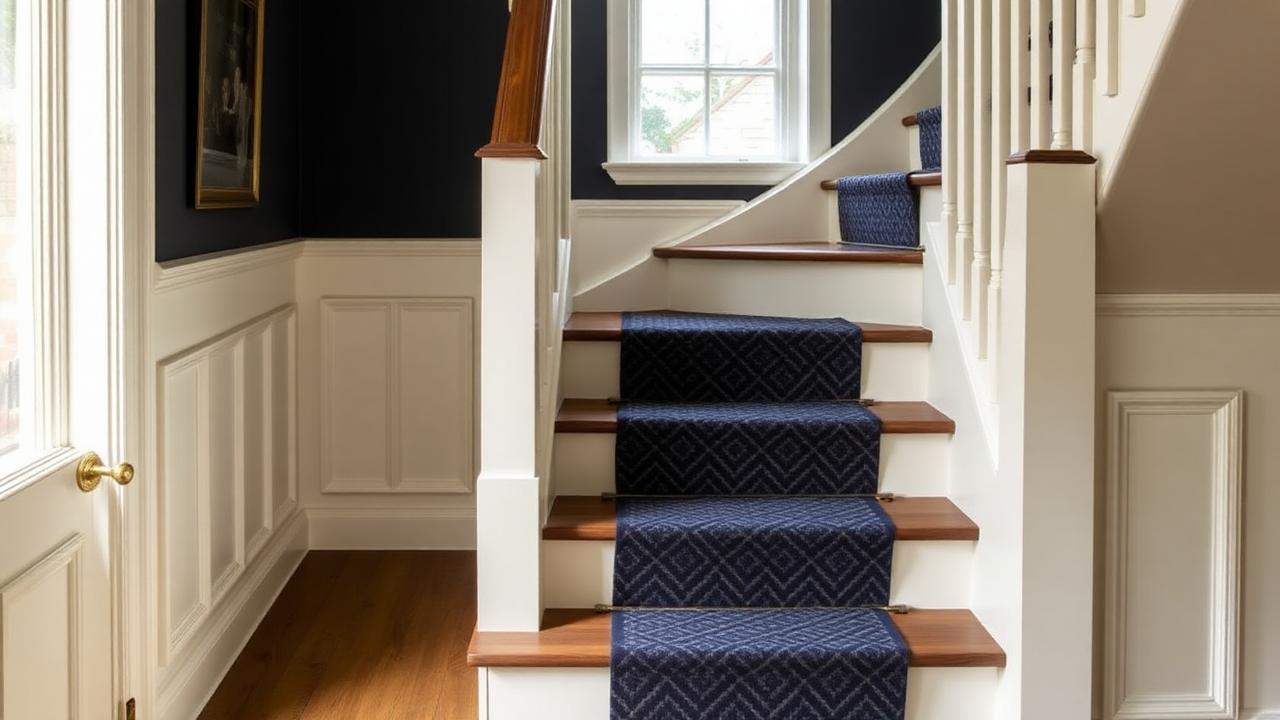
Rods, bars and rails all describe broadly the same function - a horizontal fixing at the tread-to-riser crease of each step that holds a runner flat - but the words tend to get used slightly differently by different suppliers, which causes real confusion when shopping online. Rods usually refers to the traditional, often decorative, round-profile fixing with visible finials at each end. Bars and hold-down bars usually describe a lower-profile fixing, sometimes fully hidden under the runner's fold, used more for grip than for decoration. Rails sits somewhere between the two in common usage, sometimes describing a slim decorative metal strip and sometimes describing a track-style fixing that clips rather than screws in.
Because the terms overlap, the single most useful thing you can do before buying is look at the product photo and spec sheet rather than relying on the name alone. Check whether the fixing is visible once fitted or hidden, whether it needs screws into the stringer or clips onto a track, and whether it's sold with brackets or as a full kit including fixings.
When rails make more sense than rods
Low-profile rails suit households who want the practical hold-down benefit at each step without a strong decorative statement running down the stairs - useful on a minimalist staircase, a runner with its own bold pattern that doesn't need extra visual competition, or a household with young children where a slimmer profile reduces the chance of little feet catching an edge. Decorative rods with finials suit the opposite case: a plainer runner where the hardware itself becomes part of the design, often in a period or traditional interior where brass or antique-finish rods are part of the intended look.
Check the fitting method, not just the look
Some rail systems clip into a pre-fitted track rather than being individually screwed at each step, which is faster to fit but requires the track itself to be installed accurately first - factor that extra step into your timeline.
How much runner do I need?
Whichever fixing style you choose, the runner length calculation is identical, based on your tread going, riser rise and total step count. For a 13-step flight with a 9.5 in (24 cm) tread going and 8 in (20 cm) riser rise, each step uses roughly the going plus the rise plus 1 in (2.5 cm) of crease wrap, around 18.5 in (47 cm) per step, giving about 20 ft (6.1 m) across 13 steps. Add 18-24 in (45-60 cm) for top and bottom finishing and you're at roughly 21.5-22 ft (6.6-6.7 m) before waste. Convert to metric and that's close to 6.7 m, with a 5-10% waste allowance bringing a sensible order to about 7-7.4 m. Run these figures through a stair runner calculator using your own measurements, since tread and riser sizes vary meaningfully between houses and even between flights in the same house, and a stair runner length calculator will also let you compare the US and UK figures side by side for supplier quotes in either unit system.
Choosing between rails, rods and bars
- Decorative rods with finials: best where the hardware is meant to be seen and admired.
- Low-profile rails: best for a minimalist look or a busy-pattern runner that doesn't need extra visual weight.
- Hidden hold-down bars: best where grip matters most and the runner's own pattern is the whole focus.
- Track-clip rail systems: best where speed of fitting matters and the track can be installed accurately first.
| Fixing type | Visibility | Typical use case |
|---|---|---|
| Decorative rod | Fully visible with finials | Period interiors, plain runner as backdrop |
| Low-profile rail | Slim, visible line | Minimalist stairs, patterned runner |
| Hold-down bar | Hidden under fold | Pure function, no decorative intent |
| Track-clip rail | Slim, visible line | Faster fitting once track is installed |
Fitting considerations specific to rails
Rail systems that clip onto a track need the track fitted dead straight and level at every step before the runner even goes down, since any error in the track compounds into a visibly crooked rail line down the whole flight. Screw-fitted rails are more forgiving because each one is positioned individually, but that also means more individual fixing points to get right, so budget more fitting time per step compared with a track system once the track itself is installed.
Whichever system you choose, seat the runner and check it's centred and square before finalising any fixing, because rails and rods both amplify any crookedness in the runner rather than disguising it.
Cost comparison across fixing types
In the US, decorative rods typically run $15-45 each, low-profile rails $10-30 each, and hidden hold-down bars $8-25 each, all as typical ranges that vary with material and finish. In the UK, figure on £12-35 for decorative rods, £8-25 for low-profile rails, and £6-20 for hold-down bars. Track-clip systems often price by linear length rather than per step, so ask suppliers for a like-for-like comparison against a per-rod price before deciding.
Whatever you decide, get the numbers first: the stair runner calculator doubles as a stair runner length calculator, adding nosing wrap, landings, winders, pattern repeat and waste so you order the right length the first time.
Still deciding on material, width or pattern? Our hub on stair runners compares weaves, widths, backings and fitting styles side by side, then hands the numbers straight to the calculator.
Frequently asked questions
Is a stair runner rail the same as a stair rod?
They serve the same function - holding the runner flat at each step's crease - but rail usually describes a slimmer, lower-profile fixing while rod usually implies a rounded, often finial-ended decorative fixing. Check the product photo and spec rather than relying on the name alone.
Do rails need to be screwed in at every step?
Some rail systems are individually screwed like traditional rods, while others clip onto a track that runs the length of the stairs. Track systems fit faster once the track is installed accurately, but the track itself needs to be dead straight first.
Are low-profile rails less secure than decorative rods?
Not necessarily. Security depends on the bracket and fixing method rather than the visible profile, so a slim rail with a solid bracket can hold a runner just as securely as a thicker decorative rod.
Which suits a patterned runner better, rails or rods?
Low-profile rails generally suit a busy or bold patterned runner better, since they don't add extra visual weight competing with the pattern. Decorative rods suit a plainer runner where the hardware itself becomes part of the design.
How much runner length do I need for a 13-step flight?
For typical 9.5 in (24 cm) treads and 8 in (20 cm) risers, budget roughly 21.5-22 ft (6.6-6.7 m) before waste, and about 7-7.4 m after a 5-10% allowance. A stair runner calculator will refine this for your own tread and riser measurements.
What does a hold-down bar look like once fitted?
Hidden hold-down bars typically sit fully under the runner's fold at the crease and aren't visible once fitted, unlike decorative rods or rails which show a visible line at each step.
How much do stair runner rails cost?
In the US, typical rail cost is $10-30 each; in the UK, roughly £8-25 each. These are typical ranges and vary by finish and material, with track-clip systems sometimes priced by linear length instead.
Can I mix rails and rods on the same staircase?
It's possible but not usually recommended, since a consistent fixing type and finish reads far more intentional down a full flight. If you must mix due to a winder or unusual step, keep the finish identical even if the profile differs.
Know your numbers in 30 seconds
Enter your step count, tread depth and riser height — the stair runner calculator gives you the exact length to order, in metres and feet, with waste included.
Calculate runner length before ordering railsReady for real prices?
Get quotes from vetted stair runner suppliers and fitters near you. Free, no account, no obligation.
Every guide is written from hands-on measuring and fitting experience, checked against the calculator’s own maths, and re-reviewed whenever prices or methods change. Read our editorial standards.