
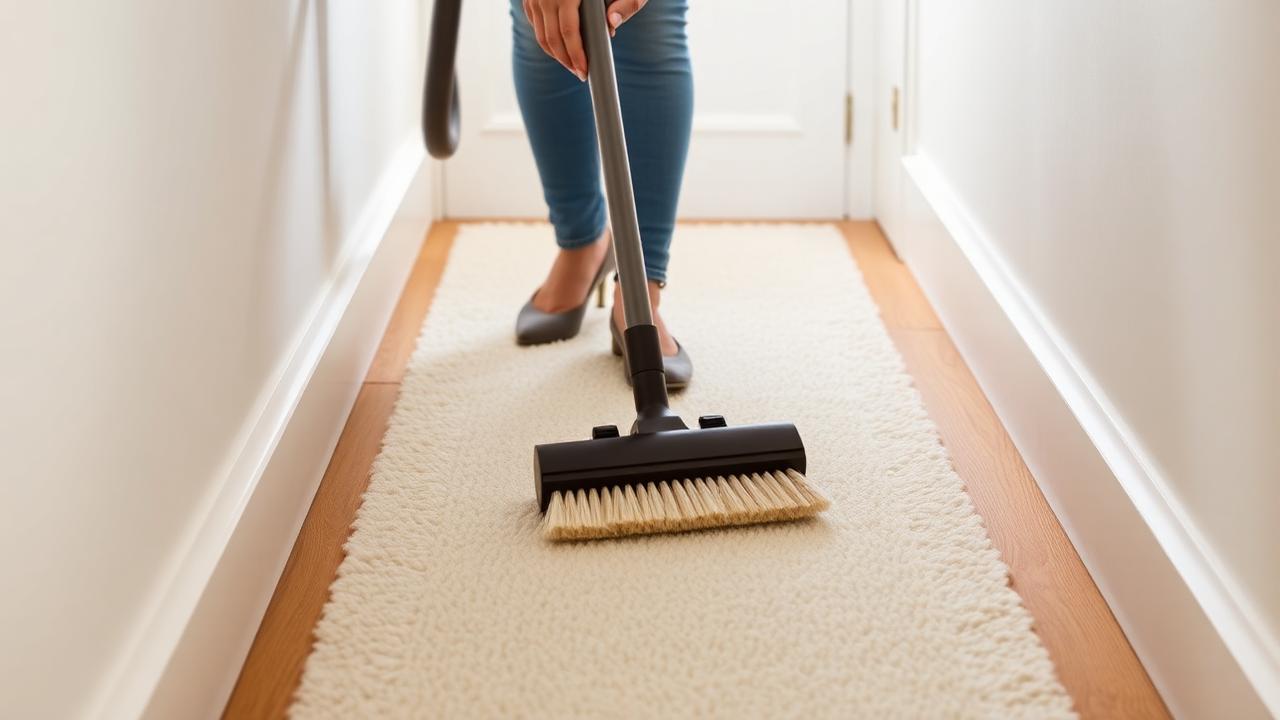
Common damage and fixes
| Damage | Likely cause | Repair option | Typical cost |
|---|---|---|---|
| Worn nosing on 2-3 steps | Concentrated foot traffic | Shift runner up/down or patch section | $60-$180 / £45-£140 |
| Fraying binding | Age, UV exposure, vacuum contact | Re-bind affected edge | $4-$25/m per side |
| Loose or lifted edge | Failed staples or tacks | Re-fix at affected steps | $40-$120 / £30-£95 |
| Pulled loop (pet claw) | Snagged pile loop | Trim or reweave the loop | $20-$80 / £15-£60 |
| Seam separation at landing | Poor original installation | Re-seam and re-fix | $80-$250 / £60-£190 |
Know your numbers in 30 seconds
Enter your step count, tread depth and riser height — the stair runner calculator gives you the exact length to order, in metres and feet, with waste included.
Open the stair runner calculatorRepair vs replace decision
- Repair if damage is confined to one or two steps and the rest of the runner still has clear pile depth.
- Repair if the fixing has failed but the carpet itself is undamaged.
- Replace if wear is visible across most of the flight, not just the high-traffic steps.
- Replace if the backing is deteriorating, since binding and re-fixing cannot restore structural integrity.
Extending life with a shift repair
If a runner is fixed with rods rather than tacked permanently, a worn section can sometimes be shifted a few inches up or down the flight, moving the worn nosing area to a less visible or less loaded position. This works once, sometimes twice, before pattern or length no longer allows it.
Do not ignore a lifted edge
A lifted or loose edge is a trip hazard, not just a cosmetic issue. Re-fix it immediately rather than waiting for a scheduled repair visit.
Timeline and cost impact
Decisions around stair runner repair guide affect both how long the job takes and its final bill. As a rule, anything that adds measuring or cutting complexity adds labour hours, and labour is usually the larger share of an installed price once the carpet itself is accounted for.
| Scenario | Typical added time | Typical added cost (US / UK) |
|---|---|---|
| Straightforward straight flight | No change | $0 |
| Extra measuring or templating step | 30-60 minutes | $40-90 / £30-70 |
| Substrate repair needed first | 1-3 hours | $75-250 / £60-200 |
| Fitter call-out for a second opinion | N/A, usually free or low cost | $0-75 / £0-60 |
Troubleshooting common problems
Even a carefully planned job related to stair runner repair guide can go wrong in a handful of predictable ways. Most issues trace back to a measurement taken at the wrong point, a substrate that was not properly checked before work began, or a step skipped to save time early on. Catching these early is far cheaper than correcting them after the runner is fixed in place.

| Symptom | Likely cause | Fix |
|---|---|---|
| Runner sits crooked after a few steps | Centre line not re-checked partway down the flight | Re-mark the centre line every 4-5 steps and adjust |
| Fabric bags or ripples at the nosing | Insufficient tension when fixing at the riser base | Pull taut before fixing and re-do that section |
| Edges fray within weeks | Binding not sealed or wrong backing for the fibre | Reseal edges or have a fitter re-bind |
| Runner shifts underfoot | Pad or gripper not anchored to solid timber | Check substrate and re-fix into sound wood |
Getting the best result long-term
A stair runner that is measured, ordered and fitted correctly on day one keeps paying off for years: it wears evenly, stays flat at the nosing, and does not need premature replacement. When working through stair runner repair guide, treat the first measurement and the final fitting check as equally important, since a good spec undone by a rushed fit still ends in an early failure.
- Keep a written record of every measurement, the supplier, and the exact spec ordered, in case you need to reorder a matching piece later.
- Ask your fitter to leave any offcut, it is useful for patching a worn tread years down the line.
- Photograph the staircase before and after fitting so you have a reference for insurance or resale.
- Revisit fixings and edges once a year even on a well-fitted runner, since timber stairs move seasonally with humidity.
Extra buying tips worth knowing
A little extra homework before ordering saves both money and disappointment on stair runner repair guide. Suppliers vary widely in how clearly they explain pricing, lead times and what happens if a measurement turns out to be wrong once the crew arrives.
| Question to ask supplier | Why it matters |
|---|---|
| Is remeasuring included before cutting? | Protects you if your DIY measurement was slightly off |
| What happens if the runner is too short on the day? | Some fitters carry matching offcuts, others do not |
| Is old carpet removal and disposal included? | Often a separate line item that is easy to miss |
| What is the aftercare/warranty policy? | Covers seam failure or edge fraying within the first year |
A quick pre-order checklist
Before you place an order relating to stair runner repair guide, run through a short checklist to catch the errors that cause the most reorders and delays. A few extra minutes here is far cheaper than a wrong cut of carpet or a mismatched batch.
- Re-measure the narrowest tread and the total flight length a second time on a different day.
- Confirm the dye lot or batch number matches across all rolls if more than one is needed.
- Check the supplier's stated waste allowance is included, not assumed.
- Agree a fitting date only once the material has actually arrived and been inspected.
- Keep the invoice and batch details safe in case a repair or extension is needed later.
Deciding between repair and replacement
A localised repair makes sense when damage is confined to one or two treads, such as a snag, a small burn, or fraying at a single edge; a full re-fit or replacement becomes the better option once wear is visible across most of the flight or the backing has failed in multiple places. As a rule of thumb, if repair costs would exceed 40-50% of a full replacement, replacement is usually the more sensible long-term choice, especially on a runner already several years into its expected 10-15 year lifespan.
Common repair costs
A professional re-binding of a frayed edge typically costs $30-60 (£25-50) per affected step, while patching a worn or damaged section using a saved offcut runs $50-120 (£40-95) per patch including labour. Re-stretching a runner that has developed ripples or bagging, often due to a failed pad, costs $100-250 (£80-200) for a full flight. Always confirm the fitter is matching dye lot and pile direction on any visible patch, since a mismatched repair can look worse than the original damage.
Whatever you decide, get the numbers first: the stair runner calculator doubles as a stair runner length calculator, adding nosing wrap, landings, winders, pattern repeat and waste so you order the right length the first time.
Still deciding on material, width or pattern? Our hub on stair runners compares weaves, widths, backings and fitting styles side by side, then hands the numbers straight to the calculator.
Frequently asked questions
How often should a stair runner be professionally reviewed?
Once a year is sensible even if nothing looks wrong, since fixings loosen and timber treads move slightly with the seasons, and catching a lifted edge early prevents a trip hazard.
Should I keep the offcut after fitting?
Yes, ask your fitter to leave any offcut from the same dye lot. It is the only reliable way to patch a worn or damaged section later with an exact colour and pattern match.
Can a worn stair runner nosing be repaired?
Yes, either by patch-repairing the worn section, or if the runner is rod-fixed, by shifting it slightly to move the worn area away from the high-wear point.
How much does it cost to repair a stair runner?
Small repairs such as re-fixing an edge or re-binding a section typically cost $40-$250 (£30-£190), well below the cost of full replacement.
When should I replace rather than repair a stair runner?
Replace when wear is visible across most of the flight rather than one or two steps, or when the backing itself is deteriorating, since re-fixing cannot restore structural strength.
Can pet claw damage on a stair runner be fixed?
Small pulled loops can often be trimmed level or rewoven by a carpet repair specialist for $20-$80 (£15-£60), provided the backing underneath is undamaged.
What is the biggest mistake people make with this?
Rushing the measuring or prep stage. Most poor outcomes with stair runner repair guide trace back to a single measurement taken at the wrong point, or a substrate check skipped to save a few minutes, both far cheaper to fix before the runner is cut than after.
Know your numbers in 30 seconds
Enter your step count, tread depth and riser height — the stair runner calculator gives you the exact length to order, in metres and feet, with waste included.
Estimate a replacement runner insteadReady for real prices?
Get quotes from vetted stair runner suppliers and fitters near you. Free, no account, no obligation.
Every guide is written from hands-on measuring and fitting experience, checked against the calculator’s own maths, and re-reviewed whenever prices or methods change. Read our editorial standards.