
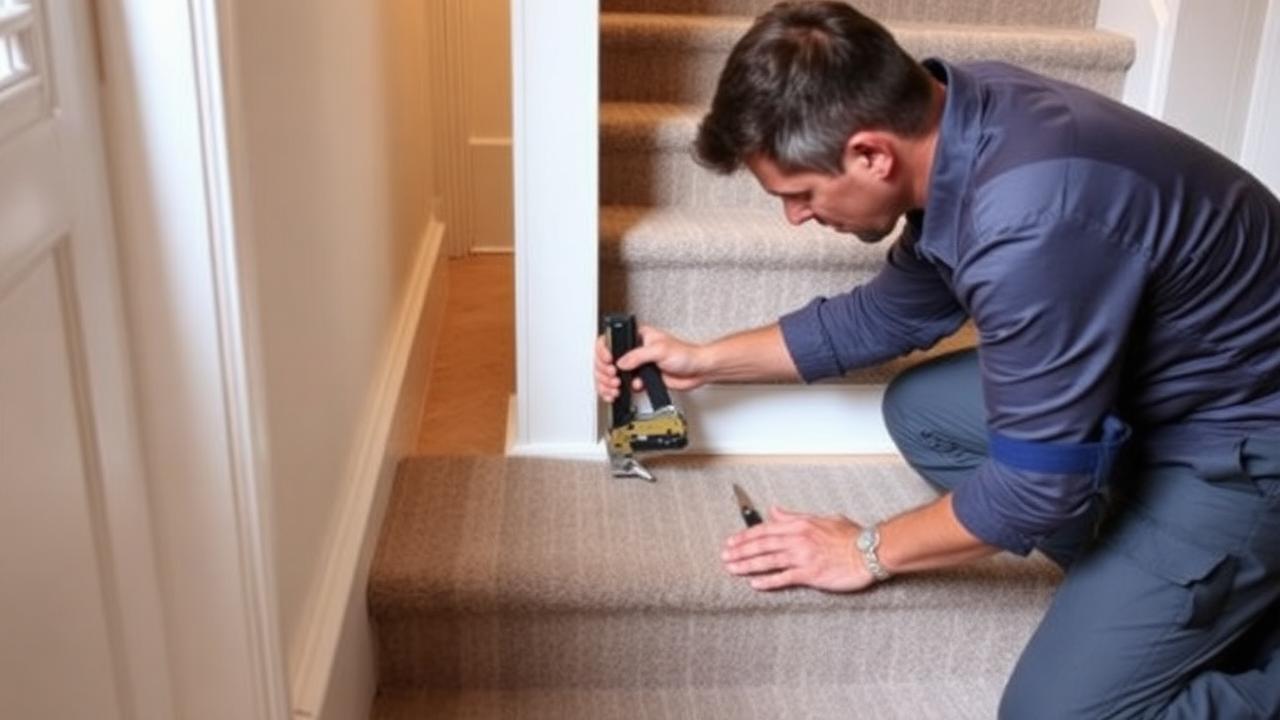
Why stair underlay is different from room underlay
Underlay designed for a living room floor is usually too thick and too soft for a staircase. Stairs flex at the nosing every time someone steps on them, and a soft, deep pad will compress unevenly over time, creating a lumpy, uneven surface and accelerating wear at the edge of each tread. Stair-specific underlay is firmer and thinner, engineered to hold its shape under repeated flexing rather than maximum softness underfoot.
Density matters more than thickness
When shopping for underlay, look at the density rating rather than just the thickness in millimetres or fractions of an inch. A dense 6-8 lb underlay (roughly 100-130 kg per cubic metre equivalent) will outperform a thicker but lower-density pad on stairs, because density is what resists compression at the high-wear nosing point. Manufacturers typically list a weight or density spec on the packaging or spec sheet; always check this before buying based on thickness alone.
How much underlay do I need?
Underlay is measured the same way as the runner itself, minus the nosing wrap allowance in some cases, depending on how your fitter wraps it. For a straightforward estimate, use the same per-step total as your runner: 10 in tread + 7.5 in riser + 0.75 in wrap = 18.25 in per step, times 13 steps is 237.25 in, plus 24 in finishing is 261.25 in (21.77 ft). Add a 10% margin for cutting and you should order about 24 ft of underlay to match your runner. Metric: 25 + 19 + 1.9 cm = 45.9 cm per step, times 13 is 596.7 cm, plus 60 cm is 656.7 cm, plus 10% is approximately 7.3 m.
| Underlay type | Best for | Typical thickness |
|---|---|---|
| Felt (dense) | Standard staircases, wool or nylon runners | 1/4 in / 6 mm |
| Rubber-crumb blend | High traffic, added durability | 1/4-3/8 in / 6-9 mm |
| Combination felt-foam | Comfort with reasonable firmness | 3/8 in / 9 mm |
Know your numbers in 30 seconds
Enter your step count, tread depth and riser height — the stair runner calculator gives you the exact length to order, in metres and feet, with waste included.
Open the stair runner calculatorMatching underlay to your runner fibre
Thicker runners, like plush wool piles, generally pair well with a firmer, thinner underlay to prevent the overall stack height from becoming unstable at the nosing. Thinner, flatter weaves such as sisal or flatweave wool can handle a slightly thicker pad since the combined stack height stays manageable. If you are unsure, ask your supplier what underlay they recommend for the specific runner you have chosen, since some manufacturers void warranties if an unsuitable pad is used underneath.

Don't skip underlay to save money
Skipping underlay entirely to cut costs is a false economy. Without it, a runner wears out significantly faster, feels harder underfoot, and transmits more impact noise through the stairs.
- Choose density over thickness when comparing underlay products.
- Match underlay firmness to your runner's pile height.
- Order the same length of underlay as your runner, plus a small cutting margin.
- Check manufacturer recommendations to avoid voiding a runner warranty.
- Never install a stair runner without underlay beneath it.
Reading a spec sheet correctly
Underlay spec sheets can be confusing because manufacturers do not all use the same units or terminology. Some list density in ounces per square yard, others in pounds per cubic foot, and imported products may use kilograms per cubic metre. As a rough guide for stairs, look for something in the range that suppliers market specifically as stair-grade or heavy traffic-grade rather than trying to convert every number precisely yourself. If a spec sheet does not mention stairs at all, treat that as a sign the product was designed for flat flooring and ask the supplier directly whether it is suitable before you buy.
| Spec sheet term | What it tells you | Watch out for |
|---|---|---|
| Density (lb or kg/m3) | Resistance to compression | Low density even if thick |
| Thickness (mm or in) | Cushioning feel | Too thick can destabilise the nosing wrap |
| Stair-grade rating | Suitability for stair flexing | Absence of this label on flat-floor products |
A worked underlay cost example
For the same 13-step flight needing about 24 ft (7.3 m) of underlay, budget felt sits at the lower end of the price range, rubber-crumb blends sit in the middle thanks to their added durability, and combination felt-foam products used for extra comfort typically land near the top. Because underlay is a smaller line item than the runner itself, it rarely pays to cut corners here purely to save a modest amount, given how much it affects the runner's lifespan.
- Look for a stair-grade or heavy-traffic label on the spec sheet.
- Compare density figures using the same units where possible.
- Don't assume a thicker pad is automatically better for stairs.
- Treat underlay as a small percentage of total project cost, not a place to cut corners.
- Ask the supplier directly if a product's suitability for stairs isn't stated.
Installation considerations
Underlay is typically stapled or tacked to each tread before the runner goes down, with a small gap left at the nosing edge so the underlay does not interfere with the crisp wrap of the runner around the tread lip. A skilled fitter will trim the underlay slightly shorter than the runner at each nosing to keep the edge looking clean rather than bulky.
Choosing the right stair runner underlay is a small decision with a big impact on how your runner performs over the years. Prioritise density, match it to your fibre choice, and order enough length to cover the whole flight without shortcuts.
Whatever you decide, get the numbers first: the stair runner calculator doubles as a stair runner length calculator, adding nosing wrap, landings, winders, pattern repeat and waste so you order the right length the first time.
Still deciding on material, width or pattern? Our hub on stair runners compares weaves, widths, backings and fitting styles side by side, then hands the numbers straight to the calculator.
Frequently asked questions
Can I use regular carpet underlay on stairs?
It is not recommended. Regular room underlay is usually too soft and will compress unevenly at the high-wear nosing points.
What density of underlay is best for stairs?
Look for a dense 6-8 lb (roughly 100-130 kg per cubic metre) rated product, which resists compression better than a thicker but softer pad.
How much underlay do I need for 13 steps?
Around 23-24 ft (7-7.3 m), matching the length of your stair runner plus a small cutting margin.
Does underlay affect noise?
Yes, a good stair underlay reduces impact noise transmission through the staircase structure.
Should thicker runners use thinner underlay?
Generally yes, to keep the combined stack height stable and manageable at the nosing edge.
Can skipping underlay void my runner's warranty?
Some manufacturers do require a specific underlay type to maintain the warranty, so always check before installing.
How is underlay attached to stairs?
It is usually stapled or tacked to each tread, trimmed slightly short of the nosing edge for a clean finish.
Is rubber-crumb underlay better than felt?
Rubber-crumb blends can offer extra durability for high-traffic stairs, while dense felt is a reliable standard choice for most homes.
Know your numbers in 30 seconds
Enter your step count, tread depth and riser height — the stair runner calculator gives you the exact length to order, in metres and feet, with waste included.
Calculate your runner and underlay length togetherReady for real prices?
Get quotes from vetted stair runner suppliers and fitters near you. Free, no account, no obligation.
Every guide is written from hands-on measuring and fitting experience, checked against the calculator’s own maths, and re-reviewed whenever prices or methods change. Read our editorial standards.