

Why turns complicate the calculation
On a straight flight, every tread has the same depth, so the per-step formula works cleanly across the whole run. A winder or turn breaks that uniformity: each winder tread is wedge-shaped, narrower at the inside of the turn and wider at the outside. If you run the runner up the center of the treads, as is standard practice, the effective tread depth at the runner's path is somewhere between the narrow and wide extremes, and it changes step by step through the turn.
Measuring a winder section
Measure the tread depth along the centerline of your intended runner path (usually the center of the walking line, not the true center of the staircase) for each winder tread individually, rather than assuming a single average value. This centerline is typically about 12-15 in (30-38 cm) from the narrow end for standard walking lines, or wherever the runner will physically sit if you're using a narrower width. Record each winder's centerline depth and riser height separately, then add each one to your running total rather than multiplying a single figure by the number of winders.
Worked example with a turn
Suppose you have 9 straight steps and a quarter-turn with 3 winders before 1 final straight step, 13 steps total. The 9 straight steps at 18.25 in each (including nosing wrap) total 164.25 in. The 3 winders average around 22 in each along the centerline due to their wedge shape, totaling 66 in. The final step adds another 18.25 in. That's 164.25 + 66 + 18.25 = 248.5 in, plus a 24 in finishing allowance, giving 272.5 in, or 22.7 ft. With a 12% waste margin for the more complex cutting around the turn, order around 25.5 ft. In metric, this scales to roughly 7.8 m.
| Section | US (in/ft) | UK (cm/m) |
|---|---|---|
| 9 straight steps | 164.25 in | 417 cm |
| 3 winders | 66 in | 168 cm |
| Final step | 18.25 in | 46.4 cm |
| Finishing | 24 in | 61 cm |
| Total with waste | ~25.5 ft | ~7.8 m |
Know your numbers in 30 seconds
Enter your step count, tread depth and riser height — the stair runner calculator gives you the exact length to order, in metres and feet, with waste included.
Open the stair runner calculatorGet a professional measurement for winders
Winder sections are the single most common source of ordering errors. If your staircase has any turn, it is worth paying a fitter or supplier to measure in person before you commit to a length.
Fitting considerations for turns
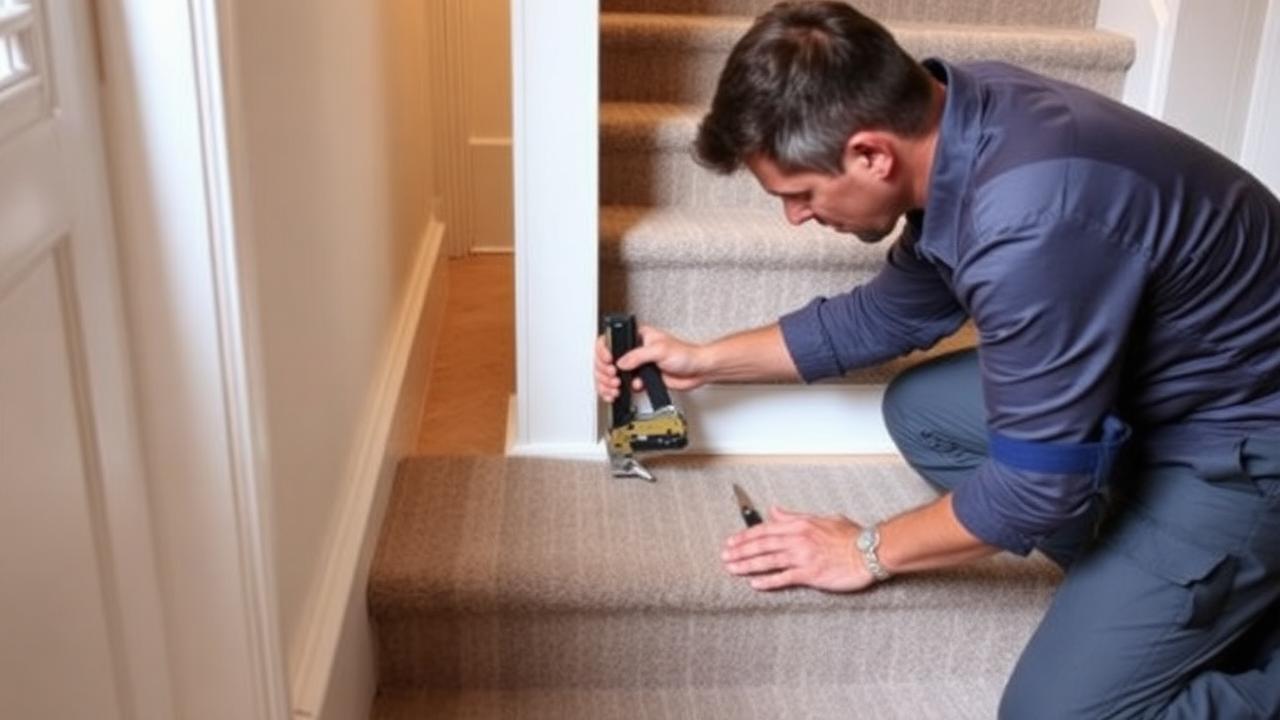
Around a turn, the runner must be pleated or cut and rejoined at each winder to lie flat, which is a specialist skill. A hollywood-fitted runner (tucked into the step angle) handles turns more forgivingly than a waterfall fit, since the fabric has some give to accommodate the change in angle. Stair rods are especially useful on turns, as they help pin the runner securely at each changing angle and disguise the small pleats or seams created by the turn.
- Measure each winder tread individually along the runner's centerline.
- Do not average a single winder measurement across all winders.
- Add 10-15% extra waste margin for turns versus straight flights.
- Use hollywood fitting for more flexibility around angle changes.
- Consider stair rods to secure and disguise pleats at each winder.
Pattern considerations on turns
If you have chosen a patterned runner, turns are where pattern alignment becomes genuinely difficult, since the fabric must twist to follow the turn. Many fitters recommend a solid or subtly textured runner for staircases with tight turns, reserving bold patterns for straight flights, to avoid an obviously broken repeat at the winders.
Turned staircases are absolutely fittable with a beautiful continuous runner, but they demand more careful measurement and a higher waste allowance than a straight flight. Use a stair runner length calculator as a starting estimate, then confirm with an in-person measurement before ordering.
Half-landings versus winders
Not every turn uses winders; many staircases instead have a half-landing, a flat rectangular platform between two straight flights, which is actually simpler to calculate than winders. Measure the landing's depth along the runner's path just as you would a very deep single step, typically 36-48 in (91-122 cm), and add that single figure to your straight-flight totals rather than trying to apply the per-step formula to it. A quarter-landing turn (90 degrees with a landing) generally needs less extra waste allowance than a full winder section, since there's no wedge-shaped tread geometry to reconcile.
| Turn type | Typical extra length (US) | Typical extra length (UK) |
|---|---|---|
| Half-landing (90°) | 36-48 in flat add | 91-122 cm flat add |
| 3-winder quarter turn | +15-20% of straight total | +15-20% of straight total |
| Full winder staircase (no landings) | +20-25% of straight total | +20-25% of straight total |
Working with your fitter on a turn
Bring your own measurements to a quote, but treat them as a planning estimate rather than a final order figure. A good fitter will template the winder section with paper or card before cutting the actual runner, which catches small inconsistencies between steps that a tape measure alone can miss. If you're supplying your own runner rather than having it supplied and fitted as one job, always over-order by the higher end of the waste range for a turn, since a shortfall discovered mid-fit is far more disruptive than a small leftover offcut.
- Half-landings add a single flat measurement, not a per-step calculation.
- Full winder sections need 20-25% extra over an equivalent straight run.
- Ask your fitter to template winders with card before cutting.
- Over-order toward the higher end of the waste range for turns.
- Treat DIY turn measurements as a planning estimate, not a final order.
Whatever you decide, get the numbers first: the stair runner calculator doubles as a stair runner length calculator, adding nosing wrap, landings, winders, pattern repeat and waste so you order the right length the first time.
Still deciding on material, width or pattern? Our hub on stair runners compares weaves, widths, backings and fitting styles side by side, then hands the numbers straight to the calculator.
Frequently asked questions
How much extra runner do I need for a turn?
Budget for roughly 15-20% more length than an equivalent straight flight, depending on the number of winders.
Should I measure winders differently to straight steps?
Yes, measure the tread depth along the runner's actual centerline path for each winder individually.
Is hollywood or waterfall fitting better for turns?
Hollywood fitting generally handles turns more forgivingly due to its flexibility around angle changes.
Can a patterned runner work on a turned staircase?
It can, but pattern alignment is much harder; many choose a solid or subtle texture for turned sections.
Do stair rods help on turns?
Yes, they help secure the runner and disguise small pleats created at each winder.
Should I hire a professional for a turned staircase?
Strongly recommended, since winder measurement errors are the most common cause of ordering problems.
How many winders are typical in a quarter-turn?
Usually 3, though this varies with the pitch and width of the staircase.
Does a turn affect the runner width I should choose?
It can; narrower runners are often easier to fit neatly around tight turns.
Know your numbers in 30 seconds
Enter your step count, tread depth and riser height — the stair runner calculator gives you the exact length to order, in metres and feet, with waste included.
Account for your turn with the stair runner calculatorReady for real prices?
Get quotes from vetted stair runner suppliers and fitters near you. Free, no account, no obligation.
Every guide is written from hands-on measuring and fitting experience, checked against the calculator’s own maths, and re-reviewed whenever prices or methods change. Read our editorial standards.