

Why dogs need traction on stairs at all
A dog's claws are built to dig into soft ground, not to grip a smooth, sealed timber, tile or laminate stair tread. On a hard nosing, the paw slides on the downstroke before the claw finds purchase, and that split-second slip is how older dogs, large breeds and puppies with still-developing joints get hurt. Vets commonly recommend adding traction to any hard staircase a dog uses daily, and a temporary runner is the fastest way to do it without altering the stairs.
Temporary is not the same as flimsy. Done properly, a temporary runner can stay down for months or years and provide the same underfoot grip as a permanently fitted one; the difference is purely in the fixing method and how easily it comes back off without marking the timber.
Temporary fixing methods compared
| Method | How it holds | Removability | Best for |
|---|---|---|---|
| Double-sided carpet tape | Adhesive strips under the runner on each tread | Peels off; can leave residue on sealed wood | Short flights, low-traffic homes |
| Adhesive stair treads (individual pads) | Cut-to-tread rubber-backed carpet or grip pads, one per step | Peels off individually; easiest to replace | Renters, quick DIY fixes |
| Rug gripper tape (rubber-based) | Reusable rubber adhesive strip, re-tacks when repositioned | Lifts cleanly, reusable multiple times | Tenants who move often |
| Rod-and-bracket system with removable brackets | Full-length runner held by rods that clip into brackets screwed into the riser angle | Runner lifts off; brackets leave small screw holes | A full look with occasional removal for cleaning |
| Weighted or friction-backed runner, no fixing | Heavy rubber backing and stair-shaped weight hold it by friction alone | Lifts straight off, no residue at all | Very short flights, light dogs, low traffic |
Choosing the right material for paws and claws
A low, dense loop pile or a flat woven runner grips a paw pad far better than a long shag or a thick plush pile, which a claw can catch and pull. Rubber-backed carpet tiles or stair treads sold specifically for pet traction usually combine a short, tough pile with a non-slip rubber underside, which does double duty as both the grip surface and part of the temporary fixing.
- Avoid loose loop-pile weaves on stairs used by dogs with long claws — a snagged loop can pull a claw painfully.
- Choose a rubber or PVC-backed runner over a jute or hessian-backed one for a temporary lay; the backing itself grips the tread.
- Pick a mid-tone or patterned colour if the dog sheds heavily; solid pale colours show hair and dirt fastest on stairs.
- Check the product is rated for stair use, not just floor use — flooring-grade rugs are often too thin to survive nosing abrasion.
Do not skip the nosing
The front edge of each tread is where a dog's front paw lands hardest on the way down, and it is the part most temporary pads fail to cover properly. Choose individual stair treads sized to wrap slightly over the nosing, or a full-length runner rather than a pad set only on the flat of the tread — a flat-only pad still leaves the slipperiest part of the step bare.
Fitting a temporary runner step by step
- Clean and dry every tread thoroughly; grease or dust under tape is the main cause of early lifting.
- Measure and cut individual tread pieces or one continuous runner to the tread depth plus enough to wrap slightly over the nosing.
- Lay strips of double-sided carpet tape or rubber gripper tape roughly 5 cm (2 in) in from each edge and one strip across the centre of the tread.
- Press the carpet or pad down firmly from the centre outward, working out any air pockets before the adhesive sets.
- Repeat for every tread, keeping the same distance from the nosing on each step so the line looks level from the bottom of the stairs.
- Leave the tape to cure for the time stated on the packaging, usually a few hours, before allowing the dog full use of the stairs.
Sizing it correctly still matters
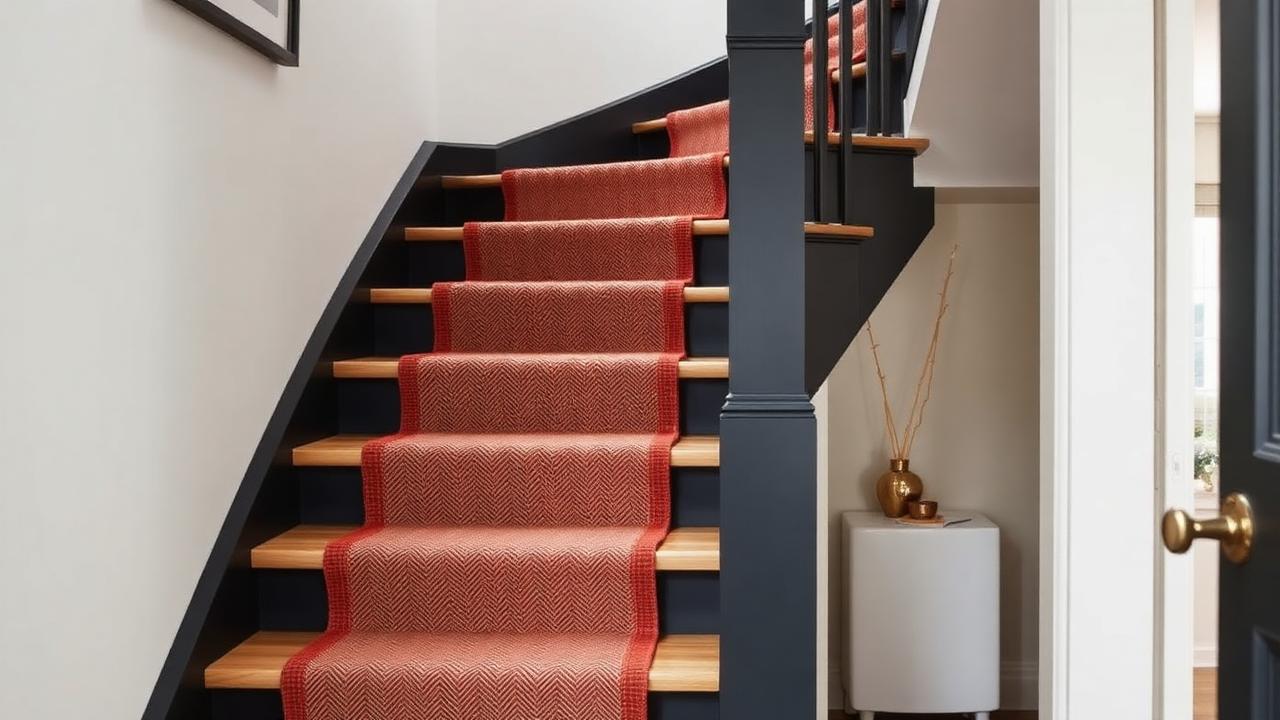
Even a temporary runner looks better and performs better when it is cut to a sensible, consistent width rather than eyeballed tread by tread. Use a stair runner calculator to work out a total length and a stair runner length calculator to check how much material a full flight actually needs before you buy, whether you are covering every tread individually or laying one continuous strip.
What it costs
| Item | Typical US | Typical UK |
|---|---|---|
| Adhesive stair treads, per step | $4-12 | GBP 3-10 |
| Double-sided carpet tape, per roll | $6-15 | GBP 5-12 |
| Full temporary runner, 13-step flight | $60-180 | GBP 50-150 |
| Removable rod-and-bracket system, 13-step flight | $120-260 | GBP 100-220 |
A temporary fit is nearly always cheaper than a permanent stapled or glued installation, mainly because it skips professional labour. Most owners fit it themselves in an afternoon, which is part of why it is the go-to option for a rental or a short-term need.
When to upgrade to a permanent installation
If a temporary runner is still down and still doing its job after six months, it is usually cheaper over time to convert it to a properly fitted runner with underlay, gripper and stretched-in fixing, because a permanent installation lasts many years longer per unit of material and looks tighter and flatter underfoot. A permanent fit is also the better choice for a large or heavy dog, since staples and gripper hold far more securely under repeated impact than tape ever will.
Multi-dog and multi-pet households
A single small dog is gentle on a temporary fit compared with two or three dogs sharing the same staircase, or a household that also has a cat sharpening claws on the runner's edge. More paws means more repeated impact at the same nosing points, and adhesive tape that would comfortably last a year under one dog can start lifting at the edges within a few months under three. If you have more than one dog, or a mixed household of dogs and cats, favour the more mechanical fixings — a rod-and-bracket system or carpet-piercing gripper tape — over plain double-sided tape, since these hold up better to the extra cycles of weight and turning.
Multiple dogs also wear a runner unevenly if one is heavier or faster on the stairs than the others; a large dog that takes two steps at a time can stress the tape at every second tread while barely touching the ones in between. Check the whole flight for lifting corners every few weeks in a multi-dog home rather than assuming the fixing is uniform, and be ready to re-tape individual treads sooner than you would in a single-dog household.
Safety checks specific to dogs on stairs
| Check | Why it matters for a dog | How often |
|---|---|---|
| Lifted corners or edges | A raised edge is a trip and snag hazard for paws, not just human feet | Weekly |
| Nosing coverage | The nosing is where a paw lands hardest; bare nosing is the most common slip point | Weekly |
| Claw snags in the pile | A caught claw can injure a dog badly if it panics and pulls away mid-stride | Monthly |
| Adhesive residue build-up | Old, degraded tape residue can become tacky in heat and stick to paw pads | Every re-tape cycle |
| Step height consistency | A pad or runner that has bunched up on one step changes the effective rise underfoot | Monthly |
Most of these checks take less than a minute per flight and catch problems well before they become a fall risk. A temporary fixing is inherently less predictable than a stapled, stretched-in installation, so a short, regular inspection habit is what keeps the safety case for a temporary runner solid over months of daily use.
Know your numbers in 30 seconds
Enter your step count, tread depth and riser height — the stair runner calculator gives you the exact length to order, in metres and feet, with waste included.
Open the stair runner calculatorWhatever you decide, get the numbers first: the stair runner calculator doubles as a stair runner length calculator, adding nosing wrap, landings, winders, pattern repeat and waste so you order the right length the first time.
Still deciding on material, width or pattern? Our hub on stair runners compares weaves, widths, backings and fitting styles side by side, then hands the numbers straight to the calculator.
Frequently asked questions
Is a temporary runner safe for a household with more than one dog?
Yes, but favour mechanical fixings like rod-and-bracket systems or carpet-piercing gripper tape over plain double-sided tape, since more dogs means more repeated impact at the same points and plain tape tends to lift sooner under that extra load.
Will double-sided tape damage sealed timber stairs?
Good quality carpet tape peels off cleanly from a properly sealed, finished surface if removed within a reasonable time, usually up to a year or so. Test a small offcut on an inconspicuous tread first, and avoid tape entirely on bare, unsealed or antique timber.
What is the best temporary option for an older dog with joint problems?
A full-length runner or individual stair treads that wrap slightly over the nosing give the most consistent grip on every part of the step, which matters most for a dog with reduced strength or coordination. Avoid thick, cushioned pads that add height variation between steps.
Can I use a temporary stair runner in a rental property?
Yes, that is one of its main uses. Rubber gripper tape, adhesive stair treads or a weighted friction-backed runner all avoid drilling, stapling or gluing, so they can be removed at the end of a tenancy without leaving marks or breaching a lease.
How long does a temporary fixing actually last?
Quality double-sided carpet tape typically holds for six months to two years depending on foot traffic and climate; rubber gripper tape can be lifted and re-tacked repeatedly. Check the manufacturer's guidance, since adhesive performance varies noticeably between products.
Do I still need underlay under a temporary runner?
It is optional but improves comfort and grip if you use a thin, dense stair-grade pad designed to sit under a temporary fit. Thick cushioned underlay is not recommended, since it can make step heights inconsistent, which is a safety concern on any staircase.
Should the temporary runner cover the full width of the stairs?
No, a standard centred runner leaving an equal margin either side works just as well for traction as a full-width covering, and it is cheaper and easier to fit. What matters most is that it wraps over the nosing, not that it spans the full tread.
Is carpet or a rubber tread mat better for a dog?
Both work; carpet feels warmer and more comfortable underfoot, while rubber tread mats are more waterproof and easier to wipe clean. For heavy shedding or muddy paws, rubber-backed carpet treads combine the benefits of both.
Know your numbers in 30 seconds
Enter your step count, tread depth and riser height — the stair runner calculator gives you the exact length to order, in metres and feet, with waste included.
Work out how much I needReady for real prices?
Get quotes from vetted stair runner suppliers and fitters near you. Free, no account, no obligation.
Every guide is written from hands-on measuring and fitting experience, checked against the calculator’s own maths, and re-reviewed whenever prices or methods change. Read our editorial standards.