
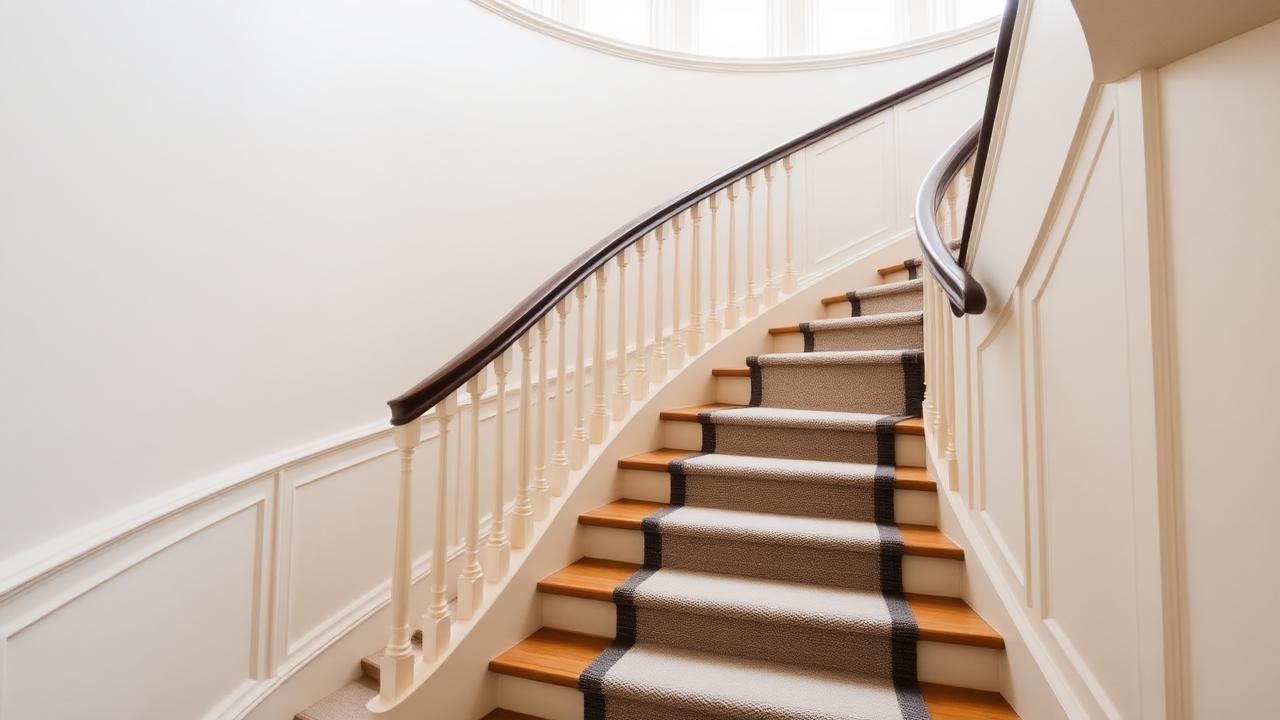
Why this transition happens
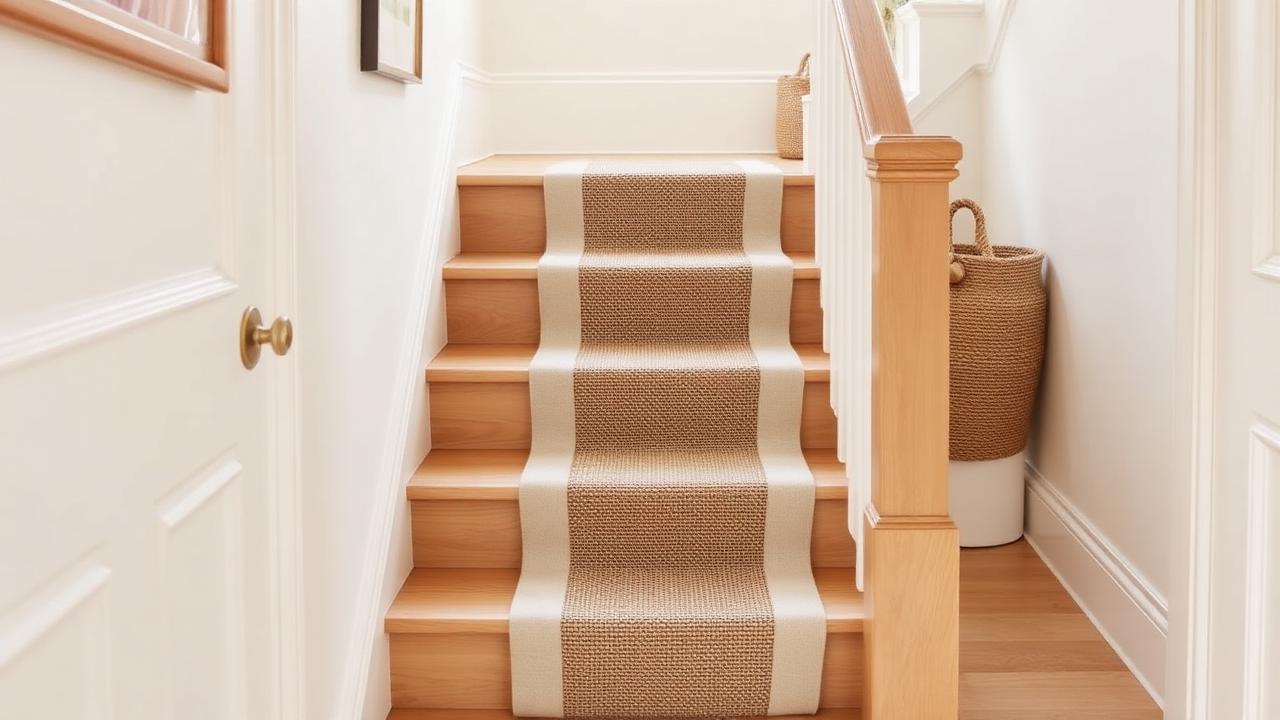
Many homeowners choose a narrower runner on the stairs, leaving an attractive border of exposed wood on each side, while opting for full wall-to-wall carpet on the upstairs landing where safety borders are less critical and the wider expanse of a hallway floor benefits from full coverage. This creates a visual and physical transition point where a narrower stair runner meets a wider carpet, and getting this junction right is one of the more technical details in a stair carpeting project.
How installers handle the transition
The most common approach is to run the stair runner up to the top riser or the first landing tread, then bind or finish its edge neatly before the full-width carpet begins. In many installations, the two carpets are seamed together directly at the top step using a heat-bonded or sewn seam, especially if the colours and pile heights are matched. If the runner and landing carpet are different products, such as a patterned wool runner meeting a plain synthetic landing carpet, installers usually create a clean division using a transition bar, a change in level such as a nosing strip, or by binding the runner's top edge and simply butting the landing carpet against it.
Measuring each section separately
It is important to measure the stair runner and the landing carpet as two separate quantities rather than trying to combine them into one continuous length, since they are usually different widths and sometimes different products entirely. Use a stair runner length calculator for the stair portion, factoring in every tread, riser, and nosing wrap, and measure the landing separately in square feet or square meters as you would for any room-sized carpet.
How much runner do I need?
For the 13-step flight: 10 in tread + 7.5 in riser + 0.75 in nosing wrap = 18.25 in per step. Across 13 steps that is 237.25 in, plus 24 in for finishing at the base and top transition point, totalling 261.25 in or 21.77 ft. With a 10% waste allowance, order about 24 ft of runner. Metric: 25 cm + 19 cm + 1.9 cm = 45.9 cm per step, times 13 is 596.7 cm, plus 60 cm is 656.7 cm, and with waste roughly 7.3 m. The landing carpet is calculated separately based on its own square footage.
| Section | US (in/ft) | UK (cm/m) |
|---|---|---|
| Stair runner total | 24 ft | 7.3 m |
| Landing carpet | Measured separately by area | Measured separately by area |
| Transition detail | Bar, bind, or seam | Bar, bind, or seam |
Know your numbers in 30 seconds
Enter your step count, tread depth and riser height — the stair runner calculator gives you the exact length to order, in metres and feet, with waste included.
Open the stair runner calculatorChoosing a transition style
A seamed transition, where the runner and the landing carpet are joined invisibly, gives the most seamless look and works best when both products are similar in colour, pile height, and fibre. A bound-edge transition, where the runner simply ends in a neat binding and the landing carpet is fitted independently, is more forgiving when the two products differ, and it is also easier to replace one element later without disturbing the other.
Match pile direction where possible
If your runner and landing carpet are similar products, ask your fitter to match the pile direction across the transition point so that light reflects consistently and the join is less visible.
Common transition methods
- Sewn or heat-bonded seam for matching products.
- Bound runner edge with independently fitted landing carpet.
- Metal or wood transition bar at the top step.
- A change in carpet colour or pattern deliberately used as a design feature.
Cost implications
Because this project involves two separate carpet products and a specialised seaming or transition detail, budget for both materials individually and factor in additional labour for the transition itself, which is more time-consuming than a standard flat seam. Always ask your fitter to quote the transition detail as a separate line item so you understand exactly what you are paying for.
In summary, transitioning from a stair runner to a full-width landing carpet is achievable with careful planning. Measure the two sections independently, decide on your preferred transition method, and use a stair runner calculator to nail down your stair yardage before ordering either product.
Still deciding on material, width or pattern? Our hub on stair runners compares weaves, widths, backings and fitting styles side by side, then hands the numbers straight to the calculator.
Frequently asked questions
Can a stair runner and landing carpet be different colours?
Yes, many homeowners deliberately use different colours or patterns, finished with a bound edge or transition bar.
Is a seam between the runner and landing visible?
If the products are matched in colour, pile, and fibre, a professional seam can be nearly invisible; mismatched products are usually better with a bound edge.
How do I measure the landing carpet separately?
Measure its length and width in square feet or square meters just as you would for any room, independent of the stair runner calculation.
What is a transition bar?
A metal or wood strip installed at the top step to create a clean, defined edge between two different flooring materials.
Do I need a professional for this transition?
Yes, seaming or precisely aligning two different carpets at a stair-to-landing junction is a skilled job best left to an experienced fitter.
How much runner do I need for a 13-step staircase?
Approximately 23 to 24 feet or 7 to 7.3 meters, calculated separately from the landing carpet.
Can I use the same carpet for both the stairs and the landing?
Yes, using the same product throughout can simplify the transition and often allows for a seamless or nearly invisible join.
What if my landing has an irregular shape?
Always have a professional measure irregular landings in person, as diagrams alone can miss important angles or obstructions.
Know your numbers in 30 seconds
Enter your step count, tread depth and riser height — the stair runner calculator gives you the exact length to order, in metres and feet, with waste included.
Plan the stair section with the stair runner calculatorReady for real prices?
Get quotes from vetted stair runner suppliers and fitters near you. Free, no account, no obligation.
Every guide is written from hands-on measuring and fitting experience, checked against the calculator’s own maths, and re-reviewed whenever prices or methods change. Read our editorial standards.