
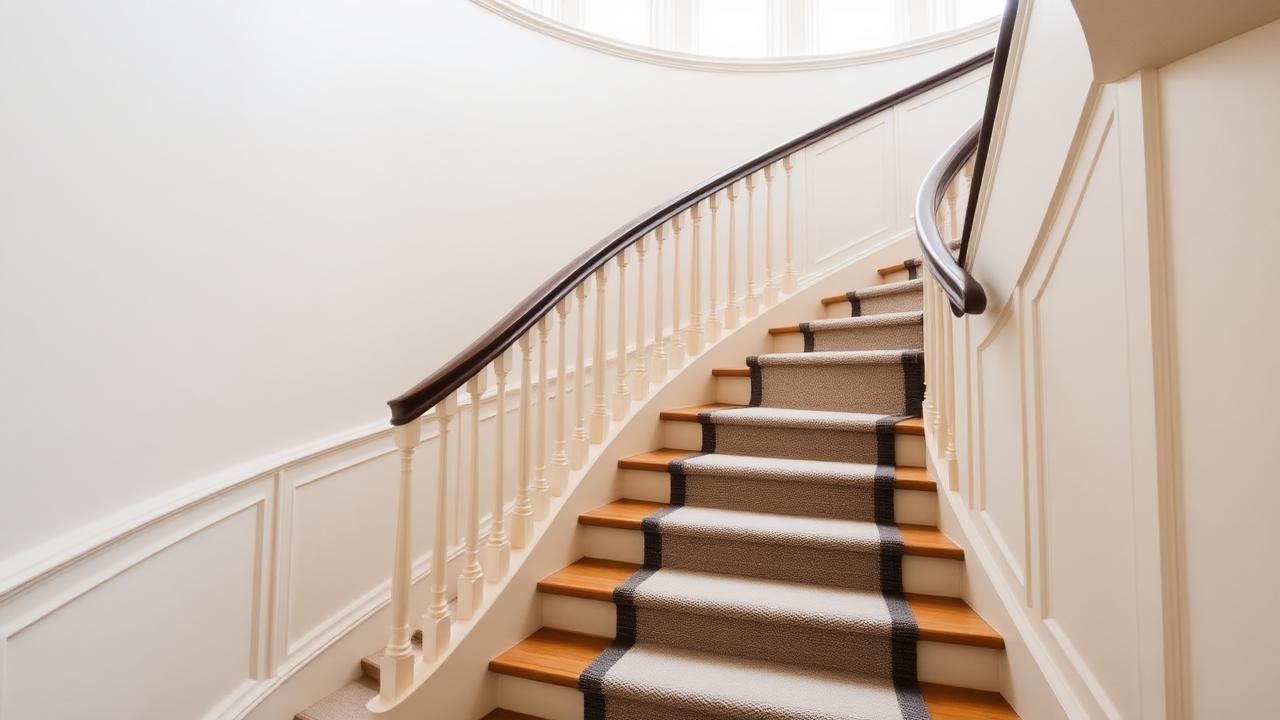
Why a landing turn changes runner measuring
A straight flight has one consistent tread run and riser height repeated down its length, so a stair runner calculator can sum riser + tread for every step and get an accurate total in one pass. A landing turn breaks that pattern in two places: the flat landing has no riser at all (just a width x depth rectangle of carpet), and the corner where the runner changes direction needs either a mitred seam or a full break in the runner.
There are three common approaches to the corner itself, in increasing order of material use and installation skill: a single continuous runner mitred at 45 degrees on the landing (most visually seamless, most waste), a runner that ends at the landing edge and restarts on the next flight with the landing carpeted separately (easiest, most visible break), and a pieced corner insert cut to match the runner's pattern (best of both, but needs a skilled fitter for pattern matching).
Measuring each section
- Measure flight A's total rise and run, and calculate its runner length the normal tread-by-tread way.
- Measure the landing's width and depth as a simple rectangle.
- Measure flight B the same way as flight A.
- Add a corner allowance: for a mitred continuous runner, add roughly the runner's own width again per 90-degree turn to cover the extra fabric consumed by the mitre; for a separate landing piece, no extra allowance is needed beyond the landing rectangle itself.
- Sum all sections for total yardage, then apply your usual 10% waste margin per section (not once on the grand total, since waste is driven by cutting each piece, not the whole run).
| Corner method | Visual result | Relative material use | Skill needed |
|---|---|---|---|
| Mitred continuous runner | Seamless diagonal join | Highest (+1 runner-width per turn) | High |
| Separate landing carpet | Visible break at landing edge | Lowest | Low-medium |
| Pieced pattern-matched insert | Near-seamless with pattern continuity | Medium-high | High |
Code and layout context
The landing itself must meet IRC's minimum 36in depth (or the stair's width, if greater) or UK Part K's minimum depth equal to the stair's width — this affects how much landing carpet you need, independent of the runner strips on either flight. Combined with IRC's 7.75in max riser / 10in min tread and UK's 220mm rise / 220mm going limits on the flights themselves, the landing turn adds real floor footprint beyond the sum of the two flights' individual runs.
Pattern direction across a turn
If you're using a directional or patterned runner (stripes, herringbone, a botanical repeat with an obvious 'up' direction), decide before ordering whether the pattern should read consistently up both flights or intentionally break at the landing — mills can sometimes weave a mirrored section for a turn, but it must be specified at order time, not after cutting.
Ordering the material
Run each flight through the stair runner calculator individually to get exact tread-by-tread lengths, then add the landing rectangle and any corner allowance by hand as shown above. For a full-flight total including waste, the stair runner length calculator can total the straight sections, but always add the landing and corner allowance as separate line items rather than trying to force them into the tread-by-tread formula.

- Measure both flights and the landing independently, never as one combined length.
- Decide on the corner method (mitred, separate, or pieced) before ordering, since it changes total yardage.
- Add roughly one runner-width of extra material per mitred 90-degree turn.
- Apply waste margin per section, not once on the combined total.
Half-landing runners: doubling back on the same footprint
A half-landing (180-degree) turn presents a different measuring challenge than a 90-degree quarter landing, because the runner effectively needs to traverse the landing twice — once arriving from the lower flight, once departing toward the upper flight — often on a landing only slightly wider than the flights themselves. Most fitters treat a half-landing as two separate 90-degree corner situations back to back rather than one continuous mitred sweep, since a true continuous 180-degree mitre in carpet is both extremely wasteful of material and very difficult to lay flat without rippling.
| Landing turn type | Recommended corner method | Relative material use |
|---|---|---|
| 90-degree (quarter landing) | Single mitre or separate landing piece | Baseline (+1 runner-width if mitred) |
| 180-degree (half landing) | Two separate corner treatments, or one full landing carpet piece | Higher — effectively two corners' worth of allowance |
Pattern-match seam allowance
If the runner has a directional or repeating pattern and you want it to match visually across a corner seam, order extra length specifically for pattern alignment at that seam — typically one full pattern repeat's worth of extra material per seam, so the fitter has room to shift the cut point until the pattern lines up rather than being forced to use whatever falls at a fixed length. Specify this at order time; a mill or fabricator generally cannot add pattern-match allowance after a length has already been cut.
- Identify the pattern repeat length in inches or centimetres before ordering.
- Add one full repeat length as extra material per corner seam that needs to match.
- Confirm with the fabricator that they will use this allowance for alignment, not simply add it as generic waste.
- Photograph the intended seam layout and share it with the fitter before cutting begins.
Know your numbers in 30 seconds
Enter your step count, tread depth and riser height — the stair runner calculator gives you the exact length to order, in metres and feet, with waste included.
Open the stair runner calculatorStill deciding on material, width or pattern? Our hub on stair runners compares weaves, widths, backings and fitting styles side by side, then hands the numbers straight to the calculator.
Frequently asked questions
How do I measure a stair runner with a landing turn?
Measure each straight flight separately with the usual tread-by-tread method, measure the landing as its own width x depth rectangle, then add a corner allowance if the runner is mitred continuously around the turn.
How much extra runner do I need for a 90-degree landing turn?
Roughly one runner-width of extra material for a mitred continuous corner; little to no extra if the landing is carpeted separately.
Should the runner pattern be continuous across a landing turn?
It's a design choice — a continuous pattern needs to be specified when ordering so the mill can weave a matching or mirrored section for the turn.
How deep must a stair landing be?
At least 36in under IRC (or the stair's width if greater), and at least equal to the stair's width under UK Part K.
What's the easiest way to fit a runner around a landing turn?
Ending the runner at the landing edge and carpeting the landing separately is the simplest method, though it leaves a visible break rather than a seamless mitred corner.
Can I use one continuous piece of runner around a 90-degree turn?
Yes, with a mitred 45-degree seam on the landing, but it uses noticeably more material and needs a skilled fitter for a clean result.
Know your numbers in 30 seconds
Enter your step count, tread depth and riser height — the stair runner calculator gives you the exact length to order, in metres and feet, with waste included.
Open the stair runner landing calculatorReady for real prices?
Get quotes from vetted stair runner suppliers and fitters near you. Free, no account, no obligation.
Every guide is written from hands-on measuring and fitting experience, checked against the calculator’s own maths, and re-reviewed whenever prices or methods change. Read our editorial standards.