

What Berber actually describes
Berber is a construction term, not a colour or a brand: it means the yarn is punched through the backing and left as an uncut loop, rather than sheared into a cut pile. The name comes from the flecked, undyed wool rugs woven by Berber communities in North Africa, and the modern carpet trade borrowed the look - typically a level loop in a heathered or fleck-dyed neutral, sometimes with a fleck of a contrasting colour for texture. True Berber can be wool, wool-blend, nylon, or olefin (polypropylene), and the fibre choice matters as much as the loop structure for how it performs underfoot.
On a staircase specifically, the loop matters because a stair nosing takes more concentrated abrasion than any flat section of floor - every footstep lands on the same two inches of tread edge. A cut pile in that spot will splay and flatten within a couple of years under heavy traffic; a loop pile, anchored at both ends of each loop, resists that same wear because there is no free fibre tip to crush.
Loop size and traffic level
Berber carpets range from tight, small loops (sometimes called level-loop or textured loop) to larger, chunkier loops. Smaller, denser loops perform better on stairs because there is less loop surface exposed to catch and pull, and the closer packing resists crushing. Large decorative loops look appealing in a sample but are the construction most prone to snagging from pet claws, vacuum brush rollers, or a dragged suitcase.
The snag trade-off
Loop pile can snag. A dog claw or cat, or a heavy case dragged up the stairs, can pull a single loop into a long run. It is a simple repair - clip the pulled loop level with the surrounding pile, never pull it further - but if your household has a large, fast-moving dog, a tightly twisted cut pile or a flat weave may be the lower-maintenance option.
Typical specification to look for
| Spec | Typical range | What it means on a stair |
|---|---|---|
| Fibre | Wool, 80/20 wool-nylon, nylon, olefin | Wool-nylon blends wear best at the nosing for the price |
| Pile weight | 1,300-2,000 g/m2 | Under 1,300 g/m2 is a room-only quality, not stair-grade |
| Loop height | 4-7 mm | Low, dense loops hug the nosing and resist crushing |
| Backing | Jute, woven or synthetic action-back | Woven backings hold staples best and resist tread creep |
| Roll width | 4 m or 5 m broadloom | Determines how efficiently runner strips can be cut |
| Runner width | 25-33 in (64-84 cm) | 26-27 in fits most 36 in (91 cm) staircases with even margins |
| Wear rating | Heavy domestic or contract grade | Anything lower shows a visible track within two years |
Choosing a runner width
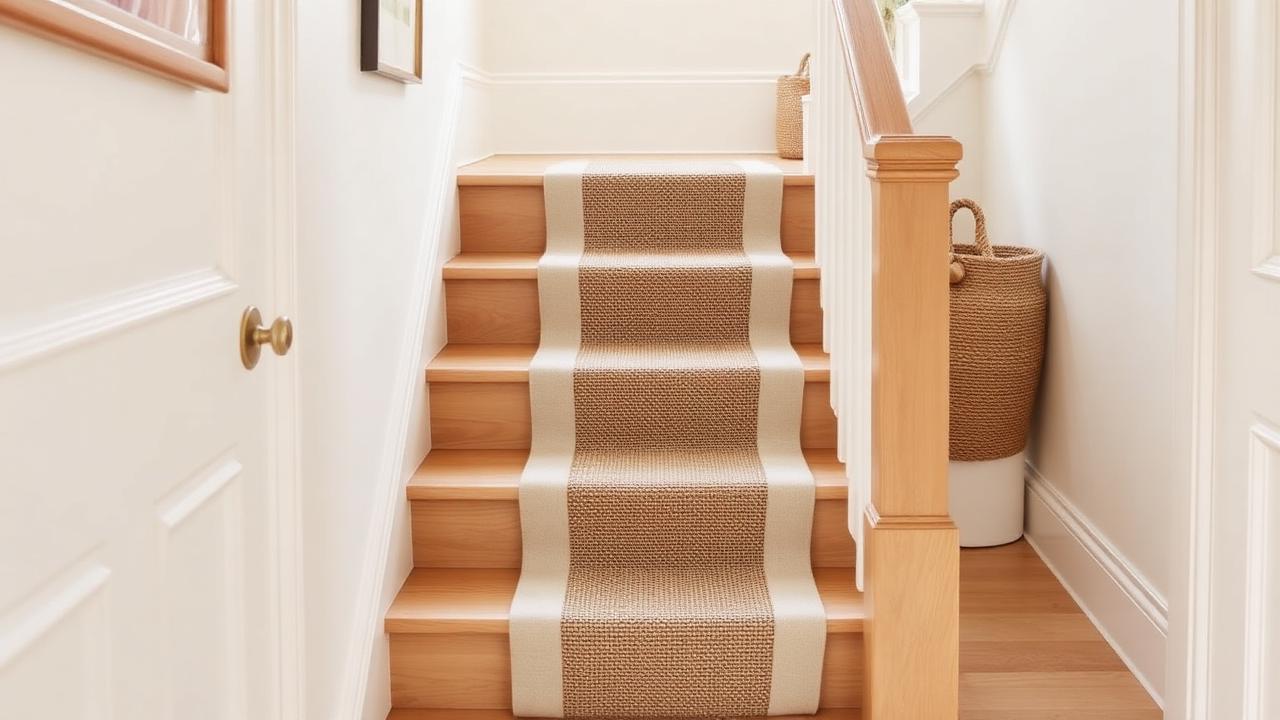
The standard approach leaves an equal margin of exposed tread on both sides of the runner. On a common 36 in (91 cm) staircase, a 27 in runner leaves roughly 4.5 in of visible timber either side, the proportion most people picture when they think of a classic stair runner. A narrower 25 in runner reads more formal and elongates the stairs visually; a wider 30 in runner gives a softer, fuller look and protects more of each tread from foot traffic.
If your staircase width falls between stock sizes, do not squeeze a runner to fit or leave uneven margins - order broadloom cut and bound to your exact measurement instead. Running your figures through a stair runner width calculator will confirm the margin either side before you commit to an order.
Measuring and fitting, step by step
Berber's loop construction is forgiving of small stretching errors compared with a delicate cut pile, but the fitting sequence is the same discipline as any stair carpet: measure accurately, allow for pattern or fleck alignment if the range has any directional lay, and stretch as you fix.
- Measure each tread depth and riser height individually - older staircases are rarely perfectly uniform step to step.
- Add the standard tuck allowance of 4-6 in (10-15 cm) at both the top and bottom of the run for finishing.
- Check the fleck or loop lay direction on the sample; some Berber ranges have a subtle nap that should run consistently up the flight.
- Cut stair-grade underlay narrower than the tread and wrap it over the nosing, never running it the full tread width.
- Fix the bottom step first, stretching the runner into the nosing with a knee kicker before stapling or gripper-fixing.
- Work upward one step at a time, re-checking that the runner remains centred on the staircase every three or four steps.
What it costs
| Item | Typical US | Typical UK |
|---|---|---|
| Berber carpet, broadloom | $22-50 per sq yd | GBP 20-45 per sq m |
| Ready-made bound runner | $18-42 per linear ft | GBP 15-35 per linear m |
| Edge binding or whipping | $4-9 per linear ft | GBP 4-8 per linear m |
| Stair-grade underlay | $4-8 per sq yd | GBP 5-9 per sq m |
| Fitting, straight flight | $26-52 per step | GBP 20-42 per step |
| Fitting, winders or curved flight | $50-105 per step | GBP 42-88 per step |
Berber sits toward the affordable end of the wool-and-blend market compared with a woven pattern carpet of similar weight, mainly because loop-pile tufting is faster to manufacture than a Wilton or Axminster weave. For a typical thirteen-step straight flight, most households land in the lower half of a four-figure sum in dollars or pounds for a mid-market wool-blend Berber. Put your own step count and price per unit into a stair runner calculator rather than relying on an average per-step figure, since winders and curved sections cost meaningfully more than straight flights.
Care and longevity
- Vacuum with the beater bar off or on its lowest setting - a rotating brush can pluck and pull loops.
- Blot spills immediately rather than rubbing, since rubbing can open a loop and leave a visible pale patch.
- Clip, never pull, any snagged loop; a clipped loop is nearly invisible once trimmed level with the surrounding pile.
- Expect a settling shed of loose fibre for four to eight weeks on a new 100% wool or wool-blend Berber.
- Keep an offcut in storage; a stair repair is straightforward with matching material and difficult without it.
Codes and geometry to check first
Berber itself is not regulated by building codes, but the staircase it sits on is. In the US, the IRC R311.7 provisions set minimum tread depth and maximum riser height for residential stairs; in the UK, Approved Document K (Part K) sets equivalent limits along with pitch and handrail requirements. Confirming your existing stair geometry falls within these figures before ordering carpet avoids discovering a non-standard nosing or riser height only after the runner has been cut.
Know your numbers in 30 seconds
Enter your step count, tread depth and riser height — the stair runner calculator gives you the exact length to order, in metres and feet, with waste included.
Open the stair runner calculatorWhatever you decide, get the numbers first: the stair runner calculator doubles as a stair runner length calculator, adding nosing wrap, landings, winders, pattern repeat and waste so you order the right length the first time.
Still deciding on material, width or pattern? Our hub on stair runners compares weaves, widths, backings and fitting styles side by side, then hands the numbers straight to the calculator.
Frequently asked questions
Is Berber carpet a good choice for stairs with pets?
It can be, but choose a tight, small loop rather than a large decorative loop, since large loops are more prone to snagging from claws. A dense wool-nylon Berber at 1,500 g/m2 or above with a low loop height performs well; if you have a large, fast-moving dog, consider a cut pile or flat weave instead.
How does Berber compare with a cut-pile carpet on stairs?
Berber's loop is anchored at both ends, so it resists the splaying and flattening that cut pile can suffer at the tread nosing under heavy foot traffic. Cut pile generally feels softer underfoot and shows a smoother, more formal surface, but wears faster in that specific two-inch nosing zone.
What loop height should I choose for a stair runner?
Aim for 4-7 mm. Lower, denser loops hug the nosing profile closely and resist crushing under repeated foot traffic, while taller loops of 9 mm or more can bridge the nosing edge and look soft rather than crisp once fitted.
Can a Berber stair runner be fitted with stair rods instead of staples?
Yes. Gripper strip fitted in the angle of each step combined with stair rods gives a removable installation that still holds the loop pile taut, which suits rented properties or period staircases where a permanent staple fix is undesirable. Expect to re-tension the runner roughly once a year with this method.
How wide should a Berber runner be for a 36 inch staircase?
A 26-27 in (66-69 cm) runner is standard, leaving about 4.5 in of exposed tread on each side. Go to 30 in for extra tread coverage and a fuller look, or 25 in for a narrower, more formal proportion.
Does Berber carpet stain easily?
Wool Berber has natural lanolin that resists water-based spills long enough to blot them before they set, but it is not stain-proof. Synthetic Berber in nylon or olefin generally resists staining better but can show oil-based marks more readily; blot rather than rub in either case.
What underlay is recommended under a Berber stair runner?
A dense stair-grade crumb rubber or firm polyurethane pad, cut narrower than the tread and wrapped over the nosing rather than running the full tread width, gives the best cushioning without showing past the edge of the runner or collecting grit at the margins.
Is Berber suitable for a staircase with winders or a curved section?
Yes, but fitting cost rises meaningfully on winders because each pie-shaped tread must be cut and fitted individually rather than run straight. Budget close to double the per-step labour rate for winder or curved sections compared with a straight flight.
Know your numbers in 30 seconds
Enter your step count, tread depth and riser height — the stair runner calculator gives you the exact length to order, in metres and feet, with waste included.
Measure my staircaseReady for real prices?
Get quotes from vetted stair runner suppliers and fitters near you. Free, no account, no obligation.
Every guide is written from hands-on measuring and fitting experience, checked against the calculator’s own maths, and re-reviewed whenever prices or methods change. Read our editorial standards.