

Finishes compared
| Finish | Character | Upkeep | Relative cost |
|---|---|---|---|
| Polished brass | Bright, traditional, formal | Polishing to stay bright | $$ |
| Antique brass | Warm, aged, forgiving | Low | $$ |
| Satin nickel | Soft silver, transitional | Low | $$ |
| Chrome | Cool, contemporary | Shows fingerprints | $ |
| Matt black | Graphic, modern | Very low | $ |
| Pewter / bronze | Muted, characterful | Low | $$$ |
Lacquered vs unlacquered brass
Lacquered brass is sealed to resist tarnish and stays bright with minimal effort, but the lacquer can eventually wear or chip, creating patchy patina. Unlacquered brass tarnishes evenly and can simply be re-polished whenever you want it bright again.
Grand vs everyday staircases
A tall entrance hall with a sweeping staircase can carry a bright, substantial 16mm or 19mm polished brass rod without looking showy, because the scale of the space absorbs it. The same rod on a narrow, low-ceilinged 1930s semi staircase reads as oversized. Match rod scale to room scale as much as to taste — a slim 9 to 10mm rod in a modest hallway often looks more considered than a heavy statement piece.
Matching the rest of the hallway
- Follow the door furniture and the light fittings before the runner colour.
- Warm interiors — oak, cream, terracotta — take brass and bronze naturally.
- Cool or monochrome interiors sit better with nickel, chrome or black.
- In a period house, aged brass usually beats polished brass unless the property is genuinely formal.
Know your numbers in 30 seconds
Enter your step count, tread depth and riser height — the stair runner calculator gives you the exact length to order, in metres and feet, with waste included.
Open the stair runner calculatorMixed metals are fine, mixed tones are not
Brass rods with black handrail brackets works. Brass rods with chrome door handles two feet away does not. Keep the temperature of the metals consistent even when the finishes differ.
Solid vs plated
Solid brass costs more but ages gracefully and can be re-polished indefinitely. Plated steel is cheaper and fine in low-traffic settings, but the plating can wear through on the rod's top surface where feet brush it.
Cost comparison by finish
| Finish | Set of 13 rods, plated | Set of 13 rods, solid |
|---|---|---|
| Brass | $100–$180 | $220–$450 |
| Nickel | $110–$190 | $240–$460 |
| Chrome | $80–$150 | n/a — usually plated only |
| Matt black | $90–$160 | $200–$380 (solid steel/iron) |
How light changes a finish
Polished brass and chrome throw light back down a staircase, which reads as bright and formal under a hallway pendant but can look brash under harsh downlights. Matt black absorbs light and reads as a strong graphic line rather than a reflective one — striking in a well-lit hallway, but it can vanish into shadow at the bottom of a dim stairwell. Antique brass and pewter sit in between, giving definition without glare either way.
Matching rods to the runner colour
| Runner tone | Rods that work well | Rods to avoid |
|---|---|---|
| Deep red or burgundy | Antique brass, bronze | Chrome — reads cold against warm reds |
| Charcoal or navy | Matt black, satin nickel | Polished brass — can look dated on cool tones |
| Natural or oatmeal | Antique brass, pewter | High-shine chrome, which overpowers a quiet palette |
| Black and white pattern | Matt black, chrome | Warm bronze, which fights the cool contrast |
Buy one rod before committing to a full set
Photos and screens shift metal tones more than almost any other material. A single sample rod held against your actual stairs in daylight and lamp light avoids an expensive full-set mismatch.
Caring for each finish
- Polished brass: buff with a brass polish every few months to keep the shine; lacquered brass needs only dusting.
- Antique brass and bronze: wipe with a dry cloth; the patina is meant to develop, not be polished away.
- Nickel and chrome: a damp microfibre cloth; avoid abrasive pads which will scratch the surface.
- Matt black: dust only; avoid polish products, which can leave a sheen on a deliberately flat finish.
Period-correct choices
If you are trying to keep a Victorian or Edwardian staircase authentic, polished or antique brass is the historically accurate choice — stair rods were almost always brass or occasionally bronze in that era, made to catch the light in a hallway lit only by gas or candle. Chrome and satin nickel are twentieth-century finishes, and matt black is a distinctly contemporary look with no real period precedent, so on a strictly heritage restoration project, brass remains the safer choice even though black has become fashionable in recent years.
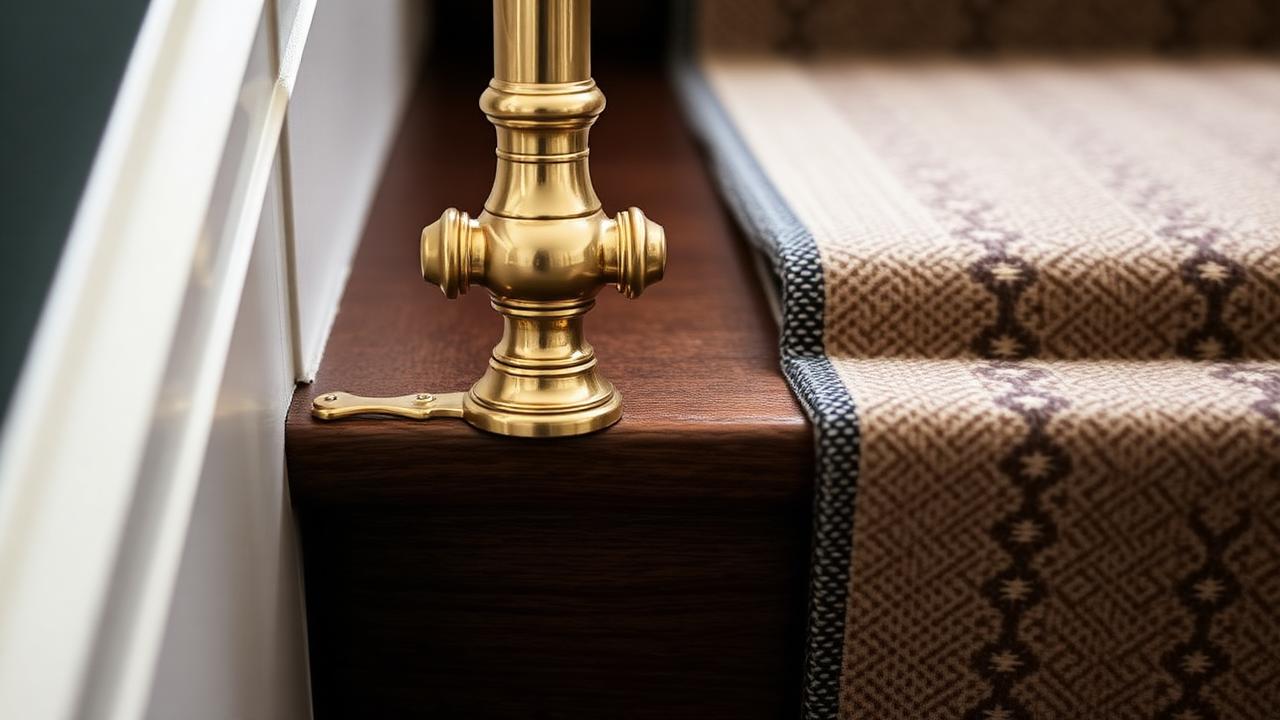
How finish interacts with runner pattern
A busy patterned runner — florals, tartans, chevrons — usually reads more calmly with a quieter rod finish, since the eye already has plenty to process in the carpet itself. Antique brass or matt black both recede against pattern in a way that polished chrome does not. On a plain or subtly flecked runner, by contrast, the rods become more of a feature in their own right, and it is worth spending more on a distinctive finish like a substantial polished brass or a warm bronze, because there is little else on the staircase competing for attention.
Testing finishes before you commit
- Order one sample rod in your shortlisted finish rather than judging from a product photo alone.
- View it against the actual runner sample and existing door furniture in both daylight and evening lamp light.
- Hold it at the top and bottom of the staircase, since light quality often differs significantly between the two ends of a flight.
- Live with the sample for at least a few days before ordering a full set — metal tones can look different again after the initial impression settles.
Budgeting across a full staircase
On a typical 13-step staircase, finish choice is usually a $100 to $200 swing across an entire set, which is a modest amount to get wrong given how visible stair rods are every single day. Spending slightly more for solid metal in your chosen finish, rather than the cheapest plated option in a compromise finish, is nearly always the better use of a stretched decorating budget on this particular item.
Whatever you decide, get the numbers first: the stair runner calculator doubles as a stair runner length calculator, adding nosing wrap, landings, winders, pattern repeat and waste so you order the right length the first time.
Still deciding on material, width or pattern? Our hub on stair runners compares weaves, widths, backings and fitting styles side by side, then hands the numbers straight to the calculator.
Frequently asked questions
Are brass or black stair rods better?
Neither is objectively better — brass suits warm, traditional and period interiors, matt black suits contemporary and monochrome schemes. Match your existing door furniture first.
Do brass stair rods tarnish?
Polished brass does and needs occasional polishing. Antique and lacquered brass finishes are designed to resist or embrace the patina.
Are solid brass stair rods worth the extra?
On a main staircase, yes. Plated rods can wear through on the exposed upper surface after years of foot contact.
Do stair rods need to match the door handles exactly?
Not exactly, but the metal temperature should agree — warm finishes like brass and bronze together, cool finishes like nickel, chrome and black together. Mixing a warm rod with cool door furniture across the same sightline usually looks unplanned.
Which finish shows the least wear over time?
Matt black and antique or aged brass, since both are designed to look consistent as they weather rather than relying on a bright, easily scuffed surface finish like polished chrome.
Should I choose rods based on the runner or the hallway?
The hallway first — door furniture, light fittings and any existing ironwork set the metal tone of the house, and the runner colour should then be chosen or matched around that, not the other way round.
Is matt black or brass more period-appropriate on an old staircase?
Brass is the historically accurate choice on Victorian and Edwardian staircases, since stair rods of that era were almost always brass or bronze. Matt black is a modern look with no real period precedent, though it has become popular on updated period interiors.
Does rod finish matter more on a patterned or a plain runner?
Both, but for different reasons. On a busy patterned runner, a quiet finish like antique brass or matt black keeps the staircase calm. On a plain runner, the rod finish becomes more of a visible feature, so it is worth choosing something distinctive.
Know your numbers in 30 seconds
Enter your step count, tread depth and riser height — the stair runner calculator gives you the exact length to order, in metres and feet, with waste included.
Price rods by finishReady for real prices?
Get quotes from vetted stair runner suppliers and fitters near you. Free, no account, no obligation.
Every guide is written from hands-on measuring and fitting experience, checked against the calculator’s own maths, and re-reviewed whenever prices or methods change. Read our editorial standards.