
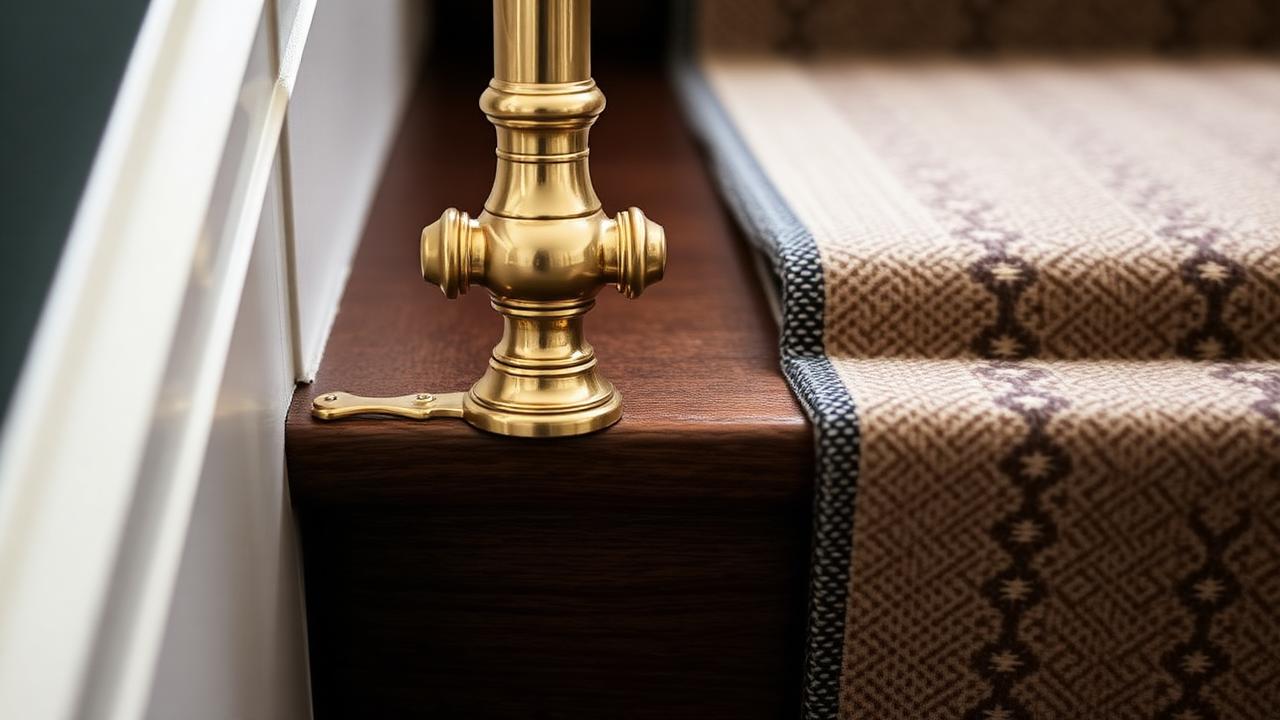
Rod length by runner width
| Runner width | Typical rod length | Overhang each side |
|---|---|---|
| 24 in | 28 in | 2 in |
| 27 in | 31 in | 2 in |
| 30 in | 34 in | 2 in |
| 32 in | 36 in | 2 in |
| 36 in | 40 in | 2 in |
Rods sit outside the runner, not on it
The brackets need to land clear of the runner edge, so a rod is normally about 4 inches longer than the runner overall. Some ranges are supplied over-long and cut to size.
Diameters and where they suit
| Diameter | Look | Best for |
|---|---|---|
| 9–10 mm | Slim, modern | Narrow runners, minimal interiors |
| 12–13 mm | Standard | Most homes, most widths |
| 16 mm | Substantial | Wide runners, period staircases |
| 19 mm+ | Statement | Grand staircases, tall ceilings |
Know your numbers in 30 seconds
Enter your step count, tread depth and riser height — the stair runner calculator gives you the exact length to order, in metres and feet, with waste included.
Open the stair runner calculatorHow many rods do you need?
One rod per step, sitting in the crotch where the tread meets the riser. Many people omit the bottom step for a cleaner line at floor level, so a 13-step flight typically takes 12 or 13 rods, plus two brackets and two finials each.
| Steps | Rods | Brackets | Finials |
|---|---|---|---|
| 10 | 10 | 20 | 20 |
| 13 | 13 | 26 | 26 |
| 16 | 16 | 32 | 32 |
Measuring the flight correctly
Measure the finished runner width, not the raw stair width, since rods size off the runner, not the timber. If you have not yet ordered the runner, measure the reveal you want on each side, subtract that twice from the stair width, and that figure is your runner width for rod sizing purposes. A common error is measuring the staircase and ordering rods a size too long, which then overhang the reveal and draw the eye to bare tread rather than the runner.
Order one spare rod length if the run is uneven
Older staircases are rarely perfectly consistent step to step. Buying one extra rod in the ordered length gives you a safety margin if a tread turns out a touch wider than the rest, without holding up the whole install waiting on a reorder.
Bracket types and how they change the fit
| Bracket type | How it works | Best for |
|---|---|---|
| Open bracket (visible rod ends) | Rod rests in a cupped bracket, ends and finials visible | Traditional, decorative rod displays |
| Closed / concealed bracket | Rod sits in a housing, no visible finials | Minimal, modern schemes |
| Stair rod holders (no drilling) | Clip or adhesive fixing into the tread/riser angle | Rental properties, older stone stairs |
| Eye and pin fixing | Rod threads through a fixed eyelet | Runners with a narrower finished width |
Runner width and rod length worked examples
Say your staircase is 36 inches wide and you want a 3 inch reveal each side. That gives a finished runner width of 30 inches, and the rod length table above puts you at roughly 34 inches. If instead you want a narrower 24 inch runner with wider reveals on a 34 inch staircase, you would look at the 24 inch row and order a 28 inch rod. Working forward from the reveal you want, rather than backward from a rod length you have seen online, keeps the whole proportion of the staircase correct.
Cost of a full stair rod set
For a typical 13-step staircase, expect $80 to $180 for a budget plated steel set, $150 to $350 for solid brass or nickel, and upwards of $400 for statement 19mm+ rods in a premium finish. Rods are usually the smaller line item next to the runner itself, but they are also the hardware you touch and see closest up, so it is worth spending a notch above the cheapest option.

Maintaining rods once fitted
Rods take dust on the top surface and grip from feet at the nosing more than anywhere else. A dry microfibre cloth weekly and a proper metal polish appropriate to the finish every few months keeps polished brass and nickel looking sharp. Matt black and antique finishes need almost nothing beyond dusting, which is part of their appeal on a busy household staircase.
What is included in a set
- The rods themselves, cut or sized to your order.
- A pair of brackets per rod, unless you are using a no-drill holder system.
- Finials — decorative end caps, sometimes sold separately from plain-end rods.
- Fixing screws, though masonry stairs may need separate wall plugs.
Common ordering mistakes
- Ordering rod length based on the stair width instead of the finished runner width.
- Forgetting the bottom step decision — decide up front whether you are fitting a rod there or leaving it clean.
- Mixing finishes between rods and other hallway hardware without checking them side by side first.
- Not accounting for a return nosing or bullnose bottom step, which needs a shorter, sometimes curved rod.
Rods on winders and curved stairs
A standard straight rod works on a normal tread, but a winder step has an angled nosing rather than a straight one, so the rod either needs to be a shorter length seated only across the usable width, or the winder is left rod-free with the runner fixed by staples or tape instead. Curved or bullnose bottom steps usually need a bespoke curved rod or a decorative end bracket rather than a standard straight length — measure the actual curve radius and confirm with the supplier before ordering, since a standard rod simply will not sit flush on a curved riser.
Rod spacing and how many brackets a long rod needs
Most stair rods up to about 36 inches only need the two end brackets, one per side, since the rod itself is rigid enough not to sag over that span. On wider runners of 40 inches or more, some ranges offer a centre support bracket to stop the rod bowing under its own weight over time, particularly in slimmer 9 to 10mm diameters. If you are ordering a wide rod in a slim diameter, ask the supplier whether a centre bracket is available or recommended for that length.
| Rod length | Diameter | Support needed |
|---|---|---|
| Up to 32 in | Any | Two end brackets |
| 32–40 in | 12mm+ | Two end brackets |
| 32–40 in | 9–10mm | Consider a centre bracket |
| 40 in+ | Any | Centre bracket recommended |
Ordering checklist
- Confirm the finished runner width, not the raw staircase width.
- Count the number of steps and decide on the bottom step treatment.
- Choose a diameter that suits the scale of the staircase and hallway.
- Pick a finish that matches existing door furniture and light fittings.
- Check whether a centre bracket is needed for wide, slim rods.
- Order one spare rod length if the staircase is older or uneven.
Whatever you decide, get the numbers first: the stair runner calculator doubles as a stair runner length calculator, adding nosing wrap, landings, winders, pattern repeat and waste so you order the right length the first time.
Still deciding on material, width or pattern? Our hub on stair runners compares weaves, widths, backings and fitting styles side by side, then hands the numbers straight to the calculator.
Frequently asked questions
What length stair rods do I need for a 27in runner?
Around 31 inches, allowing roughly 2 inches of rod beyond each edge of the runner for the brackets.
How many stair rods per step?
One rod per step, seated in the angle between tread and riser. Some people skip the bottom step for a cleaner finish.
What diameter stair rod is standard?
12 to 13mm suits most homes. Go to 16mm or above on wide runners and grand period staircases.
Do I measure the runner or the staircase for rod length?
The finished runner width, not the raw staircase width. Rods need to sit just outside the runner edges to hide the brackets, so sizing off bare stair width risks an overhang that looks unfinished.
Can stair rods be cut to a custom length?
Most suppliers offer standard lengths in 1 to 2 inch increments and some will cut to exact size for an extra charge. If your staircase is an unusual width, ask before ordering rather than rounding up and living with the overhang.
Do all stair rod sets come with brackets and finials?
Most full sets do, but no-drill clip systems and some budget ranges sell rods separately from fixings. Check the listing carefully, especially if you are matching finishes across a large order.
Can stair rods be fitted on winders or curved steps?
Standard straight rods do not sit well on an angled winder nosing or a curved bullnose step. Many installers either fit a shorter rod across the usable width of a winder or skip rods on those steps and fix the runner with staples instead. Curved bottom steps usually need a bespoke curved rod.
Do wide stair rods need a centre support bracket?
Rods over about 40 inches, especially in slimmer 9 to 10mm diameters, can benefit from a centre bracket to stop sagging over time. Most ranges up to 36 to 40 inches are fine with just the two end brackets.
Know your numbers in 30 seconds
Enter your step count, tread depth and riser height — the stair runner calculator gives you the exact length to order, in metres and feet, with waste included.
Size my stair rodsReady for real prices?
Get quotes from vetted stair runner suppliers and fitters near you. Free, no account, no obligation.
Every guide is written from hands-on measuring and fitting experience, checked against the calculator’s own maths, and re-reviewed whenever prices or methods change. Read our editorial standards.