
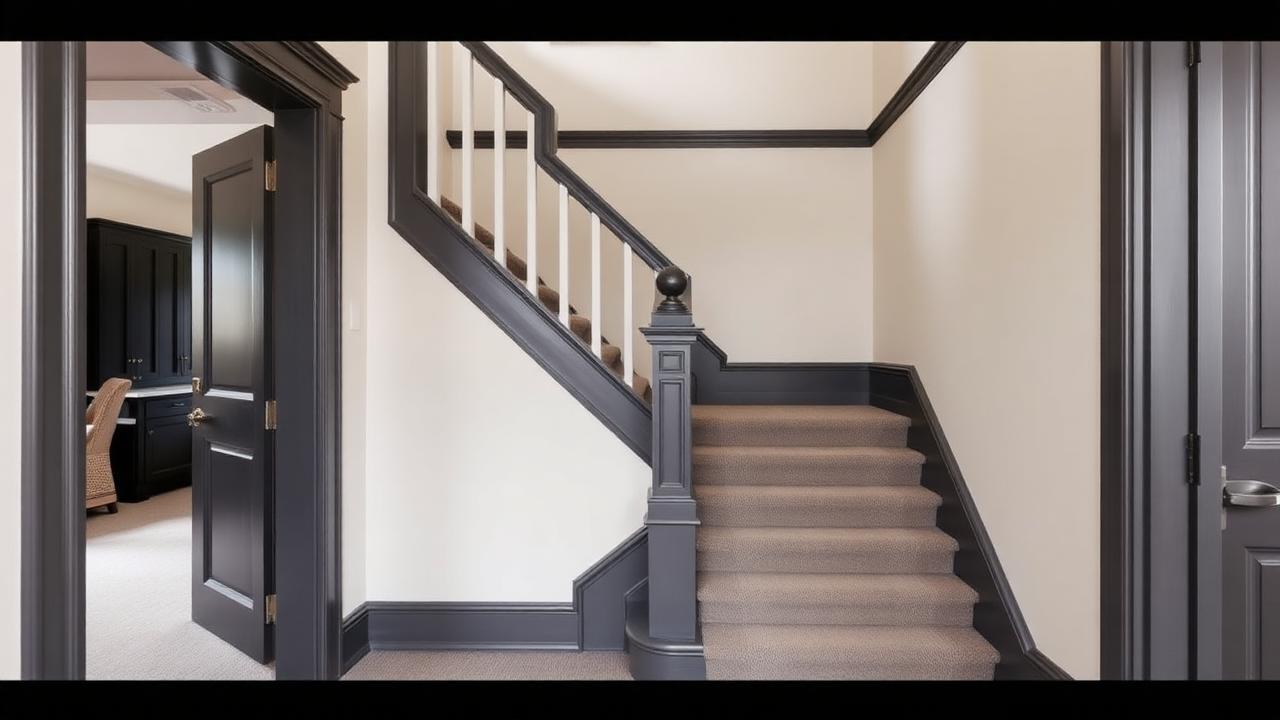
The challenge of curved stairs
Curved stairs are the ultimate test for any carpet fitter. Unlike a straight flight where you have a predictable, consistent tread, a curved stair changes in width as you move across it, and the path of the runner itself is an arc rather than a straight line. The runner needs to be carefully coaxed around the curve, and if it's a patterned runner, you have the additional hurdle of keeping the pattern perfectly centred on every tread without it drifting to one side as the stair turns. It is a precise, time-consuming job that rewards extreme attention to detail.
Measuring and template advice
For a curved staircase, don't rely on basic straight-line measurements. You absolutely need to create a full-scale template of the stair. Lay heavy-duty paper over the treads and trace the exact curve of the stringers. This template is the only way to accurately judge how much material you need and where the runner will sit. When you order your runner, remember that you aren't just measuring for the steps, but also for the extra width and length that a curved path demands.
How much runner do I need?
Calculate your straight-flight requirement first, then add a 20% premium for the curvature. If your base requirement is 20 ft (6 m), you are looking at needing 24-25 ft (7.3-7.6 m) to play it safe. Using the stair runner calculator is vital here; it helps you estimate the curved path more accurately than mental math. Always have more than you think you need—it’s far cheaper than having to re-order and wait for a second roll that might not match the original dye lot perfectly.

| Measurement | Standard Flight | Curved Flight |
|---|---|---|
| Base length | 20 ft (6 m) | 20 ft (6 m) |
| Waste/Curvature allowance | 5% | 20% |
| Total runner length | 21 ft (6.3 m) | 24 ft (7.3 m) |
Know your numbers in 30 seconds
Enter your step count, tread depth and riser height — the stair runner calculator gives you the exact length to order, in metres and feet, with waste included.
Open the stair runner calculatorWhen you are searching for your next stair runner, look for options that are easy to work with on a curve. Natural fibres can be stiff and stubborn on sharp turns, whereas a well-backed synthetic might be more forgiving. Always remember to search for stair runner carpet and use the stair runner calculator before you buy anything.
- Template the curve accurately on heavy paper.
- Start fitting from the bottom step and work up, re-checking alignment every step.
- Keep constant tension to avoid bunching at the inner radius of the curve.
- Use high-quality underlay to support the runner on the curved nosing.
Whatever you decide, get the numbers first: the stair runner calculator doubles as a stair runner length calculator, adding nosing wrap, landings, winders, pattern repeat and waste so you order the right length the first time.
Frequently asked questions
Is a curved stair runner harder to fit?
Yes, it is significantly more difficult than a straight runner, requiring precise templating and expert cutting to prevent wrinkling.
Why do I need more runner for a curved stair?
The runner travels a longer path along the outer arc of the curve, requiring extra fabric to cover the increased tread surface.
Can I use patterned carpet on a curved stair?
It's very difficult. Patterns often drift out of alignment on curves, so stripes or large repeats are usually avoided.
How do I centre a runner on a curved stair?
By using a template and checking the centre-line alignment on every individual step as you progress upwards.
Is professional fitting recommended?
For a curved staircase, professional fitting is almost always recommended to ensure a smooth, lasting finish.
Does the runner width change on a curve?
The runner itself doesn't change, but the tread depth does, which makes fitting a uniform-width runner a complex exercise in tension.
What is the biggest risk with curved runners?
Uneven tension causing wrinkles or the runner drifting significantly off-centre, leading to a lopsided look.
Are there specific runner materials best for curves?
Generally, more flexible, softer runners are easier to shape around the tight radii of a curved staircase than rigid or heavy materials.
Know your numbers in 30 seconds
Enter your step count, tread depth and riser height — the stair runner calculator gives you the exact length to order, in metres and feet, with waste included.
Plan your curved runner with the stair runner calculatorReady for real prices?
Get quotes from vetted stair runner suppliers and fitters near you. Free, no account, no obligation.
Every guide is written from hands-on measuring and fitting experience, checked against the calculator’s own maths, and re-reviewed whenever prices or methods change. Read our editorial standards.