
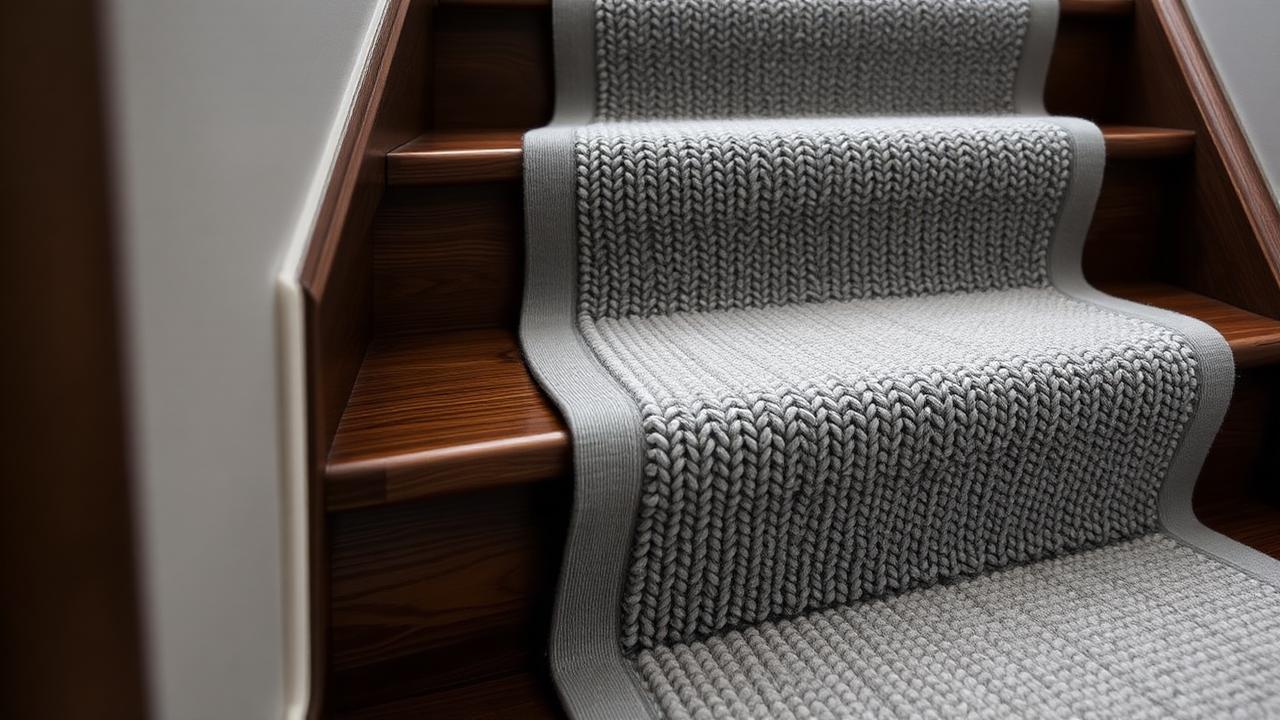
Why nylon is the fitter's default for busy stairs
On the flights I fit that see the most daily footfall, three dogs, four kids, a household running up and down forty times a day, nylon is what goes down more often than any other fibre bar wool. It's a resilient fibre, meaning individual filaments spring back to their original shape after being flattened, which matters enormously on stair treads and nosings where the same three or four square inches get compressed by a foot dozens of times a day. Compare that to polypropylene, which stays crushed once flattened, and you can see why nylon holds its pile height on stairs for years longer under identical use.
Nylon also takes dye exceptionally well, which is why you'll find it in almost any colour and in fine, intricate patterns that a stiffer fibre like sisal simply can't reproduce. Modern nylon runners are usually treated with a stain-resist finish at the mill, which helps with everyday spills but does wear off gradually with repeated hot-water extraction cleaning, so it's worth asking your carpet cleaner to use a pH-neutral solution rather than anything harsh if you want that finish to last.
Nylon versus wool versus polypropylene on stairs
If you've compared prices already you'll know nylon sits in the middle: pricier than polypropylene, usually a bit cheaper than good wool, though premium branded nylons can cost as much as mid-range wool once you add underlay and fitting. What you get for the extra spend over polypropylene is genuine longevity on stairs specifically, since stairs wear fibre far faster than flat flooring does; a nylon runner on a busy main stair commonly lasts 12-15 years where a polypropylene one in the same spot might need replacing at 6-8.
Ask about the twist level, not just the fibre name
Two nylon runners can wear very differently depending on how tightly the yarn is twisted before tufting. A tighter, denser twist resists crushing far better on stair nosings than a soft, loosely twisted pile, even within the same fibre type.
How much runner do I need?
Take the same reference flight fitters use most often: 13 steps, a 10 in tread run and a 7.5 in riser height in US measurements. Add a 0.75 in nosing wrap per step for a standard rounded bullnose, giving 18.25 in per step. Multiply by 13 steps for 237.25 in, then add 24 in total (12 in top, 12 in bottom) for tucking under the landing carpet and finishing at the base. That's 261.25 in, or 21.77 ft. Nylon is durable to cut and handle, so a 6-7% waste margin is usually enough on a plain colourway, bringing the order to about 23.2 ft.

Converted to UK metric, that's a 25 cm tread, 19 cm riser, and 1.9 cm nosing wrap, giving 45.9 cm per step. Across 13 steps that's 596.7 cm, plus a 60 cm finishing allowance for 656.7 cm, and with a 6-7% waste margin the final figure lands close to 6.95-7 m. Patterned nylon with a repeat needs the higher end of that margin, or a touch more, to keep the pattern lined up on every tread.
| Measurement | US (in/ft) | UK (cm/m) |
|---|---|---|
| Tread run | 10 in | 25 cm |
| Riser height | 7.5 in | 19 cm |
| Nosing wrap per step | 0.75 in | 1.9 cm |
| Per-step total | 18.25 in | 45.9 cm |
| 13 steps subtotal | 19.77 ft | 5.97 m |
| Plus finishing allowance | 21.77 ft | 6.57 m |
| With 6-7% waste margin | 23.2 ft | 7 m |
Know your numbers in 30 seconds
Enter your step count, tread depth and riser height — the stair runner calculator gives you the exact length to order, in metres and feet, with waste included.
Open the stair runner calculatorGrades of nylon worth knowing before you buy
Not all nylon is equal, and the branding on a sample card can be more marketing than substance. The two things actually worth asking about are the denier (a measure of fibre thickness, where higher generally means more durable on a stair) and whether it's a solution-dyed or a piece-dyed nylon, with solution-dyed holding colour better under sunlight and repeated cleaning, similar to solution-dyed polypropylene. Some premium ranges use a branded nylon fibre with an added stain-resist and static-resist treatment baked in at the fibre stage rather than sprayed on afterward, which tends to last the life of the carpet rather than wearing off within a couple of years.
- Check the denier or face weight if it's listed, higher generally survives stairs longer.
- Ask whether the dye is solution-dyed or piece-dyed for a sense of colour longevity.
- Request a sample and crease-test it by hand, folding it tightly and checking how quickly it springs back.
- Confirm the backing type; a woven or dense synthetic backing holds a stair rod bracket better than a thin foam one.
- Get a written fibre content and warranty statement from the retailer rather than relying on a verbal description.
Fitting nylon on stairs
Nylon is generally easier to work with on site than a natural fibre because it doesn't fray as readily and holds a crease line cleanly at the tread-to-riser join, which matters on a waterfall installation where the runner runs straight down over the nosing rather than being tucked. On a cap-and-band or Hollywood installation, where the runner is tucked into a groove cut into the tread edge, nylon's slight give makes it a touch easier to dress into the groove neatly compared with a stiffer sisal or seagrass weave.
One practical note from site: nylon pile can build up a small amount of static in dry winter conditions, particularly in centrally heated homes, so if that's a known issue in your house look for a range with an anti-static treatment mentioned on the spec sheet rather than discovering it the hard way on the first frosty week.
For anyone comparing nylon against the wider field of stair runners before committing to an order, it's worth spending ten minutes reading around the different stair runner carpet fibre options, since the right choice really does depend on your household's specific traffic pattern rather than any single fibre being universally best.
Whatever you decide, get the numbers first: the stair runner calculator doubles as a stair runner length calculator, adding nosing wrap, landings, winders, pattern repeat and waste so you order the right length the first time.
Frequently asked questions
Is nylon a good choice for stairs?
Yes, nylon is one of the most resilient synthetic fibres available and holds its pile height on stair nosings far better than polypropylene, which is why it's a common recommendation for busy family staircases.
How long does a nylon stair runner last?
A good-quality nylon runner on a busy main staircase typically lasts 12-15 years before showing significant wear, compared with roughly 6-8 years for budget polypropylene in the same spot.
Is nylon more expensive than polypropylene?
Generally yes, nylon costs more per metre or yard than polypropylene, but it usually needs replacing less often on stairs specifically, which can make the lifetime cost comparable or even lower.
Does nylon stair runner stain easily?
Most modern nylon runners come with a stain-resist treatment applied at the mill, which helps significantly with everyday spills, though the treatment gradually wears off with repeated harsh cleaning over the years.
What is solution-dyed nylon?
It's nylon where the colour is added to the fibre before it's spun rather than dyed onto finished yarn afterward. It typically holds colour better under sunlight and repeated cleaning than piece-dyed nylon.
Can nylon stair runners cause static shocks?
In dry, centrally heated homes some nylon carpets can build a small static charge. Ranges with an anti-static treatment specified on the spec sheet avoid this, so it's worth checking before ordering for a very dry house.
Is nylon or wool better for a stair runner?
Wool generally has a more natural feel and slightly better long-term resilience, but costs more. Nylon offers a strong middle ground on durability at a lower price, and it's usually the better pick for a tight household budget.
How do I clean a nylon stair runner?
Vacuum regularly with the beater bar on an appropriate pile setting, and use a pH-neutral carpet cleaner for spot cleaning to preserve any stain-resist treatment. Avoid harsh alkaline cleaners which strip the finish faster.
Know your numbers in 30 seconds
Enter your step count, tread depth and riser height — the stair runner calculator gives you the exact length to order, in metres and feet, with waste included.
Work out exact yardage with the stair runner length calculatorReady for real prices?
Get quotes from vetted stair runner suppliers and fitters near you. Free, no account, no obligation.
Every guide is written from hands-on measuring and fitting experience, checked against the calculator’s own maths, and re-reviewed whenever prices or methods change. Read our editorial standards.