
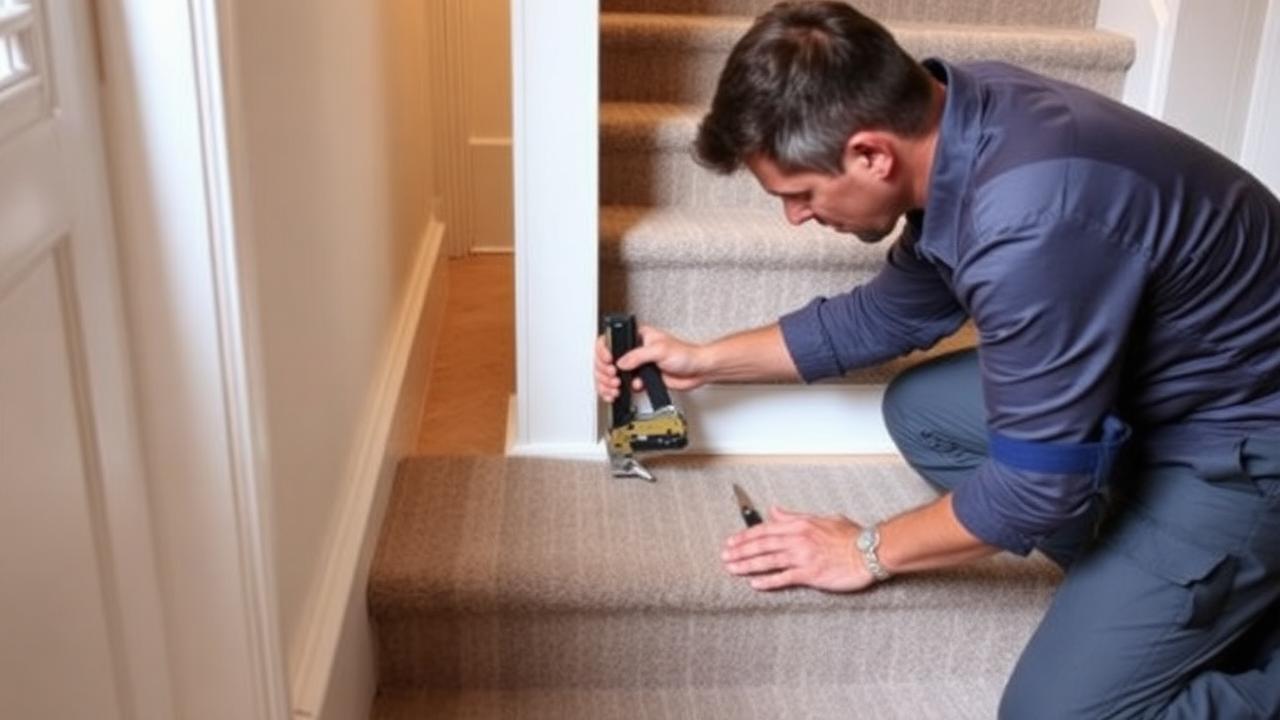
Why skipping underlay is a costly mistake
In my two decades of fitting carpets, the question I get asked most by DIYers is: “Can’t I just staple the runner directly to the wood?” The short answer is yes, you can, but you shouldn't. Underlay is not just about making the stairs feel soft; it is a critical structural component of the entire installation. When you walk on a stair runner that has no underlay, the carpet’s backing is being crushed directly between your foot and the hard surface of the step. This creates an enormous amount of friction. Within a few months, the primary backing of the runner will start to break down, the fibres will come loose, and you will see visible bald patches on the nosing of every step. Skipping underlay is the fastest way to turn a beautiful investment into a piece of scrap carpet.
Furthermore, underlay acts as a stabilizer. A stair runner is under constant tension, and every time you walk on it, you are trying to push it down and forward. Without a dense underlay to grip the backing and absorb that energy, the runner will eventually start to shift. This leads to stretching, which creates dangerous ripples. I have seen hundreds of stair runners that have become trip hazards simply because the owner thought they could save fifty pounds on underlay. When you use a stair runner calculator to budget your project, always factor in a high-quality, high-density underlay as a non-negotiable item. It is the cheapest insurance you can buy for the longevity of your staircase.
Finally, there is the issue of noise and comfort. Wood and concrete are hard, resonant surfaces. Without underlay, every footstep will echo through the house like a drumbeat. Underlay provides a layer of sound absorption that makes the whole home feel quieter and more peaceful. It also makes the stairs much more comfortable for those who walk in bare feet or socks. A staircase with a good underlay feels solid and high-end, while one without feels thin, cheap, and noisy. If you are investing in a beautiful stair runner carpet, you owe it to yourself to provide the foundation it deserves.
How much runner do I need?
Measuring correctly is the first step to a professional finish. Let's look at the standard US figures: for a 13-step flight with a 10 in tread and a 7.5 in riser, plus a 0.75 in nosing wrap, you have 18.25 in per step. Multiplying 18.25 by 13 gives you 237.25 in. You then need to add 24 in total for the top and bottom finishing allowances, reaching 261.25 in (21.77 ft). Including an 8% waste margin for a plain runner, you should order 23.5 ft.
In the UK, the metric equivalent for a 25 cm tread and a 19 cm riser with a 1.9 cm wrap is 45.9 cm per step. Over 13 steps, that’s 596.7 cm. Add a 60 cm finishing allowance, and you get 656.7 cm. Including an 8% waste margin, the final requirement is 7.09 metres. A stair runner length calculator is an invaluable tool here to ensure you don't over-order or, even worse, run out of material before you reach the bottom step.
| Measurement | US (in/ft) | UK (cm/m) |
|---|---|---|
| Tread run | 10 in | 25 cm |
| Riser height | 7.5 in | 19 cm |
| Nosing wrap | 0.75 in | 1.9 cm |
| Per-step total | 18.25 in | 45.9 cm |
| 13 steps | 19.77 ft | 5.97 m |
| Finishing | 21.77 ft | 6.57 m |
| Total (8% waste) | 23.5 ft | 7.09 m |
Know your numbers in 30 seconds
Enter your step count, tread depth and riser height — the stair runner calculator gives you the exact length to order, in metres and feet, with waste included.
Open the stair runner calculatorThe benefits of a professional underlay
When I talk about underlay, I don't just mean any old foam. For stairs, you need something specifically designed for high-traffic areas. The benefits are manifold. First, it creates a much better 'grip.' A high-density underlay (like crumb rubber or felt) has a textured surface that interlocks with the carpet backing, helping to keep it in place. This is especially important on the risers, where the carpet is most likely to sag over time. By using the right underlay, you ensure that the stair runners stay tight and crisp against every surface, which is the hallmark of a professional installation.

Second, it protects your stairs. If you have beautiful hardwood stairs, a runner without underlay can actually damage them. The rough jute backing of a runner acts like sandpaper, scratching the finish of the wood every time someone walks on it. A good underlay provides a soft but firm barrier that protects the wood underneath, which is important if you ever decide to remove the runner in the future. It also prevents the carpet’s dye from potentially bleeding into the wood if it gets wet. In this way, underlay isn't just protecting the carpet; it’s protecting your home's equity.
Finally, consider the sound insulation. Impact noise – the sound of feet hitting the floor – travels through the structure of the house. A dense underlay acts as a shock absorber, significantly reducing the amount of noise that reaches the rooms below or adjacent to the staircase. In a busy family home, this difference is noticeable. It transforms the staircase from a noisy thoroughfare into a quiet, integrated part of the interior design. When you are picking out your stair runner carpet, remember that the underlay is doing half the work of making your home feel quiet and comfortable.
Safety First
The number one cause of stair runner failure is poor underlay choice. Never skip it, and never use an underlay that is too soft or too thick for a staircase. Firm and dense is the rule.
- Underlay doubles the life of your stair runner.
- Prevents the carpet backing from cracking and wearing.
- Provides essential sound insulation for the whole house.
- Protects the wooden stairs underneath from scratches.
- Adds safety by preventing the runner from rippling.
- Makes the stairs much more comfortable for bare feet.
- Allows for a tighter, more professional-looking fit.
- Essential for maintaining the tension of the runner over time.
Exceptions and special cases
Are there any cases where you don't need underlay? Very few. Some extremely thick, felt-backed runners claim they don't need a separate underlay, but even then, I usually recommend a thin layer of rubber for extra grip. The only real exception is if you are using a runner for purely decorative purposes on a stair that is never used – but how many of those exist? In a real home, underlay is a mandatory part of a safe and durable installation. If someone tells you otherwise, they are likely trying to save time on the job at the expense of your carpet's lifespan.
When you are fitting a runner over concrete or metal, the type of underlay and how you fix it changes, but the need for it remains the same. In these cases, you might use a high-strength adhesive to bond the underlay to the stair before stapling or gluing the runner on top. Regardless of the substrate, the underlay provides the necessary buffer that prevents the carpet from failing. So, before you start your project, make sure you have ordered enough high-quality underlay to cover every inch of those stairs. Your future self (and your wallet) will thank you. Using a stair runner calculator early on will help you ensure you have all the components ready for a successful DIY or pro fit.
Frequently asked questions
Is underlay mandatory for a stair runner?
Yes. Without it, your runner will wear out prematurely, lose its shape, and potentially become a trip hazard within months.
Can I use old underlay from another room?
No. Stair underlay must be high-density and in good condition to handle the intense pressure of foot traffic on the nosings.
Does underlay make stairs safer?
Yes, provided you choose a firm, dense underlay. It prevents the runner from shifting and provides a stable surface for walking.
How does underlay protect the carpet?
It acts as a shock absorber, preventing the carpet's backing from being crushed against the hard stair surface, which stops it from cracking and wearing bald.
Will underlay make my stairs quieter?
Significantly. It absorbs the impact noise of footsteps, preventing the 'drumming' sound that often occurs on wooden stairs.
Can I just use a thick carpet instead?
No. Even the thickest carpet needs the support of an underlay to prevent it from stretching and rippling over time.
What is the best underlay for stairs?
Crumb rubber or high-density felt are widely considered the best options for their durability and lack of compression.
Is underlay expensive?
It is a relatively small part of the overall cost but provides the greatest return on investment by doubling the life of your runner.
Know your numbers in 30 seconds
Enter your step count, tread depth and riser height — the stair runner calculator gives you the exact length to order, in metres and feet, with waste included.
Size your runner with the stair runner calculatorReady for real prices?
Get quotes from vetted stair runner suppliers and fitters near you. Free, no account, no obligation.
Every guide is written from hands-on measuring and fitting experience, checked against the calculator’s own maths, and re-reviewed whenever prices or methods change. Read our editorial standards.