

The rise of PU foam in stair installations
Polyurethane foam, commonly known as PU foam, has become the dominant underlay material in the UK and US carpet markets over the last decade. It is manufactured from recycled foam offcuts, which are granulated and then steam-bonded together to create a multi-density product. When it comes to stair runners, PU foam is often chosen for its incredible 'out of the box' comfort. It feels softer and more luxurious than crumb rubber, which many homeowners appreciate when walking around in socks or bare feet. However, as a fitter, I always emphasize that for stairs, the density of the foam is far more important than the thickness.
One of the key advantages of PU foam is its weight. Unlike crumb rubber, which can be back-breaking to carry up three flights of stairs, PU foam is incredibly lightweight. This makes the installation process much easier for DIY enthusiasts and professionals alike. It is also very easy to cut and manipulate, allowing for a very tidy finish around the complicated spindles and turns often found on Victorian or Edwardian staircases. When you are calculating your needs with a stair runner calculator, the ease of handling PU foam means you can often complete the job faster than you would with heavier materials.
Modern PU foam underlays are also designed with better resilience than the foams of twenty years ago. High-density versions, often marketed as 'Super High Density' or 'Contract Grade,' are specifically engineered to withstand the crushing forces present on a staircase. These foams contain more material per cubic metre, meaning they won't squash flat quite as easily. When choosing a PU foam for your stair runners, I always recommend looking for a density rating of at least 100kg/m³ or higher. Anything less than that will likely fail on the nosing within a couple of years, leading to a visible 'trough' where people step most frequently.
How much runner do I need?
Getting the measurements right is essential to avoid waste or, worse, running out of material mid-job. Let's look at the standard US sizing first. For a typical 13-step flight where each step has a 10 in tread and a 7.5 in riser, plus a 0.75 in nosing wrap, you need 18.25 in per step. Multiplying that by 13 gives you 237.25 in. You must then add an allowance for the top and bottom finishes (usually 12 in each), bringing the total to 261.25 in, or 21.77 ft. I always add an 8% waste margin, which brings the final order to roughly 23.5 ft.
In the UK, using metric measurements, a 25 cm tread and a 19 cm riser with a 1.9 cm wrap gives you 45.9 cm per step. For 13 steps, that totals 596.7 cm. Add 60 cm for the top and bottom finishing, and you reach 656.7 cm. With that same 8% waste margin, you should order at least 7.09 metres of stair runner carpet. Using a stair runner length calculator can simplify this process, especially if you have winders or a landing to account for, as those require more complex geometry.
| Measurement | US (in/ft) | UK (cm/m) |
|---|---|---|
| Tread run | 10 in | 25 cm |
| Riser height | 7.5 in | 19 cm |
| Nosing wrap | 0.75 in | 1.9 cm |
| Per-step total | 18.25 in | 45.9 cm |
| 13 steps | 19.77 ft | 5.97 m |
| Finishing | 21.77 ft | 6.57 m |
| Total (8% waste) | 23.5 ft | 7.09 m |
Know your numbers in 30 seconds
Enter your step count, tread depth and riser height — the stair runner calculator gives you the exact length to order, in metres and feet, with waste included.
Open the stair runner calculatorDensity versus thickness: The golden rule for stairs
If there is one piece of advice I give every client, it is this: on stairs, density beats thickness every time. I often see people buying 11mm or even 12mm PU foam, thinking that more thickness equals more luxury. On a staircase, a thick, low-density foam is actually a safety hazard. As you step onto the edge of the stair, a soft foam will compress entirely, causing your foot to shift slightly. This can lead to a loss of balance, especially for children or elderly residents. A 9mm high-density foam is far superior to an 11mm low-density foam because it provides a stable, firm edge that doesn't 'wobble' underfoot.
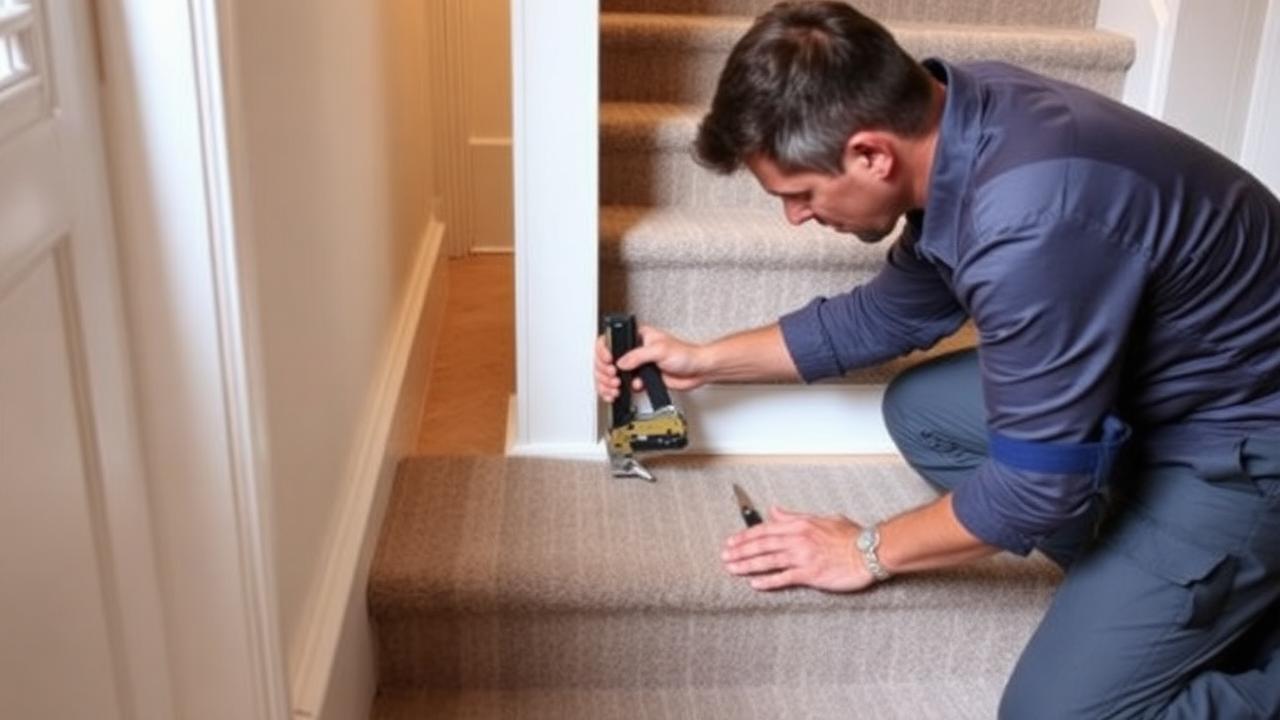
From a fitting perspective, thinner, denser PU foam is also much easier to work with. It allows you to create sharp, crisp corners where the tread meets the riser. A thick underlay often results in a 'bridge' effect, where the carpet doesn't quite sit into the corner, creating a hollow sound when stepped on and increasing the tension on the carpet backing. By using a 8mm or 9mm high-density foam, you ensure that the stair runners sit tight against the wood, which is essential for a professional, long-lasting look. It also makes it much easier to fit stair rods, as the brackets won't be buried deep in a sea of foam.
Thermal insulation is another area where PU foam excels. The tiny air bubbles trapped within the foam act as a barrier to heat loss. If your staircase is located against an exterior wall or in a particularly cold part of the house, a good PU underlay can make a noticeable difference in the temperature of the hallway. Most high-quality PU foams have a tog rating between 2.0 and 3.0, which is significantly higher than crumb rubber. This makes it the ideal choice for those looking to maximize the warmth and energy efficiency of their home, provided they don't have underfloor heating, which requires a lower tog rating to function correctly.
Eco-friendliness and recycled content
A common misconception is that synthetic foams are bad for the environment. In reality, modern PU foam underlay is one of the greenest products in the carpet industry. It is made almost entirely from recycled offcuts from the furniture and automotive industries. Instead of these materials going to landfill, they are shredded and reborn as underlay. Furthermore, PU foam is itself fully recyclable at the end of its life. As a fitter, I find it heartening to see how the industry has moved toward these sustainable practices, and I always encourage my clients to look for products with a high percentage of recycled content.
However, not all recycled products are created equal. Some cheaper PU foams use lower-quality binders that can break down over time, leading to that 'dusty' residue you sometimes see under old carpets. When you are investing in beautiful stair runner carpet, it is worth spending a few extra pounds on a branded, high-quality PU foam from a reputable manufacturer. These products use better bonding agents that ensure the foam remains intact for the full lifespan of your runner, typically ten to fifteen years depending on the traffic levels in your home.
Fitter's Insight
When installing PU foam, I always recommend using a good quality spray adhesive on the treads before stapling. This prevents the foam from sliding during the installation and helps to maintain the tension of the runner over time.
- Excellent 'out-of-the-box' comfort and luxury.
- Highly effective thermal insulation (high tog).
- Lightweight and easy to install for DIYers.
- Made from recycled materials and fully recyclable.
- Available in specific 'Stair' or 'Contract' grades.
- Provides good sound absorption for impact noise.
- Easier to achieve crisp edges on the stairs than thick rubber.
- Cost-effective compared to premium crumb rubber.
Installation tips for a perfect finish
When you are fitting PU foam, the way you cut it around the nosing is crucial. I like to 'feather' the edge of the underlay slightly so that there isn't a sharp drop-off where the underlay ends and the runner touches the stair. This creates a smoother, more elegant transition. Also, be sure to keep the underlay at least half an inch away from the gripper strips if you are using them. If the underlay overlaps the gripper, the carpet won't be able to hook onto the pins properly, and you'll end up with a loose, shifting runner.
Another tip is to pay close attention to the direction of the foam. Some PU foams have a mesh or film on one side; this should almost always face upwards to make it easier for the carpet to slide into position without snagging the foam. If you are using a stair runner calculator to determine your material needs, remember that you also need to order enough underlay to cover every tread and riser, as skimping on the risers is a common mistake that leads to a 'cheap' feel and poor sound insulation.
Finally, always check for any staples that haven't gone in fully. Because PU foam is so soft, it's easy for a staple to sit just slightly above the surface, hidden by the foam's bounce. If a staple is sticking up, it will eventually work its way through the back of your runner, creating a sharp point that can be painful to step on. Run your hand firmly over every step before you lay the carpet to ensure everything is flush and secure. A little bit of extra care during the underlay stage makes the final carpet fitting much smoother.
Frequently asked questions
Is PU foam underlay suitable for stairs?
Yes, but only if you choose a high-density grade specifically designed for high-traffic areas. Low-density foam will flatten quickly on the stair nosings.
What is the best density for stair foam?
Look for a density of at least 100kg/m³. Professional 'contract' grades often go even higher for maximum durability.
Does PU foam provide good insulation?
Yes, it has a higher tog rating than rubber or felt, making it excellent for keeping hallways warm and quiet.
Is it easy to install PU foam yourself?
Very. It is lightweight and easy to cut with a standard utility knife, making it the preferred choice for many DIY projects.
Is PU foam eco-friendly?
Yes, most modern PU foam underlays are made from recycled foam offcuts and are fully recyclable at the end of their life.
Can I use 11mm foam on stairs?
I generally advise against it. An 8mm or 9mm high-density foam is safer and provides a more stable walking surface on the edge of the steps.
How long does PU foam last on stairs?
A high-quality, high-density foam should last 10-15 years, while cheaper grades may need replacing in under 5 years.
Will PU foam stop my stairs from squeaking?
It won't fix structural squeaks in the wood, but it will significantly reduce the sound of footsteps and impact noise.
Know your numbers in 30 seconds
Enter your step count, tread depth and riser height — the stair runner calculator gives you the exact length to order, in metres and feet, with waste included.
Size your runner with the stair runner calculatorReady for real prices?
Get quotes from vetted stair runner suppliers and fitters near you. Free, no account, no obligation.
Every guide is written from hands-on measuring and fitting experience, checked against the calculator’s own maths, and re-reviewed whenever prices or methods change. Read our editorial standards.