

Tools and materials you will need
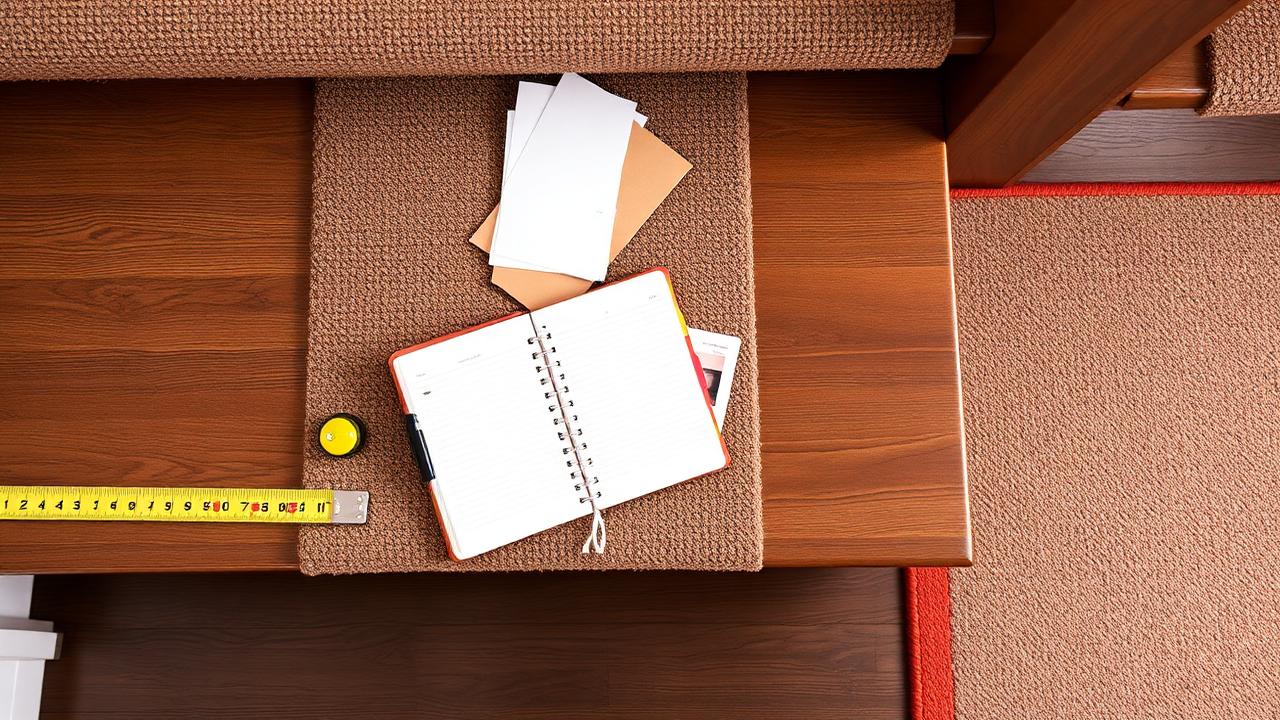
Before you start, gather a tape measure, a staple gun or tackless strip system, a stair tool or wide chisel for tucking the carpet into corners, a utility knife with sharp blades, a knee kicker if you are working with padding, and your underlay of choice, usually felt or rubber. If you are going the traditional route with rods rather than fixed fastening, you will also need your chosen stair rods and their brackets. Having everything laid out before you begin saves constant trips up and down the stairs.
Step 1: Measure and confirm your runner length
Use a stair runner length calculator to confirm exactly how much material you need before cutting anything. It is far cheaper to double-check your numbers than to run short partway through a flight. Remember to measure tread depth, riser height, and add a nosing wrap allowance of roughly 0.75 in (1.9 cm) per step, plus a finishing allowance at the top and bottom of the flight.
Step 2: Fit the underlay
Cut individual pads of underlay for each step, or use a continuous roll if your supplier recommends it. Staple or glue the underlay securely so it does not shift once the runner goes down. The underlay should sit just short of the tread edge so it does not create a visible ridge under the runner.
Step 3: Position and secure the runner
Starting at the top of the flight, align the runner centrally, checking the gap on both sides matches your plan. Working down one step at a time, pull the runner taut and secure it into the crease where the tread meets the riser, using a stair tool to push the fabric firmly into the corner before stapling or fitting a tackless strip. Consistent tension is the key to a smooth, wrinkle-free finish; check every couple of steps that the runner is still centred and taut.
How much runner do I need?
For a 13-step flight in US units: 10 in tread + 7.5 in riser + 0.75 in wrap = 18.25 in per step, totalling 237.25 in across 13 steps. Add 24 in for finishing to reach 261.25 in (21.77 ft), then add an 8-10% waste margin, bringing your order to roughly 23.5-24 ft. In metric: 25 cm + 19 cm + 1.9 cm = 45.9 cm per step, totalling 596.7 cm, plus 60 cm finishing for 656.7 cm, and with waste margin around 7.1-7.3 m.
| Stage | US (in/ft) | UK (cm/m) |
|---|---|---|
| Per-step total | 18.25 in | 45.9 cm |
| 13 steps | 19.77 ft | 5.97 m |
| Plus finishing | 21.77 ft | 6.57 m |
| Plus waste | 23.5-24 ft | 7.1-7.3 m |
Know your numbers in 30 seconds
Enter your step count, tread depth and riser height — the stair runner calculator gives you the exact length to order, in metres and feet, with waste included.
Open the stair runner calculatorStep 4: Finish at the top and bottom
At the top of the flight, the runner is usually tucked under a gripper or folded neatly against the landing. At the bottom, fold the excess under itself and secure it flush with the final riser or the floor, depending on your staircase design. A clean finish at both ends is what separates an amateur job from a professional one, so take your time here rather than rushing the last steps.
Work top to bottom, always
Fitting from the top down keeps the pattern aligned and lets gravity help you keep tension consistent. Starting at the bottom is a common beginner mistake that often results in a runner that drifts off-centre by the top of the flight.
Common fitting mistakes to avoid
The most frequent errors are insufficient tension, which causes visible sagging within weeks; misaligned centring, which becomes obvious under hallway lighting; and skipping underlay to save money, which drastically shortens the life of the carpet. Take the extra hour to do the underlay properly, and check your centring with a tape measure every three or four steps rather than eyeballing it.
- Confirm your total length with a stair runner calculator before cutting.
- Fit underlay before the runner, cut to size for each tread.
- Work from the top of the flight downward for consistent tension.
- Check centring every few steps rather than only at the start.
- Finish both ends neatly, tucking or folding excess fabric cleanly.
Cost bands for DIY versus professional fitting
A DIY fit on a 13-step flight typically costs the price of underlay (about $40-70 or GBP 30-55), a staple gun or tackless strip kit if you do not already own one ($25-60 / GBP 20-45), and any stair rods, which range from $8-25 (GBP 6-20) per rod in basic finishes up to $30-60 (GBP 24-48) per rod for solid brass. A professional fitter typically charges $8-15 per linear foot (GBP 18-30 per metre) for labour alone on a straightforward straight flight, so a 24 ft (7.3 m) run adds roughly $190-360 (GBP 130-220) on top of materials. Winders, half-landings, or very narrow treads push labour toward the top of that range, since each step needs individual templating rather than a repeatable cut.
Spec checks before you buy
Before ordering, confirm four things with your supplier: the pile weight in oz/sq yd or g/sq m (aim for at least 40 oz/sq yd or 1350 g/sq m for stairs, since stairs wear faster than flat flooring), the backing type (a woven or latex-secondary backing resists stretching better than a foam-backed domestic carpet), the recommended underlay thickness (typically 6-9 mm / 0.24-0.35 in for stairs, thinner than a living room underlay to avoid an unstable, spongy nosing), and whether the runner is rated for stairs at all, since some decorative flatweaves are sold for flat floors only and will crush or fray quickly on a nosing edge.
| Fitting route | Typical cost (13 steps) | Time needed |
|---|---|---|
| DIY, staples | $120-220 / GBP 95-175 | One full day |
| DIY, tackless strip | $150-280 / GBP 120-220 | One full day plus prep |
| Professional install | $350-650 / GBP 280-520 | Half a day |
- Keep the beater bar off when vacuuming to protect nosing fibres.
- Re-tension staples or check tackless grip every 12 months on busy stairs.
- Rotate any loose stair rods slightly each year to even out wear marks.
- Blot spills immediately rather than scrubbing to avoid pile distortion.
- Schedule a professional deep clean every 12-18 months for wool runners.
Whatever you decide, get the numbers first: the stair runner calculator doubles as a stair runner length calculator, adding nosing wrap, landings, winders, pattern repeat and waste so you order the right length the first time.
Still deciding on material, width or pattern? Our hub on stair runners compares weaves, widths, backings and fitting styles side by side, then hands the numbers straight to the calculator.
Frequently asked questions
Can I fit a stair runner myself without professional experience?
Yes, many homeowners fit their own runners successfully, though a helper makes holding tension easier.
Do I need underlay when fitting a stair runner?
Yes, underlay significantly extends the life of the carpet and improves comfort and sound insulation.
How long does it take to fit a 13-step runner?
Budget a full day for a first-time DIY fit, including underlay and finishing details.
Should I use staples, tackless strips, or rods?
All three work; staples and tackless strips are hidden and modern, while rods add a traditional decorative element.
What is the biggest mistake beginners make?
Losing tension partway down the flight, which causes visible sagging and wrinkles.
How do I keep the runner centred?
Measure the gap on both sides every few steps rather than relying on visual judgement alone.
Can I fit a runner over an existing stair carpet?
It is possible in some cases, but it usually looks bulky; removing the old carpet first gives a cleaner result.
What tools are essential for fitting?
A staple gun or tackless strips, a stair tool for tucking corners, a sharp utility knife, and a tape measure.
Know your numbers in 30 seconds
Enter your step count, tread depth and riser height — the stair runner calculator gives you the exact length to order, in metres and feet, with waste included.
Plan your fit with the stair runner calculatorReady for real prices?
Get quotes from vetted stair runner suppliers and fitters near you. Free, no account, no obligation.
Every guide is written from hands-on measuring and fitting experience, checked against the calculator’s own maths, and re-reviewed whenever prices or methods change. Read our editorial standards.