

Why turns and winders need special treatment
A straight flight of stairs has uniform treads and risers, which makes calculating and fitting a runner relatively straightforward. A staircase with a turn introduces winders: pie-shaped or angled treads that are narrower on the inside of the turn and wider on the outside. Because the runner has to travel over the widest point of each winder to maintain a consistent visual width, you need more material than a simple straight-flight calculation would suggest, and the fitting itself takes considerably more skill and time.
Calculating extra material for a turn
Start with your straight-flight calculation as a baseline. For a 13-step flight with 10 in treads and 7.5 in risers, the straight-run total is 10 in + 7.5 in + 0.75 in nosing wrap = 18.25 in per step, times 13 steps for 237.25 in, plus 24 in finishing, giving 261.25 in (21.77 ft). Now, if three of those steps are winders forming a quarter-turn, each winder consumes noticeably more runner width-wise and requires extra length to navigate the pivot point cleanly. As a rule of thumb, add 10-15% more material for a quarter-turn with 2-3 winders, and 20-25% more for a half-turn or a full staircase with a mid-flight landing and turn. For our 13-step example, this brings the total to roughly 26-28 ft (8-8.5 m). Metric: the straight-run baseline of 656.7 cm (with 10% waste already at 7.3 m) becomes approximately 8-8.5 m once winder allowance is added.
| Turn Type | Extra Material Needed | 13-Step Example |
|---|---|---|
| Straight flight (no turn) | Baseline | 24 ft / 7.3 m |
| Quarter-turn (2-3 winders) | +10-15% | 26-28 ft / 8-8.5 m |
| Half-turn or landing + turn | +20-25% | 29-30 ft / 8.8-9.1 m |
Know your numbers in 30 seconds
Enter your step count, tread depth and riser height — the stair runner calculator gives you the exact length to order, in metres and feet, with waste included.
Open the stair runner calculatorCost impact of turns and winders
Winders do not just consume more material, they also take considerably longer to fit, and labour is priced accordingly. Where a straight 13-step flight might cost $100-$200 (GBP 75-160) in labour, the same flight with a quarter-turn of 2-3 winders typically runs $180-$320 (GBP 140-250), and a half-turn with a mid-flight landing can push labour to $280-$450 (GBP 220-350). This reflects the extra time needed to measure each winder individually, cut and piece the runner, and maintain a consistent visual width through the turn.
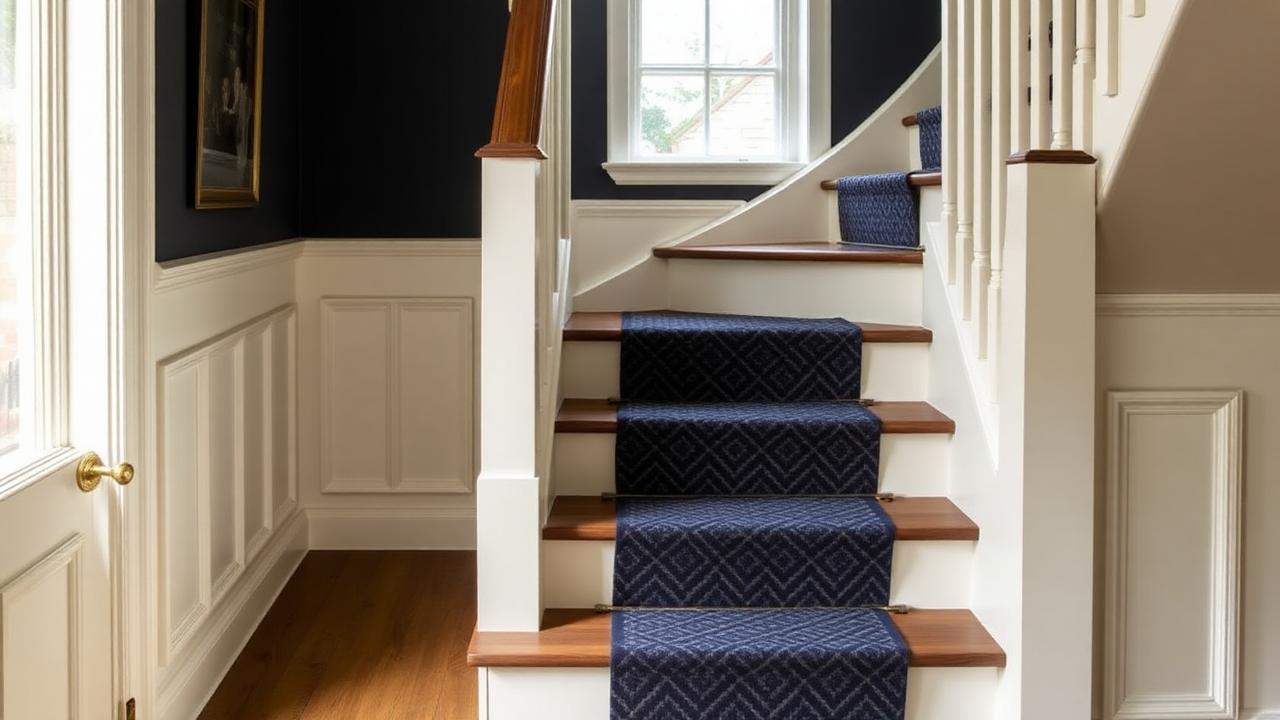
Material cost rises in step with the extra length. Using the mid-range wool-blend price of roughly $35-45 per foot (GBP 25-35 per metre), the straight-flight material cost of $840-$1,080 (GBP 580-750) for 24 ft (7.3 m) becomes roughly $910-$1,260 (GBP 630-875) for a quarter-turn needing 26-28 ft (8-8.5 m), and $1,015-$1,350 (GBP 700-940) for a half-turn needing 29-30 ft (8.8-9.1 m).
Signs a turn needs a professional fitter
- More than one winder in the turn, especially on an older or settled staircase
- A patterned runner that must align visually across the turn
- A mid-flight landing combined with a change of direction
- Any uncertainty about where to hide the seam neatly
- Limited experience with a knee kicker on angled, narrow treads
| Configuration | Extra Labour Cost | Extra Material Cost |
|---|---|---|
| Straight (baseline) | $0 | $0 |
| Quarter-turn, 2-3 winders | +$80-$120 / GBP 65-95 | +$70-$180 / GBP 50-125 |
| Half-turn with landing | +$180-$250 / GBP 145-195 | +$175-$270 / GBP 120-190 |
Fitting the winder section
The winder section is where a professional fitter earns their fee. Each pie-shaped tread must be measured individually, since no two winders in a flight are ever perfectly identical once the staircase has settled over the years. The runner is cut and pieced section by section, often with a seam hidden in the tightest part of the turn or beneath a stair rod, where it is least visible. Consistent width down the centre of the flight is the key visual goal; a runner that visibly narrows or widens as it crosses the turn looks unfinished no matter how well it is otherwise fitted.
Key techniques for a clean turn
- Measure each winder tread individually rather than assuming uniformity.
- Keep the runner centred and consistent in width throughout the turn.
- Hide any seams in the tightest part of the turn or under a stair rod.
- Use extra tackless strip on the angled cuts of winder treads for a secure hold.
- Dry-fit sections before final stapling or tacking to check alignment.
Consider a professional fitter for turns
Winders are widely regarded as the most technically demanding part of stair runner installation. Even experienced DIYers often bring in a professional specifically for the turn while handling the straight sections themselves.
Ordering the right amount of runner
Because winder sections consume more material unpredictably, always err on the side of ordering extra, particularly if your runner has a directional pattern that needs to align through the turn. A shortfall discovered mid-installation, especially with a runner from a specific dye lot, can delay your project by weeks while you wait for a matching reorder.
Use the stair runner calculator to establish your straight-run baseline first, then apply the 10-25% turn allowance depending on your staircase configuration, and always round up rather than down when placing your final order.
Whatever you decide, get the numbers first: the stair runner calculator doubles as a stair runner length calculator, adding nosing wrap, landings, winders, pattern repeat and waste so you order the right length the first time.
Still deciding on material, width or pattern? Our hub on stair runners compares weaves, widths, backings and fitting styles side by side, then hands the numbers straight to the calculator.
Frequently asked questions
How much extra runner do I need for a staircase with a turn?
Typically 10-15% more for a quarter-turn with 2-3 winders, and 20-25% more for a half-turn or landing-plus-turn configuration.
Are winder treads all the same size?
No, winders vary slightly across most staircases, especially older builds, so each should be measured individually.
Can I install a runner over winders myself?
It is possible but challenging. Many DIYers handle the straight sections themselves and hire a professional for the turn.
Where should seams be placed on a turn?
In the tightest part of the winder or hidden beneath a stair rod, where they are least visible.
Does a patterned runner make turns harder to fit?
Yes, aligning a directional pattern through a turn requires more material and more precise cutting than a plain runner.
How do I keep the runner width consistent through a turn?
Keep the runner centred on each winder tread and consistently measure from the same reference point throughout the turn.
What tools help with winder installation?
A stair tool for tucking tight creases, sharp shears or a utility knife, and extra tackless strip cut to angled shapes.
Should I order extra for a directional pattern on a turn?
Yes, order at least 15-20% extra beyond your calculated length to allow for pattern matching across winder treads.
Know your numbers in 30 seconds
Enter your step count, tread depth and riser height — the stair runner calculator gives you the exact length to order, in metres and feet, with waste included.
Plan your turn with the stair runner calculatorReady for real prices?
Get quotes from vetted stair runner suppliers and fitters near you. Free, no account, no obligation.
Every guide is written from hands-on measuring and fitting experience, checked against the calculator’s own maths, and re-reviewed whenever prices or methods change. Read our editorial standards.