

What the nosing detail actually is
The nosing is the rounded or bullnosed front edge of each tread, and it's the single hardest-working part of any staircase, taking direct impact from every foot that lands on the step. The nosing detail refers to how the runner fabric wraps that curved edge: enough carpet needs to come up and over the round, and slightly under, so the gripper strip fixed just below the nosing can catch and hold it firmly, while leaving a clean, taut curve visible rather than a loose fold or a strip that stops short and exposes bare wood.
Get the wrap allowance wrong in either direction and it shows immediately. Too little, and the runner pulls tight across the nosing, exposing a sliver of bare wood at the front edge or pulling away from the gripper within months of foot traffic tugging at it. Too much, and the extra fabric bunches slightly at the nosing, creating a soft ridge that looks untidy and, worse, wears unevenly because the bunched section takes more direct impact than a flat-fitted wrap would.
Standard allowance by nosing profile
Most modern stairs have a rounded bullnose profile with roughly a 0.5-0.75 in (1.3-1.9 cm) radius, and for these a 0.75 in (1.9 cm) wrap allowance per step works well as a default. Older or grander staircases sometimes have a deeper, more pronounced bullnose, occasionally with a decorative scotia moulding underneath, and these need a slightly larger allowance, up to 1 in (2.5 cm), to wrap fully without pulling. Square-edged or minimally rounded modern treads, more common on newer builds with a simple chamfered edge rather than a full curve, need less, sometimes as little as 0.5 in (1.3 cm).
| Nosing profile | Recommended wrap allowance |
|---|---|
| Standard rounded bullnose | 0.75 in / 1.9 cm |
| Deep or period bullnose with scotia | 1 in / 2.5 cm |
| Square or lightly chamfered edge | 0.5 in / 1.3 cm |
| Pencil-round modern edge | 0.6 in / 1.5 cm |
Measure your actual nosing profile, don't assume
Run a finger along the front edge of a couple of treads on your own staircase before ordering. A shallow, tight curve needs less wrap allowance than a deep, rounded Victorian bullnose, and using the wrong default wastes carpet or leaves a gap.
How much runner do I need?
Nosing wrap allowance is baked into the per-step calculation, so getting the profile right changes your total length. Take a 13-step US flight with a deep period bullnose: 10 in tread run, 7.5 in riser height, and a 1 in nosing wrap (rather than the standard 0.75 in), giving 19.25 in per step. Across 13 steps that's 250.25 in (20.85 ft). Add a 24 in finishing allowance for 274.25 in (22.85 ft), then a 7% waste margin brings the total to roughly 24.5 ft, noticeably more than the same flight would need with a standard 0.75 in wrap, which lands closer to 23.3 ft.
In UK measurements, the same 13-step flight with a 2.5 cm deep-bullnose wrap uses 25 cm tread run, 19 cm riser height, giving 46.5 cm per step, or 604.5 cm across 13 steps. Add a 60 cm finishing allowance for 664.5 cm, then a 7% waste margin brings the total to roughly 7.11 m, compared to about 7.03 m for the same flight with a standard 1.9 cm wrap. The difference looks small per step but adds up across a full flight, which is exactly why nosing profile should be measured before ordering rather than assumed.
Know your numbers in 30 seconds
Enter your step count, tread depth and riser height — the stair runner calculator gives you the exact length to order, in metres and feet, with waste included.
Open the stair runner calculatorFitting the wrap cleanly
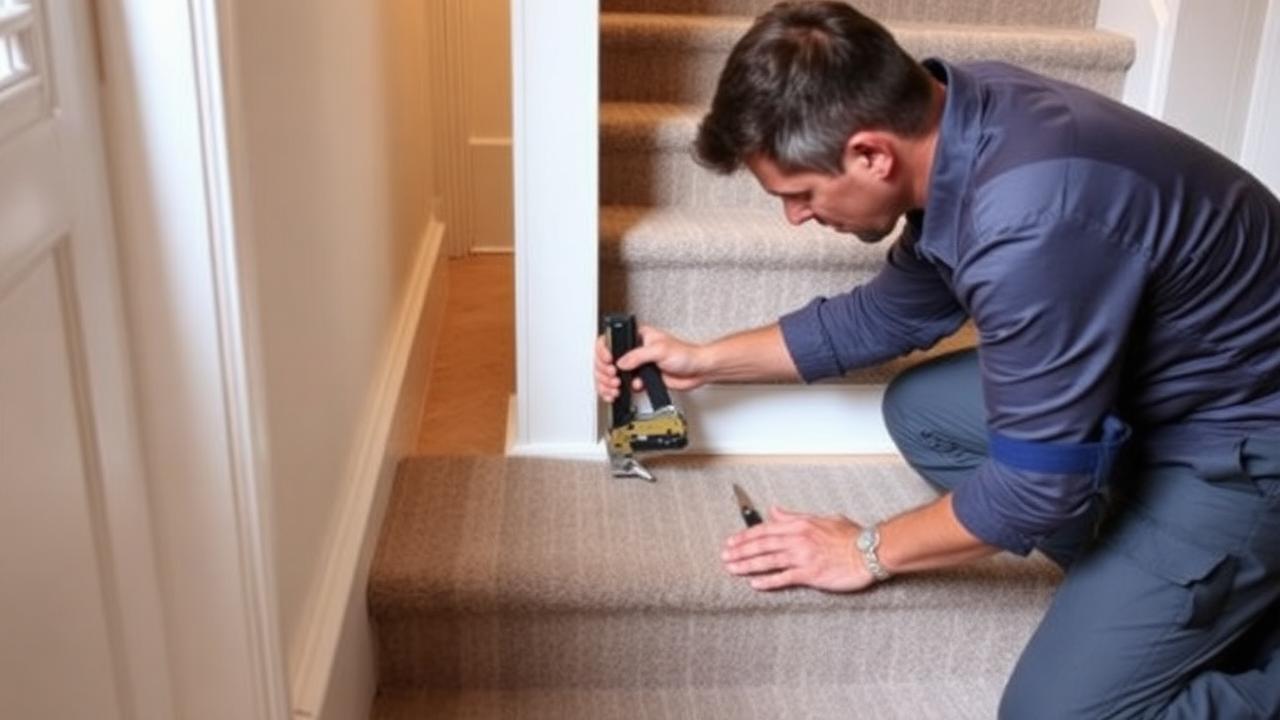
- Position the gripper strip at the base of the riser, close enough to the nosing that the wrap fabric reaches it without stretching, but not so close it sits under the curve itself.
- Pull the runner taut over the nosing before fixing, working from the centre of the step outward to avoid a diagonal pull that skews the wrap to one side.
- Check the wrap sits flush against the curve with no visible gap and no bunching, running a hand along the edge to feel for lumps before final fixing.
- On a deep bullnose with a scotia moulding, tuck the extra fabric into the moulding's own recess rather than letting it sit proud over the top.
- Repeat the check on every step individually rather than assuming the first step's fit will match the rest, since minor variations in tread shape are common even on newer stairs.
Why nosing wear is usually a fitting problem, not a fibre problem
Most premature wear at the nosing, a runner thinning or flattening right at the front edge of a step long before the rest of the flight shows any wear, traces back to an incorrect wrap allowance rather than a poor-quality carpet. A wrap that's too tight stretches under repeated footfall and thins faster at exactly the point of maximum tension. A wrap that's bunched from too much allowance takes uneven impact and compresses faster in the bunched section than in a flat-fitted wrap. Both problems are avoidable at the measuring and cutting stage, well before the runner ever gets fitted, which is why nosing detail deserves more attention up front than most guides give it.
Before ordering, measure your actual nosing profile and run it through a stair runner calculator alongside your tread run and riser height, since a generic default allowance can leave you noticeably short or with excess fabric depending on your specific stair profile. Stair runner carpet bought with the correct wrap allowance built in from the start fits tighter, wears more evenly, and needs re-fixing at the nosing far less often than one measured with a rough, one-size-fits-all guess.
Whatever you decide, get the numbers first: the stair runner calculator doubles as a stair runner length calculator, adding nosing wrap, landings, winders, pattern repeat and waste so you order the right length the first time.
Frequently asked questions
How much extra runner do I need for the nosing wrap?
Typically 0.6-1 in (1.5-2.5 cm) per step, depending on how deep and rounded your tread's front edge is. A standard modern bullnose needs about 0.75 in (1.9 cm), while a deep period bullnose with a scotia moulding needs closer to 1 in (2.5 cm).
What happens if the nosing wrap allowance is too small?
The runner pulls tight across the curved edge, which can expose a sliver of bare wood at the front and puts extra tension on the fabric right at the point of maximum foot impact, causing it to thin and wear out faster than the rest of the flight.
What happens if the nosing wrap allowance is too large?
The extra fabric bunches slightly at the curve, creating a soft ridge that looks untidy and wears unevenly, since the bunched section takes more direct impact from footsteps than a flat, correctly-fitted wrap would.
Do all stair treads have the same nosing profile?
No. Standard modern bullnose treads need around 0.75 in (1.9 cm) wrap, deep period bullnoses with a scotia moulding need closer to 1 in (2.5 cm), and square or lightly chamfered modern edges need as little as 0.5 in (1.3 cm).
How do I check my staircase's nosing profile before ordering a runner?
Run a finger along the front edge of a couple of treads to feel how deep and rounded the curve is, and compare it against a standard bullnose reference. This takes a couple of minutes and prevents ordering the wrong wrap allowance for your specific stairs.
Why is nosing wear usually a fitting issue rather than a carpet quality issue?
Most premature nosing wear traces back to an incorrect wrap allowance at the cutting stage, either too tight and stretched or too loose and bunched, rather than to the fibre itself. Correct measurement before fitting prevents most of this wear entirely.
Does nosing wrap allowance change how much total runner I need to order?
Yes, noticeably across a full flight. A deeper bullnose needing 1 in (2.5 cm) of wrap per step instead of the standard 0.75 in (1.9 cm) adds roughly a foot to the total order on a typical 13-step staircase once finishing allowance and waste are included.
Should the gripper strip sit right up against the nosing curve?
No, it should sit at the base of the riser, close enough that the wrap fabric reaches it without stretching, but not directly under the curve itself, which would prevent the fabric from wrapping the nosing cleanly before being caught and held.
Know your numbers in 30 seconds
Enter your step count, tread depth and riser height — the stair runner calculator gives you the exact length to order, in metres and feet, with waste included.
Include the correct nosing allowance automatically with the stair runner calculatorReady for real prices?
Get quotes from vetted stair runner suppliers and fitters near you. Free, no account, no obligation.
Every guide is written from hands-on measuring and fitting experience, checked against the calculator’s own maths, and re-reviewed whenever prices or methods change. Read our editorial standards.