
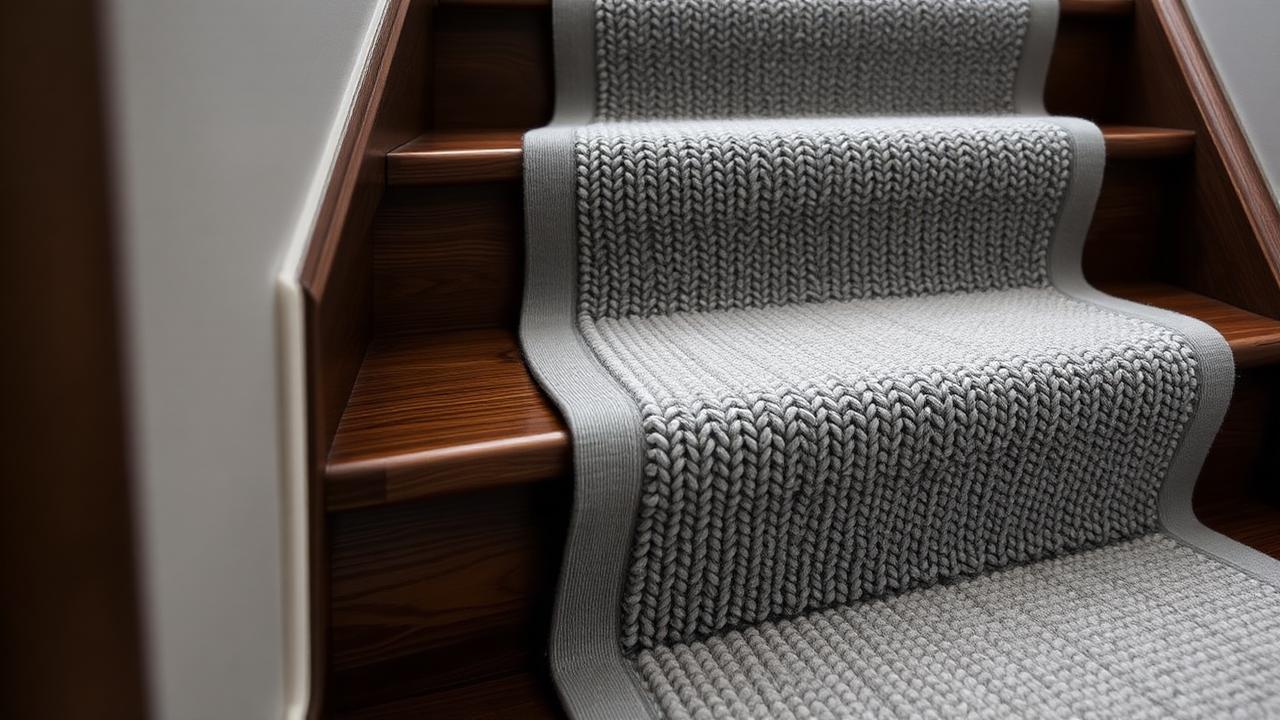
Full leather stairs vs leather inlay: two different products
It's worth separating these clearly before pricing anything. A full leather-clad tread — the whole width and depth of the step covered in leather — is a bespoke joinery product usually fitted by a specialist stair or upholstery contractor, typically on open-tread or feature staircases rather than a traditional carpeted flight. A leather inlay is a narrow strip, usually 20-80mm, set into the centre or along the edge of a carpet, sisal or timber runner, used the way a contrast border is used: as a design detail, not as the wearing surface itself.
| Format | What it is | Where it suits | Durability on stairs |
|---|---|---|---|
| Full leather tread covering | Leather wraps the whole tread and nosing | Open, contemporary or feature staircases, light-to-moderate traffic | Wears at the nosing edge; needs periodic reconditioning |
| Leather inlay strip | Narrow leather band set into carpet or timber | Any staircase as a design accent | Very durable — it isn't the primary wearing surface |
| Leather-bound carpet edge | Leather tape replaces cloth binding on a runner's sides | Traditional to industrial-style interiors | Durable; only the outer 15-25mm is leather |
Why full leather on stairs is a specialist call
Leather is not a soft flooring material and stairs are the single hardest place in a house to put a hard, smooth, natural-hide surface: every descending step lands with concentrated force right on the nosing, which is exactly where leather's face coating and grain are thinnest and most exposed. Full leather treads can and do work, particularly with a textured or embossed hide and a matt rather than high-gloss finish for slip resistance, but they need a genuine specification conversation with a supplier about hide thickness, finish and anti-slip treatment before ordering — this is not a like-for-like swap for carpet.
Slip resistance is the real question, not looks
Smooth or highly finished leather on a stair nosing is measurably more slip-prone than carpet or a textured natural fibre, particularly in socks or with any moisture on the sole. Any full leather stair specification should include a tested anti-slip finish and, ideally, a textured or embossed hide rather than a smooth polished one.
Leather as an inlay or edge: the popular version
This is where leather earns its keep on most staircases. A leather strip inlaid down the centre of a stone or timber stair, or set as a contrast band inside a carpet runner, adds a warm, tactile line without putting leather anywhere a foot actually lands directly and repeatedly at an angle. Leather binding tape used in place of cotton or linen tape on a carpet runner's outer edge gives the same warm detail at the edge, where wear is lower than at the centre of the tread.
- Choose a full-grain or top-grain hide at 1.2-2mm thickness for inlay strips — thinner splits and cracks at the fold over the nosing.
- Ask for a UV-stable, water-resistant finish; untreated leather marks permanently from spilled liquid.
- Vegetable-tanned leather ages with a rich patina but is softer and marks more easily than chrome-tanned.
- Have inlay strips fitted by the same tradesperson doing the carpet or timber work, not as a separate later job — alignment errors compound up a flight.
Sound, feel and patina
Leather underfoot on stairs, even as a border, has a firmer, more tactile presence than carpet and no acoustic dampening — a full leather tread is noticeably louder underfoot than carpet, closer to timber. Patina develops with use: high grain leathers darken and soften attractively over years, which suits a traditional or characterful interior far better than a pristine modern one where an even, unmarked surface is the goal.
What it costs
| Item | 13-step flight, approx. |
|---|---|
| Full leather tread covering (mid-grade hide) | £2,400-6,000 / $3,200-8,000 |
| Leather inlay strip added to carpet runner | £200-600 / $270-800 |
| Leather binding tape replacing cloth binding | £150-450 / $200-600 |
Know your numbers in 30 seconds
Enter your step count, tread depth and riser height — the stair runner calculator gives you the exact length to order, in metres and feet, with waste included.
Open the stair runner calculatorMaintenance
Full leather treads need periodic conditioning with a leather-specific cream to stop the surface drying and cracking at the fold over the nosing — every 6-12 months is typical. Leather inlays and binding need far less: an occasional wipe and the same conditioning schedule, since they take much less direct foot pressure than a full covering.

Leather stair runners in different climates
Leather is more climate-sensitive than carpet or synthetic flooring, and this matters more on a staircase than on a flat floor because a leather tread or inlay experiences repeated flexing at the nosing in addition to whatever the ambient humidity is doing to the hide. In consistently humid climates, leather can absorb moisture and soften unpredictably, while in very dry, centrally heated homes over winter, leather can dry out and become brittle at the fold unless conditioned more frequently than the standard 6-12 month schedule. If you're considering leather for a staircase in a climate with pronounced seasonal humidity swings, budget for more frequent conditioning than the general maintenance guidance above assumes.
Combining leather with a carpet stair runner carpet
The most common real-world use of leather on a staircase, as covered above, is as an accent within a broader carpet installation rather than as the primary surface, and this combination is worth planning as a single coordinated order rather than two separate purchases. Order the leather inlay or binding tape alongside the carpet stair runner carpet itself so the fitter can install both in one visit and confirm the leather element sits flush and consistent with the carpet's pile height, since a leather strip proud of or recessed below the surrounding carpet pile is a common, avoidable fitting defect when the two elements are sourced and installed separately.
Cost drivers within leather inlay pricing
The wide price range quoted for leather inlay strips reflects several variables worth understanding before you get a quote: hide grade (full-grain costs meaningfully more than corrected-grain or bonded leather), width (a wider inlay uses proportionally more hide), and finishing (a hand-stitched inlay costs more than a machine-applied one). When comparing quotes from different suppliers, ask specifically which of these variables differ between them, since two quotes that look far apart in price sometimes reflect genuinely different hide grades rather than one supplier simply being more expensive for the same product.
Planning the rest of the staircase around a leather accent
Because a leather inlay or binding is a design accent rather than the primary wearing surface, get the surrounding carpet or stair runner sized correctly first, then treat the leather element as an addition to an already-correct plan rather than the starting point. Measure your flight with a stair runner calculator to establish the base runner width and length, and only then decide how a leather inlay strip or binding tape fits within that already-confirmed layout, since resizing the carpet after a leather element has been ordered to a specific width is more disruptive than the reverse.
Whatever you decide, get the numbers first: the stair runner calculator doubles as a stair runner length calculator, adding nosing wrap, landings, winders, pattern repeat and waste so you order the right length the first time.
Frequently asked questions
Can you put leather on stairs?
Yes, as a full tread covering on open or feature staircases, or more commonly as an inlay strip or edge binding within a carpet or timber runner. Full leather needs a specialist supplier and a tested anti-slip finish.
Is leather slippery on stairs?
Smooth or high-gloss leather is more slip-prone than carpet or textured natural fibre, especially in socks. Choose a textured or embossed hide with a tested anti-slip finish for any full leather stair application.
How much does a leather stair runner cost?
A full leather tread covering for a 13-step flight is roughly £2,400-6,000 or $3,200-8,000. A leather inlay strip added to a carpet runner is far less, around £200-600 or $270-800.
What's a leather inlay stair runner?
A narrow leather strip, typically 20-80mm wide, set into the centre or edge of a carpet, sisal or timber runner as a design accent rather than the main wearing surface.
How durable is leather on stairs?
As a full covering, moderate — the nosing edge wears fastest and needs periodic conditioning. As an inlay or edge binding, very durable, because it takes far less direct foot pressure than a full tread surface.
Does leather need special care on stairs?
Full leather treads benefit from conditioning every 6-12 months to stop cracking at the nosing fold. Inlay strips and edge binding need only occasional wiping and less frequent conditioning.
What type of leather is best for stairs?
Full-grain or top-grain hide at 1.2-2mm, textured or embossed rather than smooth, with a water-resistant finish. Vegetable-tanned leather patinas beautifully but marks more easily than chrome-tanned.
Is leather quieter or louder than carpet on stairs?
Louder. Leather has no acoustic dampening the way carpet pile and underlay do, so a full leather tread sounds and feels closer to timber underfoot.
Know your numbers in 30 seconds
Enter your step count, tread depth and riser height — the stair runner calculator gives you the exact length to order, in metres and feet, with waste included.
Estimate leather vs carpet costReady for real prices?
Get quotes from vetted stair runner suppliers and fitters near you. Free, no account, no obligation.
Every guide is written from hands-on measuring and fitting experience, checked against the calculator’s own maths, and re-reviewed whenever prices or methods change. Read our editorial standards.