
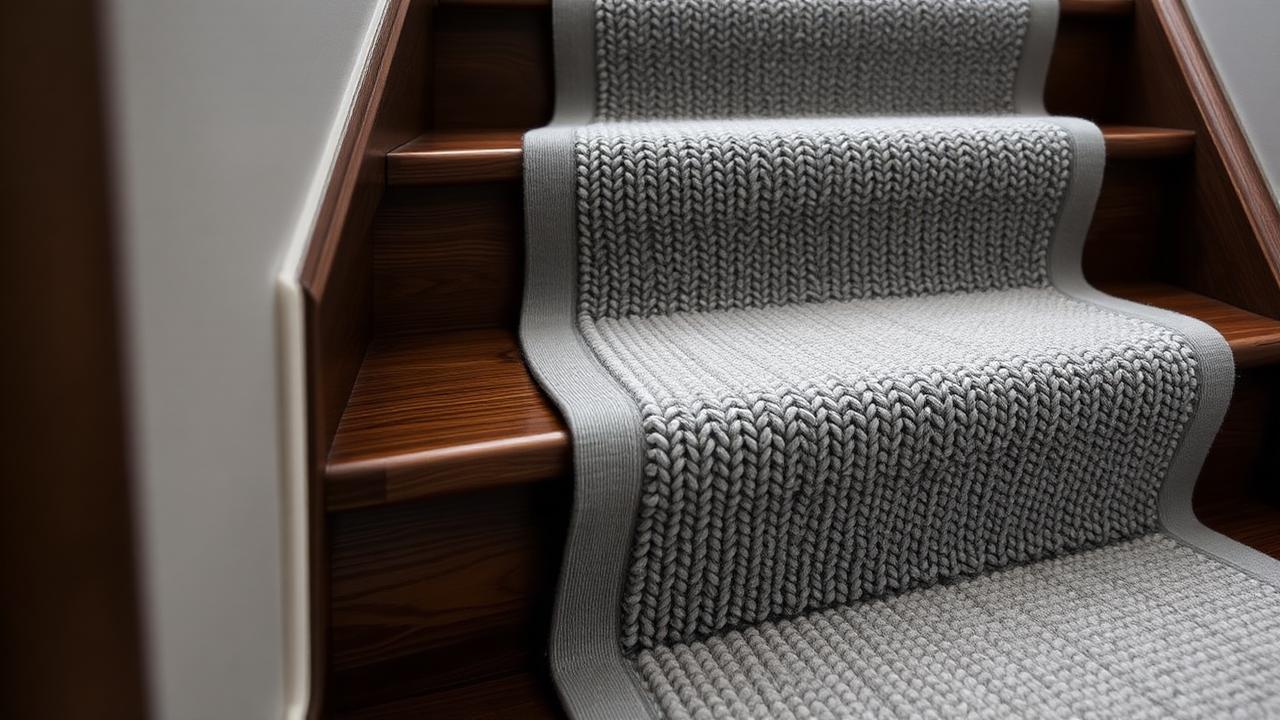
What 'pet-proof' actually needs to resist
Pet damage on stairs isn't one problem, it's at least four separate ones, and no single fibre solves all four perfectly. There's claw snagging from cats and puppies, there's flattening wear from repeated paw traffic, particularly from larger dogs, there's staining and odour from accidents, and there's grip, or the lack of it, which affects the animal's safety as much as the carpet's condition. A material that's brilliant on one front, like a soft plush wool being warm and cosy, can be genuinely poor on another, like grip, so the right choice always depends on weighing which of these four risks matters most in your specific household.
I generally sort households into three rough categories: mostly-dog homes where grip and flattening wear are the priority, mostly-cat homes where claw-snag resistance in the weave matters most, and multi-pet or puppy-and-child households where stain resistance and durability against several failure modes at once matter more than optimising for any single one.
Fibre-by-fibre comparison
| Material | Claw/chew resistance | Stain resistance | Grip | Typical cost |
|---|---|---|---|---|
| Dense wool, cut pile | Very good | Good with treatment | Good | Higher |
| Wool-blend twist | Good | Good with treatment | Good | Mid-high |
| Solution-dyed nylon | Good | Very good | Good | Mid |
| Polypropylene Berber | Fair (loop risk) | Very good | Good | Lower |
| Loop-pile wool | Poor (snag risk) | Fair | Very good | Mid-high |
| Sisal/jute | Poor | Poor | Fair | Mid |
| Plush/shaggy cut pile | Fair | Fair | Poor | Mid |
The pattern in that table is fairly consistent: anything with prominent loops trades away claw and chew resistance in exchange for grip, and anything very soft and plush trades away both grip and durability for comfort underfoot. Dense, tightly twisted cut-pile constructions, whether wool or synthetic, are the closest thing to an all-round compromise, which is why they turn up repeatedly as the recommended choice across dog, cat and puppy households alike.
Underlay and fixing are half the pet-proofing
Even the best fibre choice underperforms if it's sitting on a soft domestic underlay pad and fixed with loosely tensioned stair rods. A firm, stair-rated felt or rubber-crumb underlay resists the concentrated point-loading of paws and claws far better than a plush cushioned pad meant for a bedroom floor, and it also reduces the flexing that lets a runner shift slightly underfoot, which is where a lot of edge-lifting and subsequent snagging starts. Gripper-rod fixing, run the full width of each tread, holds a runner flatter and tighter than tacking at intervals, leaving fewer opportunities for a claw or tooth to find a loose spot.

- Choose a dense, cut-pile or tightly twisted weave over any loose loop-pile construction.
- Apply a stain-guard treatment at order time, not as an afterthought later.
- Specify a firm, stair-rated underlay rather than a standard soft domestic pad.
- Use full-width gripper-rod fixing rather than intermittent tacking or loose stair rods.
- Pick a mid-tone or patterned colour to disguise everyday marks between deep cleans.
No material is fully claw or chew proof
Even the most durable dense wool-blend will show some texture change over years of pet use. The goal of choosing pet-proof materials is extending the runner's useful life by years, not achieving total immunity from wear.
How much runner do I need?
Working in US measurements for a 13-step flight, 10 in tread run, 7.5 in riser, and a 0.75 in nosing wrap: each step needs 18.25 in, giving 237.25 in across 13 steps, or 19.77 ft. Add a 24 in finishing allowance to reach 21.77 ft, then a 7% waste margin lands you at roughly 23.3 ft, so order 23-24 ft. Pet households often benefit from ordering a slightly larger offcut beyond the standard waste margin, since a spare patch of matching material makes future repairs to a heavily used tread far easier than trying to source a colour-matched remnant years later.
In UK metric terms: 25 cm tread run, 19 cm riser and 1.9 cm nosing wrap gives 45.9 cm per step, 596.7 cm across 13 steps, plus a 60 cm finishing allowance for 656.7 cm, and a 7% waste margin brings the total to about 7.03 m. If your household has more than one type of pet, size generously and lean toward the higher end of that waste range, since multi-pet homes tend to put more varied stress on a runner than a single-pet household does.
Know your numbers in 30 seconds
Enter your step count, tread depth and riser height — the stair runner calculator gives you the exact length to order, in metres and feet, with waste included.
Open the stair runner calculatorWeighing cost against real-world durability
It's tempting to default to the cheapest polypropylene option for a pet household purely on the logic that it'll get damaged anyway, but that's not always the most economical choice over time. A mid-range solution-dyed nylon or a well-chosen wool-blend often lasts long enough in a pet household to work out cheaper per year than replacing a budget polypropylene runner twice in the same period, particularly in the areas that see the heaviest paw traffic near the bottom of the flight. Balance the upfront cost against how many years of genuine use you expect, rather than optimising purely for the lowest sticker price.
Whatever material you land on, get your measurements right before ordering. Stair runners are usually sold by length and width, and a stair runner calculator that accounts for your specific tread, riser and waste allowance avoids the common and costly mistake of under-ordering, which matters even more in a pet household where an ill-fitting or short runner creates the exact loose edges and exposed gaps that lead to the fastest pet-related damage.
Whatever you decide, get the numbers first: the stair runner calculator doubles as a stair runner length calculator, adding nosing wrap, landings, winders, pattern repeat and waste so you order the right length the first time.
Still deciding on material, width or pattern? Our hub on stair runners compares weaves, widths, backings and fitting styles side by side, then hands the numbers straight to the calculator.
Frequently asked questions
What is the most durable stair runner material for pets?
Dense, cut-pile wool and solution-dyed nylon or polypropylene are the most durable all-round choices, offering a good balance of claw and chew resistance, stain resistance and grip. No single material excels at everything, so the best choice depends on which pets are in the household.
Is wool or synthetic better for a pet-proof stair runner?
Wool feels warmer and hides light marks well but needs a stain-guard treatment to match synthetic stain resistance. Solution-dyed nylon and polypropylene are generally more stain-resistant out of the box and usually cost less.
Are loop-pile stair runners bad for pets?
Loop-pile weaves give good grip for dogs but are the most vulnerable to snagging and pulling from cat claws and puppy teeth. Cut-pile or tightly twisted weaves are a safer all-round choice for most pet households.
Does underlay affect how pet-proof a stair runner is?
Yes, significantly. A firm, stair-rated felt or rubber underlay resists point-loading from paws and claws far better than a soft domestic underlay, and it also reduces the flexing that leads to edge-lifting and subsequent snagging.
How much does a pet-proof stair runner typically cost?
Pricing varies widely by material and width, but expect polypropylene to sit at the lower end, wool-blend twist in the mid-to-upper range, and dense wool at the top. Typical ranges vary by supplier, so treat any figure as a starting point for comparison rather than a fixed quote.
Can I make an existing stair runner more pet-proof?
You can improve its resilience by adding a stain-guard treatment, upgrading to a firmer stair-rated underlay, and re-tensioning or re-fixing any loose edges, though you can't fully change the underlying fibre's inherent claw or chew resistance after the fact.
How much runner do I need for a 13-step staircase?
For a typical 13-step flight with 10 in (25 cm) treads and 7.5 in (19 cm) risers, plan for roughly 23-24 ft (7-7.3 m) once nosing wrap, finishing allowance and a 7% waste margin are included, with pet households often ordering slightly extra for future repairs.
Should I choose a different material for cats than for dogs?
Ideally yes if you can. Dogs benefit most from loop or textured grip-focused weaves, while cats do better with cut-pile weaves that resist claw-snagging. In mixed households, a dense cut-pile wool-blend is usually the best compromise for both.
Know your numbers in 30 seconds
Enter your step count, tread depth and riser height — the stair runner calculator gives you the exact length to order, in metres and feet, with waste included.
Calculate your exact runner length with the stair runner calculatorReady for real prices?
Get quotes from vetted stair runner suppliers and fitters near you. Free, no account, no obligation.
Every guide is written from hands-on measuring and fitting experience, checked against the calculator’s own maths, and re-reviewed whenever prices or methods change. Read our editorial standards.