
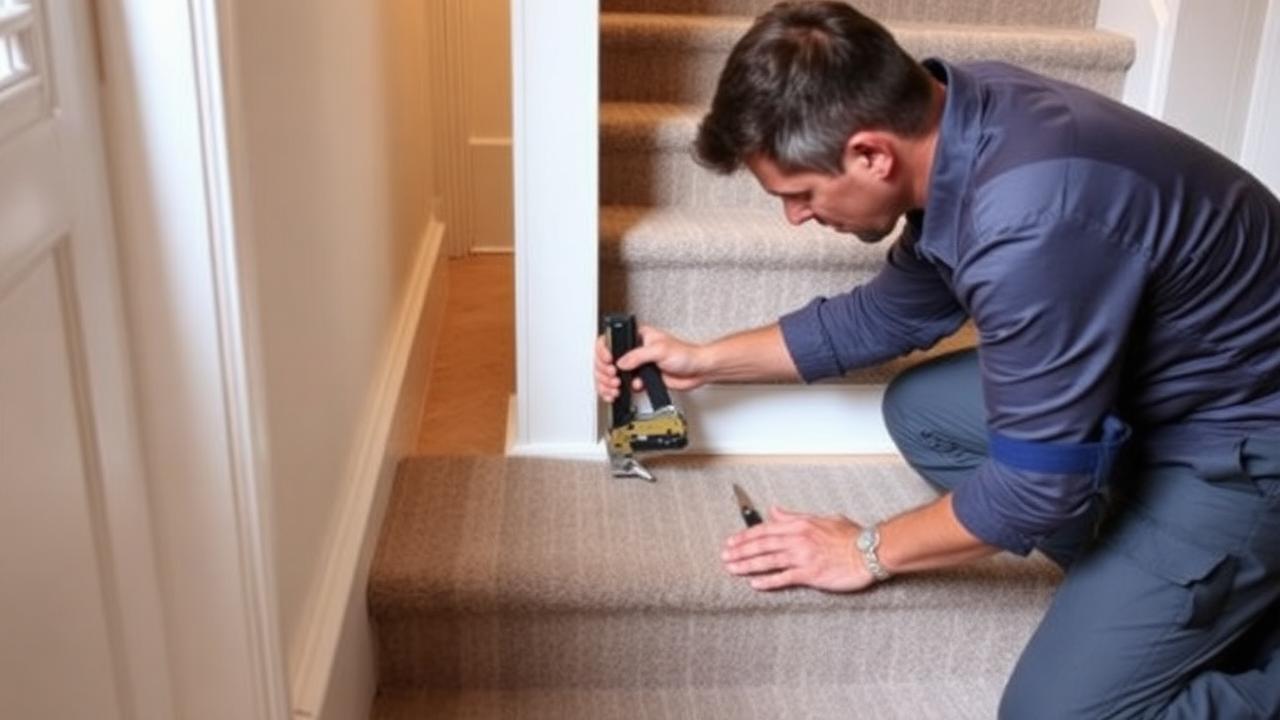
Why oak needs different treatment to a plain pine staircase
Oak stairs are usually the ones a homeowner has spent real money on, either an original period flight that's been stripped and re-oiled, or a newer staircase specified in solid oak as a feature. That changes the calculus on fixing methods completely. On a builder's-grade softwood staircase that's going to be fully carpeted eventually, a few staple holes in the tread edge are irrelevant. On an oak flight where the wood either side of the runner will stay visible and varnished, every staple hole, adhesive residue mark or scuff from a badly seated gripper rod is a permanent, visible mistake. I've been called out more than once to fix a previous fitter's staple pattern that was never going to be hidden because the runner was narrower than planned.
The other practical issue with oak is hardness. Oak is a dense hardwood, and driving staples directly into solid oak by hand is slow, tiring work that risks the staple bending sideways and tearing the surface rather than sinking cleanly - which is exactly the kind of scarring you're trying to avoid. Pilot holes and a decent pneumatic or electric staple gun rated for hardwood use make this workable, but it's still a different job to stapling into softwood pine treads, which take a staple almost effortlessly.
Fixing method one: hollywood or waterfall with gripper rods
The traditional rod-and-gripper method is usually my first recommendation for oak. You fit a thin gripper strip (a row of angled pins on a wooden lath) into the internal angle where tread meets riser, then the carpet is stretched over it using the standard carpet-fitting technique, and a decorative metal stair rod is laid across each riser purely for looks - it isn't structurally doing much of the holding on a proper gripper installation, though on some styles the rod does clip into small brackets that take a light mechanical fixing into the riser face. The gripper itself needs only a handful of small nails or staples tucked right into the internal angle, which is the one part of the step that's essentially invisible once the runner is down, so on oak this is the fixing method that leaves the least visible mark on the exposed wood either side of the runner.
The waterfall style, where the runner falls straight down each riser without tucking into the angle below, is marginally kinder to a very ornate oak nosing profile since it doesn't ask the carpet to bend sharply around a decorative edge, but it uses very slightly less fabric per step and shows more of the riser face, so it's really a style choice more than a wood-protection one.
Fixing method two: staples direct into the tread
Direct stapling, where the runner is stretched and stapled straight into the tread and riser without a gripper strip underneath, is faster and cheaper, and it's the method most DIY stair runner kits assume. On oak I'd only recommend it if the runner is being run genuinely full width, meaning the staple line sits right at the very edge of the tread under the nosing overhang where it's essentially never seen, or if you've accepted that a narrow strip of visible staple heads along the runner's outer edge is a trade you're happy to make for a quicker, cheaper job. Use narrow-crown staples in the 1/2-3/4 in (13-19 mm) leg length range so you're not driving unnecessarily deep into a tread that's often only an inch or so thick over a plywood or engineered substrate.
Test staple depth on an offcut first
Oak varies noticeably in density even within one staircase - older reclaimed oak can be harder than new-cut oak. Fire a test staple into a scrap of the same oak, or an inconspicuous spot under where the runner will sit, before committing to a full flight.
Fixing method three: adhesive, and why I'm cautious with it on oak
Carpet adhesive or double-sided stair tape is sometimes used on hard, smooth substrates like tile or sealed concrete, and it can technically be used on oak too, but I'm more cautious here than on other substrates. Solvent-based adhesives can react with certain oil or wax finishes on oak, softening or discolouring the surface finish under the runner over time, and if you ever want to remove the runner, a strongly bonded adhesive strip can pull up flakes of the finish, or in bad cases splinters of the veneer on an engineered oak stair tread, with it. If a fitter suggests adhesive on solid oak, ask specifically what product they're using and whether it's rated as removable from a finished hardwood surface, and get that in writing before they start.
How much runner do I need?
Take a 13-step oak staircase in the US with a 10 in tread run, 7.5 in riser height and a 0.75 in nosing wrap allowance for a rounded oak nosing profile - oak stairs often have a slightly more pronounced bullnose than a basic softwood step, so don't skimp on this figure. Per step that's 18.25 in, multiplied by 13 steps gives 237.25 in, or 19.77 ft. Add a 24 in combined top and bottom finishing allowance for 261.25 in, then apply a 7% waste margin for the straight cuts, landing at roughly 279.5 in, or about 23.3 ft, so order 23-24 ft to be safe.

In UK metric terms the same flight is 25 cm treads, 19 cm risers and a 1.9 cm nosing wrap, giving 45.9 cm per step. Across 13 steps that's 596.7 cm, plus a 60 cm finishing allowance for 656.7 cm, and a 7% waste margin brings you to roughly 7.03 m. A stair runner calculator will run both unit systems for your own oak staircase measurements in seconds and is worth using before you order, since oak runners are often a premium wool or wool-blend product you don't want to be short on.
| Measurement | US (in/ft) | UK (cm/m) |
|---|---|---|
| Tread run | 10 in | 25 cm |
| Riser height | 7.5 in | 19 cm |
| Nosing wrap (oak bullnose) | 0.75 in | 1.9 cm |
| Per-step total | 18.25 in | 45.9 cm |
| 13 steps, plus finishing + waste | 23-24 ft | 7.0-7.2 m |
Know your numbers in 30 seconds
Enter your step count, tread depth and riser height — the stair runner calculator gives you the exact length to order, in metres and feet, with waste included.
Open the stair runner calculatorProtecting the exposed oak either side of the runner
- Re-oil or re-wax exposed oak treads before fitting so the runner isn't laid over a finish that's due for maintenance anyway.
- Use felt or carpet-safe furniture pads under any tools or equipment resting on the exposed tread during the fit.
- Choose a runner width that leaves at least 3-3.5 in (7.5-9 cm) of oak exposed per side so the grain reads clearly as a deliberate design choice.
- Avoid metal-edged tools or staple gun feet dragging across the bare oak when working - a scrap of card or felt underneath protects the finish.
Choosing a runner that suits oak
Stair runners on oak tend to look best in either a strong contrast - a deep charcoal, navy or patterned wool runner against warm oak tones - or a close tonal match using a natural sisal or jute-look weave that reads as an extension of the wood rather than a competing material. Wool and wool-blend stair runners are the most common choice for a genuine oak staircase because they're durable enough for the traffic a main stair carries and take a border or pattern well, which suits the kind of period or feature staircase oak usually signals. Whatever runner you choose, measure and order using the same worked method above, and don't assume a supplier's generic length estimate accounts for your specific nosing profile.
When to bring in a professional fitter
If your oak staircase is original, listed, or simply expensive to replace, I'd lean towards a professional installation rather than a first-time DIY attempt, specifically because mistakes on oak are harder and pricier to fix than on painted or carpeted stairs. A fitter experienced with hardwood will already know the right staple gauge, whether your particular oak finish tolerates adhesive, and how to seat a gripper rod without denting the tread edge. It costs more upfront but it protects a surface that's expensive to repair or replace if it goes wrong.
Whatever you decide, get the numbers first: the stair runner calculator doubles as a stair runner length calculator, adding nosing wrap, landings, winders, pattern repeat and waste so you order the right length the first time.
Frequently asked questions
Can I staple a stair runner directly into oak treads?
Yes, but use narrow-crown staples 1/2-3/4 in (13-19 mm) long and expect the staple line to be visible along the runner's outer edge unless the runner is fitted full width so the line sits under the nosing overhang.
Is adhesive safe to use on oak stairs?
Use it cautiously. Some solvent-based adhesives can affect oiled or waxed oak finishes and are hard to remove cleanly later, so check the product is rated safe and removable for finished hardwood before using it on solid oak.
What's the best fixing method for a period oak staircase?
A gripper rod and stretched-carpet method, sometimes with decorative stair rods over the top, generally leaves the least visible marking on oak because the actual fixing points sit hidden in the internal tread-riser angle.
Will fitting a runner damage my oak stair finish?
Done correctly with the right staple gauge and fixing method, damage is minimal and confined to hidden areas. The bigger risk is a rushed fit with the wrong tools, so test on an offcut and don't rush the nosing wrap.
How wide should a runner be on oak stairs?
Most oak staircases suit leaving 3-4 in (7.5-10 cm) of exposed oak tread per side, sometimes more on a wider or grander flight, since showing genuine oak grain either side is usually the point of choosing oak stairs in the first place.
Do I need a carpet pad under a runner on oak stairs?
A thin pad improves comfort and reduces wear noise, and doesn't affect the oak either side of the runner, but factor its thickness into your nosing wrap allowance since a thicker pad slightly changes how the runner sits at the tread edge.
Can I remove a stair runner from oak stairs without damage?
Gripper and staple installations lift cleanly with minimal marking once staples are pulled carefully. Adhesive installations are the riskiest to remove and can pull finish or veneer with them, which is the main reason I'm cautious recommending adhesive on oak.
How much runner do I need for a 13-step oak staircase?
For a 13-step flight with 10 in (25 cm) treads and 7.5 in (19 cm) risers, plan on roughly 23-24 ft (7.0-7.2 m) including nosing wrap, finishing allowance and a waste margin.
Know your numbers in 30 seconds
Enter your step count, tread depth and riser height — the stair runner calculator gives you the exact length to order, in metres and feet, with waste included.
Work out your oak staircase length with the stair runner calculatorReady for real prices?
Get quotes from vetted stair runner suppliers and fitters near you. Free, no account, no obligation.
Every guide is written from hands-on measuring and fitting experience, checked against the calculator’s own maths, and re-reviewed whenever prices or methods change. Read our editorial standards.