
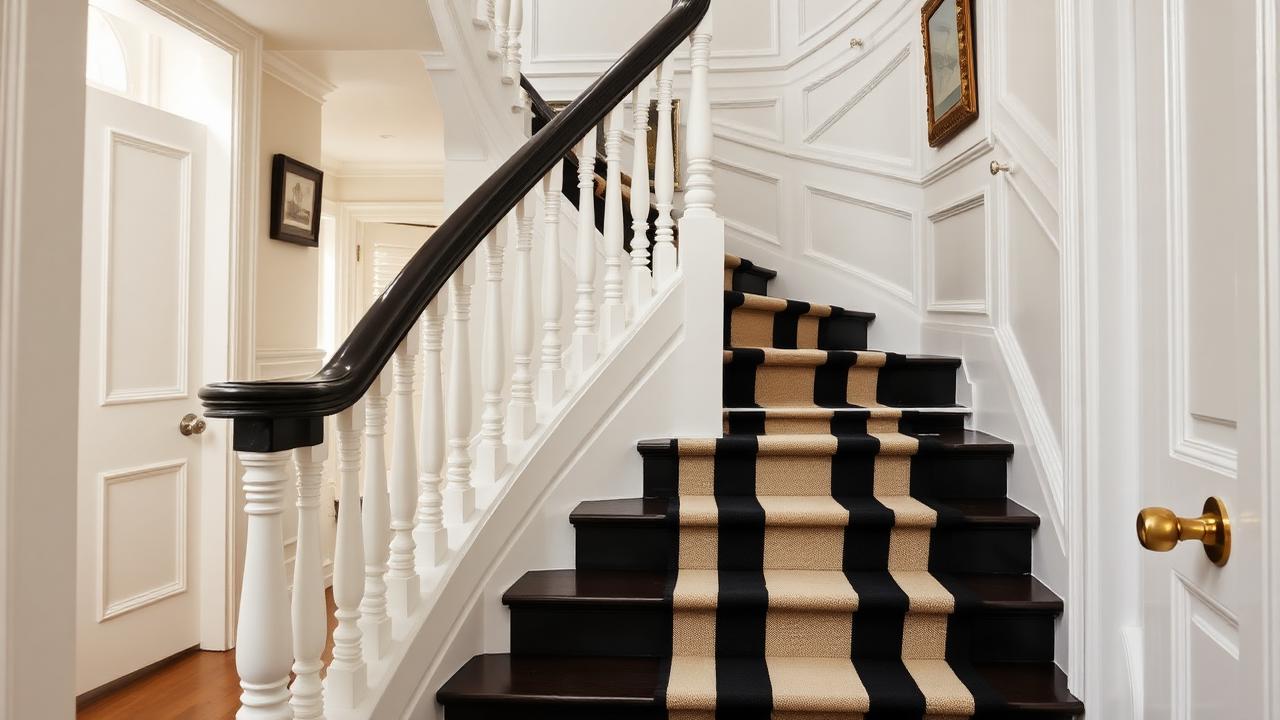
For a period or traditional timber staircase
Exposed timber treads and a painted or stained string are the strongest starting point for a classic runner look. A herringbone or small-repeat wool in a muted natural tone - oatmeal, moorland, pebble - lets the timber do the visual work while the runner adds warmth and quiets footfall. Brass or antique bronze stair rods finish the look and are historically accurate for pre-1960s staircases, though they also work purely decoratively on newer builds designed to look traditional.
| Element | Typical choice for a period look |
|---|---|
| Fibre | Wool or wool-rich blend, 1,300-2,000 g/m2 |
| Colour | Natural neutrals: oatmeal, stone, moss, deep red or navy for a bolder version |
| Width | 25-27 in (64-69 cm), leaving a generous timber margin |
| Fixing | Stair rods over gripper for a removable, period-correct finish |
For a modern or minimalist staircase
Open-riser or floating stairs, painted white strings, and a generally pared-back interior suit a flat weave in a single deep tone or a fine, tonal texture rather than an obvious pattern. Charcoal, deep forest green and black all read as confident and architectural against pale timber or white paint. Keep the width closer to the narrower end of the range, since a slim runner reinforces the lightness that a modern staircase is usually designed around.
- Flat weave or tight cut pile in a single saturated colour
- No visible pattern repeat, or a very fine tonal texture only
- Width toward 25-26 in (64-66 cm) to keep the line slim
- Staples or a hidden fixing rather than visible rods, for an uninterrupted look
For a farmhouse or country interior
Natural fibre runners - sisal, jute or a wool-sisal blend - or a striped flatweave in muted heritage colours both suit this direction. Natural fibre needs to be bound rather than left raw-edged for stair use, and it is coarser underfoot than wool, so households with bare feet on the stairs daily may prefer a wool-look alternative with the same colour palette instead.
Natural fibre on stairs - a practical caveat
Sisal and jute are strong and long-wearing but can be slippery when new and are not forgiving of standing water. If your staircase is near an entrance where wet shoes are common, choose a wool or wool-blend runner with a similar colour and texture instead, or fit a natural-fibre-look synthetic that offers better slip resistance and stain tolerance.
For a busy family staircase with children or pets
Pattern and texture do the heavy lifting here rather than colour alone. A herringbone, houndstooth or fine fleck weave in a mid-tone hides day-to-day marks far better than a plain solid colour, and a loop-pile or twist-pile cut construction resists matting better than a plush velvet pile under constant traffic.
- Choose a mid-tone colour rather than very pale or very dark - both extremes show marks fastest.
- Pick a pattern or fleck weave over a plain solid for daily wear concealment.
- Specify heavy domestic or contract wear rating regardless of how the staircase looks in the showroom.
- Add a firm, stair-grade underlay to reduce impact wear at the nosing.
- Keep an offcut in storage from day one, since repairs are simple with matching material and difficult without.
By budget
| Budget direction | Typical spec | Typical US cost | Typical UK cost |
|---|---|---|---|
| Value | Polypropylene or synthetic-blend flatweave, plain colour | $14-24 per sq yd | GBP 12-22 per sq m |
| Mid-range | 80/20 wool-nylon Berber or woven pattern | $28-50 per sq yd | GBP 25-45 per sq m |
| Premium | 100% wool woven Axminster or Wilton, designer range | $55-90+ per sq yd | GBP 48-80+ per sq m |
Fitting cost sits on top of material in every budget tier and moves with step count and flight complexity rather than the fibre chosen, so a value-tier runner on a long staircase with winders can still cost more in total labour than a premium runner on a short straight flight. Use a stair runner calculator to see the material and rough total side by side before deciding where to spend the budget.

Colour direction inspiration
- Navy on oak treads with brass rods - the enduring, classic pairing for period and transitional homes.
- Charcoal or deep grey on painted white stairs - a modern, low-contrast, architectural look.
- Forest green with warm timber - a confident, slightly traditional statement that photographs well.
- Oatmeal or stone neutrals - the safest, most flexible choice for resale value and changing decor.
- Black and cream stripe on a wide staircase - graphic and formal, best suited to hallways with strong natural light.
Inspiration for tricky staircase shapes
Most inspiration photos show a straight flight, which is the easiest shape to plan for but not the most common in older or split-level homes. Curved staircases, dog-leg turns and winders all need a slightly different approach to pattern and width than a straight run, and the best-looking examples of these tend to simplify rather than complicate the design in response.
| Staircase shape | What tends to work best | What to avoid |
|---|---|---|
| Curved or sweeping staircase | Plain or fine-texture solid colour, cut to a custom curved template | Large geometric or directional pattern that cannot bend cleanly |
| Dog-leg with a half landing | Consistent width and colour continued across the landing | Changing runner width or colour at the landing break |
| Winders (triangular treads) | A pattern with a small, forgiving repeat, or a plain colour | Bold stripes or large motifs, which distort badly on a winder |
| Split-level, short flights | A lighter or fleck colour rather than a very deep, heavy tone | Very dark solids, which can look disproportionately heavy on 3-4 steps |
Winders are the pattern-killer
If your staircase has any winders — the triangular treads used to turn a corner without a landing — ask your fitter to show you exactly how a patterned runner will look across that section before ordering. Stripes and geometric repeats can distort so much on a winder that many experienced fitters recommend a plain or very fine-texture option for any staircase with more than one turn.
Small details that lift an ordinary runner
- A contrast binding in a single accent colour, even on an otherwise plain runner, adds definition without the cost of a full pattern.
- Brass or matte black stair rods, chosen to match existing door and window hardware rather than picked in isolation.
- A slightly deeper or richer colour than first instinct — most samples read lighter once laid across a full flight of steps.
- Continuing the same runner onto a landing or short adjoining hallway run, rather than stopping abruptly at the top step.
- A subtle heather or fleck rather than a completely flat solid, which hides everyday wear far better in real use than in a showroom sample.
Know your numbers in 30 seconds
Enter your step count, tread depth and riser height — the stair runner calculator gives you the exact length to order, in metres and feet, with waste included.
Open the stair runner calculatorWhatever you decide, get the numbers first: the stair runner calculator doubles as a stair runner length calculator, adding nosing wrap, landings, winders, pattern repeat and waste so you order the right length the first time.
Still deciding on material, width or pattern? Our hub on stair runners compares weaves, widths, backings and fitting styles side by side, then hands the numbers straight to the calculator.
Frequently asked questions
Where should I start when looking for stair runner inspiration?
Start with your staircase type, not a colour or pattern you like in a photo. A period timber staircase, a modern open-tread flight and a busy family staircase each suit a different fibre, width and pattern, and matching the idea to your actual staircase avoids an expensive mismatch later.
What is the safest colour choice if I am not confident designing this myself?
A heathered or fleck-dyed neutral - oatmeal, stone or pebble tones - is the lowest-risk choice. It suits most timber and wall colours, hides everyday wear reasonably well, and does not date as quickly as a strongly saturated or trend-led colour.
Are patterned stair runners harder to fit than plain ones?
Slightly, yes. A pattern needs to be centred and squared to the first tread before fitting begins, which takes more time and can add a small amount of material waste compared with a plain colourway, but it also hides daily wear noticeably better once installed.
Is natural fibre like sisal a good idea for a main staircase?
It can be, but it is coarser underfoot than wool and can be slippery when new, especially near an entrance where wet shoes are common. Consider a wool or wool-blend alternative in a similar tone if the staircase sees heavy bare-foot traffic or wet weather exposure.
How do I make a narrow hallway staircase feel less cramped with a runner?
Choose a narrower runner width toward 25 in (64 cm) with a pale or mid-tone colour and minimal pattern, and keep the exposed timber margins visible and consistent. A very wide runner or a dark, bold pattern will make a narrow stair feel more enclosed rather than less.
What is a good budget-friendly way to get a premium look?
Choose a mid-range 80/20 wool-nylon blend in a woven pattern rather than a full 100% wool designer range - the wear performance is close, the visual difference is minor once fitted, and the savings can be put toward better underlay or rod hardware instead.
Do stair rods suit every style of staircase?
No. Rods suit traditional and transitional staircases well, particularly with a herringbone or patterned runner, but they can look busy or dated against a very minimalist, modern staircase, where a hidden staple fixing usually reads cleaner.
How many colour or pattern samples should I get before deciding?
Order at least two or three genuine contenders rather than one, and tape each to both a tread and a riser in your own lighting. Comparing samples side by side in situ reveals differences that are easy to miss when looking at a single option in isolation.
Know your numbers in 30 seconds
Enter your step count, tread depth and riser height — the stair runner calculator gives you the exact length to order, in metres and feet, with waste included.
Measure my staircaseReady for real prices?
Get quotes from vetted stair runner suppliers and fitters near you. Free, no account, no obligation.
Every guide is written from hands-on measuring and fitting experience, checked against the calculator’s own maths, and re-reviewed whenever prices or methods change. Read our editorial standards.