
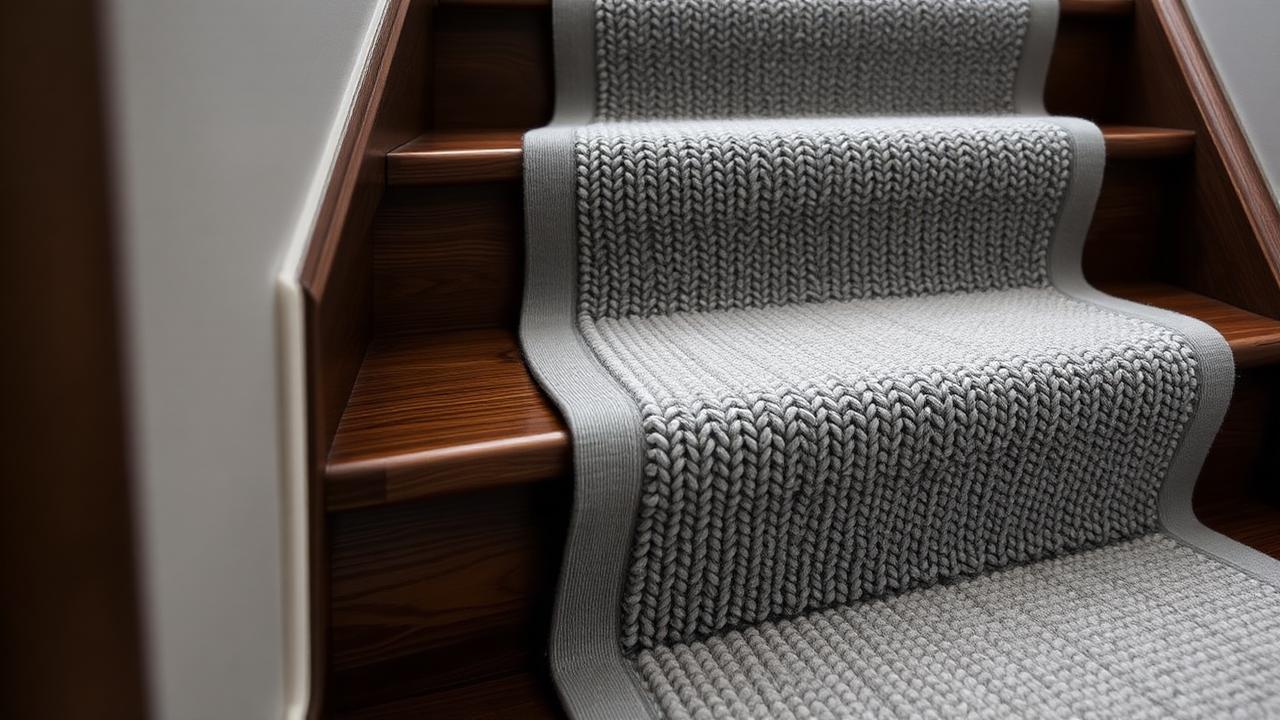
When laying a runner over existing carpet works
The best candidate for an over-carpet runner is a low, dense, tightly woven fitted stair carpet in reasonable condition — worn in colour or pattern but still structurally sound, flat, and free of ripples or loose sections. A runner laid on top of that kind of base can look genuinely finished, especially where the existing carpet is a plain neutral that will read as a discreet flanking border either side of the new runner.
- Existing carpet is low pile (under 8mm) and firmly bonded to the stairs with no lifting edges.
- You want a fast, lower-disruption refresh rather than a full strip-out and re-carpet.
- The existing carpet colour works as an incidental border either side of the new runner.
- You are in a rented property and cannot remove the base carpet at all.
When it does not work
Thick, plush, or heavily worn fitted carpet is a poor base. A deep pile compresses unevenly under a runner and gripper, creating a soft, unstable feel underfoot and premature wear at the nosing. Carpet with loose seams, worn-through patches, or visible flattening in a track down the centre of the treads will telegraph through the new runner and undermine the refresh. In both cases, removing the old carpet before fitting the runner gives a far more durable result.
| Existing carpet condition | Suitable for over-fit? | Recommended action |
|---|---|---|
| Low pile, flat, well bonded, faded colour | Yes | Fit runner directly, ideally with fresh underlay strip |
| Medium pile, generally sound | Marginal | Consider thin fixing method, monitor for movement |
| Deep pile or plush | No | Remove first, or accept a soft, less durable result |
| Worn through, loose seams, ripples | No | Remove and address the subfloor before any new runner |
Fixing methods for an over-carpet runner
Standard tackless gripper strip is designed to bite into carpet backing and the tread beneath it, and can be used over a low-pile base carpet if the gripper pins reach through to solid timber underneath — check this before ordering, since some gripper heights are too short once the base carpet's thickness is accounted for. Where gripper is not reliable, adhesive-based fixing or a no-screw tension rod system that clamps the runner in place without penetrating the base carpet is usually the safer route.
- Vacuum and inspect the existing carpet thoroughly for lifting, seams or wear before deciding.
- Choose gripper long enough to reach solid timber through the base carpet thickness, or switch to adhesive/clip fixing.
- Add a thin underlay strip between the two carpets if the runner needs extra cushioning, checking total build-up height at the nosing.
- Fit standard style holders or rods as normal once the runner is tensioned and fixed.
- Re-check fixing after a few weeks, since a soft base can allow more settling than bare timber.
Check nosing height before you commit
Adding a runner and underlay on top of existing carpet raises the tread edge. On stairs with a shallow nosing this can change the feel underfoot and, in some cases, affect step edge visibility for safety — measure the combined build-up before fitting.
Styling ideas that suit an over-carpet fit
- Choose a runner colour that reads as a deliberate contrast to the visible flanking carpet, not an accidental mismatch.
- Keep the runner width generous enough that the visible edge of the base carpet looks like an intentional border, typically leaving at least 3-4in either side.
- Favour a low-to-medium pile runner over a deep pile, which keeps the combined build-up manageable at the nosing.
- A patterned runner over a plain worn base carpet is one of the most effective disguises, since the base carpet's wear is far less visible under strong pattern.
Costs and what you save
The main saving from an over-carpet fit is labour and disposal — no strip-out, no skip, and typically a shorter job. Material costs for the runner itself are the same as any other fit; the saving is on the removal side.

| Approach | Typical saving vs full strip-out | Trade-off |
|---|---|---|
| Fit runner over sound low-pile carpet | £100-300 / $135-400 in removal and disposal | Shorter lifespan if base carpet degrades |
| Fit runner after full strip-out | None — full cost applies | Best long-term durability and flattest result |
Know your numbers in 30 seconds
Enter your step count, tread depth and riser height — the stair runner calculator gives you the exact length to order, in metres and feet, with waste included.
Open the stair runner calculatorStyling ideas that specifically suit an over-carpet fit
Because an over-carpet runner sits on a soft, slightly compressible base rather than bare timber, styling choices that keep the combined build-up visually neat tend to work best. A mid-tone or patterned runner disguises the transition between the two carpets more effectively than a very pale, plain colour, since any slight unevenness at the runner's edge is far less noticeable against a busier pattern or a mid-depth tone than against a flat pale colour where every ripple catches the light.
Pairing the new runner's fibre with the existing base carpet
A low-pile synthetic or tight wool-blend runner generally sits better over an existing fitted carpet than a thick, plush pile, since a plush pile compounds with the base carpet's own depth and can create a noticeably soft, unstable feel underfoot. If your existing stair runner carpet or fitted carpet underneath is itself a mid-pile wool, choose a similarly firm construction for the new runner on top so the two layers compress together predictably rather than one sinking more than the other.
Pattern repeat maths over an uneven base
An existing fitted carpet is rarely perfectly flat, so a patterned over-fit runner needs a slightly more generous waste allowance than the same pattern fitted to bare timber. On a 13-step flight with a 10in (25cm) going and 7.5in (19cm) rise, budget the standard 13ft 6in (4.1m) running length plus a 10-15% pattern allowance if there is a repeat, and consider adding a further 3-5% contingency specifically to cope with small dips or high spots in the base carpet that can shift how the pattern falls tread to tread.
How an over-carpet fit wears compared with a bare-timber fit
A runner fitted over existing carpet typically wears faster at the nosing than the same runner fitted to bare timber, because the softer base flexes slightly under footfall and adds extra movement at exactly the point where the carpet already takes the most abrasion. Expect a modest reduction in useful life – often 15-25% shorter – compared with the same specification fitted properly to a solid subfloor, which is worth weighing against the labour and disposal savings an over-fit provides.
Checking your plan with the stair runner calculator before buying
Before ordering a runner intended to sit over existing carpet, measure your stairs and confirm quantities with the stair runner calculator, then add the extra contingency described above for the uneven base. This matters more here than on a standard fit, since a shortfall discovered mid-installation is harder to correct cleanly when the base surface is already uneven and the fitter is working around it.
| Base carpet condition | Extra waste allowance vs bare timber | Expected lifespan impact |
|---|---|---|
| Flat, low pile, well bonded | +3-5% | 10-20% shorter than bare-timber fit |
| Slightly uneven, medium pile | +5-8% | 20-30% shorter, monitor closely |
| Visibly rippled or worn | Not recommended – remove first | Not applicable |
Whatever you decide, get the numbers first: the stair runner calculator doubles as a stair runner length calculator, adding nosing wrap, landings, winders, pattern repeat and waste so you order the right length the first time.
Frequently asked questions
Can you put a stair runner over existing carpet?
Yes, if the existing carpet is low pile, flat, well bonded and in reasonable structural condition. Thick, plush or worn-through carpet is a poor base and should generally be removed first.
Do you need special fixings for a runner over carpet?
Often yes. Standard gripper needs to reach solid timber through the base carpet's thickness, so check gripper height, or use adhesive or clamping fixings that do not rely on penetrating the base carpet.
Will a runner over carpet feel different underfoot?
It typically feels softer and slightly higher at the nosing than a runner fitted to bare timber, because you are adding thickness on top of an existing carpet.
Is fitting over old carpet cheaper than a full strip-out?
It usually saves on labour and disposal costs since there is no removal step, though the runner material itself costs the same either way.
What existing carpet condition rules out an over-fit?
Deep or plush pile, loose seams, ripples, or patches worn through to the backing all rule out a reliable over-fit; the old carpet should be removed in those cases.
Does a runner over carpet affect stair safety?
It can, by raising the tread build-up and changing the nosing edge. Measure the combined height of both carpets plus any underlay before fitting, especially on stairs with a shallow nosing.
What runner styles disguise old carpet best?
A patterned runner in a colour that contrasts deliberately with the visible edge of the old carpet tends to disguise wear on the base carpet most effectively.
How do I price a runner fitted over existing carpet?
Use the stair runner cost calculator for the runner material and standard fitting, then subtract the removal and disposal line since it usually is not needed for an over-fit.
Know your numbers in 30 seconds
Enter your step count, tread depth and riser height — the stair runner calculator gives you the exact length to order, in metres and feet, with waste included.
Price my over-carpet runnerReady for real prices?
Get quotes from vetted stair runner suppliers and fitters near you. Free, no account, no obligation.
Every guide is written from hands-on measuring and fitting experience, checked against the calculator’s own maths, and re-reviewed whenever prices or methods change. Read our editorial standards.