
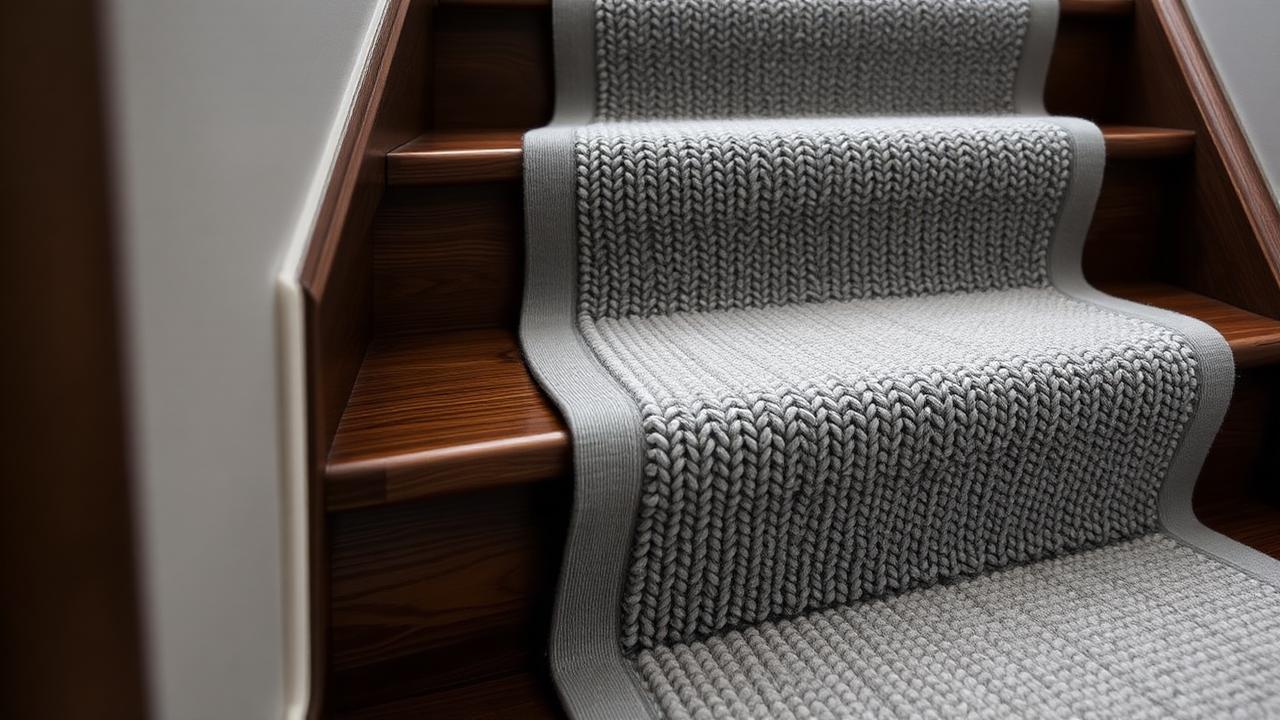
Why padding matters more on stairs than on floors
On a floor, carpet padding is about comfort and a little about wear. On a staircase it is almost entirely about wear, and the mechanics are specific. Every descending foot lands on or just behind the nosing, concentrating the whole body weight onto a strip of carpet perhaps 40mm wide, bent through ninety degrees over a hard timber edge. Without padding, the carpet backing is compressed directly against that edge thousands of times a week, and the pile abrades from underneath as much as from above.
Padding does three things about that. It cushions the compression so the backing is not crushed against timber. It distributes the load across a wider band of carpet instead of a hard line. And it lets the carpet flex over the nosing rather than being creased permanently in one place. The practical result is roughly double the useful life on the nosings, for around a tenth of the project cost.
Specification: dense, not thick
The most common padding mistake is buying the thickest product available. Above about 11-12mm, the padding softens the crease, the runner loses definition at the nosing, and — counter-intuitively — wear accelerates, because the carpet can now move against the timber under foot rather than staying put. The correct specification is dense and moderately thick.
| Type | Thickness | Density | Verdict for stairs |
|---|---|---|---|
| PU foam | 8-11mm | 100-140 kg/m3 | Best all-round; the default specification |
| Crumb rubber | 6-9mm | High | Excellent for heavy traffic and sound; heavier to handle |
| Sponge rubber | 8-10mm | Medium-high | Traditional, good under wool |
| Felt | 8-10mm | Medium | Suits sisal, jute and other natural fibres |
| Combination felt / rubber | 9-11mm | High | Contract-grade; the premium choice |
| Cheap foam 12mm+ | 12mm+ | Low | Avoid — crease collapses, wear accelerates |
| Rug anti-slip mesh | 1-3mm | n/a | Not padding; provides no wear protection |
Check density, not just thickness
Two 10mm PU pads can differ by 60 kg/m3, and that difference is everything on a stair nosing. If the specification only quotes thickness, ask for the density before buying — a reputable supplier will have it.
How much padding a flight needs
Padding is cut per tread, so the quantity is treads multiplied by the padded area, not the full runner length. Each piece is the runner width, and long enough to cover the tread depth plus the nosing wrap plus 40-50mm down the riser face.
| Flight | Runner width | Pad piece | Total area |
|---|---|---|---|
| 12 treads | 26in / 66cm | 13in / 33cm deep | 2.6 m2 |
| 13 treads | 27in / 69cm | 13in / 33cm deep | 2.9 m2 |
| 14 treads | 27in / 69cm | 13.5in / 34cm deep | 3.2 m2 |
| 16 treads | 30in / 76cm | 13.5in / 34cm deep | 3.7 m2 |
| 13 treads + landing | 27in / 69cm | plus landing area | 3.5-4.5 m2 |
Buy 10-15% more than the calculated area. Padding is cheap, offcuts are useful for the landing and the bottom step, and running short mid-flight means a second delivery for a few pounds' worth of material.
Fitting padding correctly
- Fit gripper strip first, in the angle of every step, before any padding.
- Cut each pad to the runner width — not the full stair width — so no padding sits under the exposed reveal.
- Cut each pad long enough for the tread, the nosing wrap and 40-50mm onto the riser face.
- Butt the pad up to the gripper at the back of the tread; do not overlap it.
- Staple along the back edge, along both sides and under the nosing.
- Pull the pad tight over the nosing before the underside staples go in — a loose pad rolls under foot.
- Repeat identically on every tread, then fit the runner.
The single detail that separates a professional pad-out from an amateur one is where it stops on the riser. Continuous padding down the full riser face makes the runner look puffy at the fold, kills the shadow line that gives a staircase its definition, and adds nothing — nobody's foot ever touches the middle of a riser.
Padding width and the reveal
Padding must be exactly the runner width or 5-10mm narrower — never wider. A pad that shows beyond the bound edge of the runner is visible from the side, collects dust, and creates a soft ridge right where a foot may land off-centre. Cutting it slightly narrow is the safer error: the runner edge then sits marginally lower and reads as a crisp, deliberate line.

What padding costs
| Grade | Price | 13-step flight (≈3 m2) |
|---|---|---|
| Budget PU, low density | £4-6 per m2 / $0.6-0.9 per sq ft | £12-18 / $20-30 |
| Standard PU, 100-120 kg/m3 | £6-9 per m2 / $0.9-1.3 per sq ft | £18-27 / $30-42 |
| Premium PU, 130-140 kg/m3 | £9-14 per m2 / $1.3-2 per sq ft | £27-42 / $42-65 |
| Crumb rubber | £10-16 per m2 / $1.5-2.4 per sq ft | £30-48 / $48-78 |
| Felt or felt/rubber | £8-14 per m2 / $1.2-2 per sq ft | £24-42 / $39-65 |
Against a runner project of £650-1,300 or $900-1,800, the entire difference between the cheapest and the best padding is around £30 or $48. There is no other line on the job where that money buys as much extra life, which is why fitters who quietly downgrade the padding to win a quote are doing the client no favours.
Know your numbers in 30 seconds
Enter your step count, tread depth and riser height — the stair runner calculator gives you the exact length to order, in metres and feet, with waste included.
Open the stair runner calculatorCan you fit a runner without padding?
Yes, and there are three legitimate cases. Very thin flat-weave and sisal runners are sometimes specified unpadded because padding makes them roll and lose definition. Tread mats and rug runners usually have their own backing. And on some period restorations, a bare-timber-and-carpet build-up is deliberate. Outside those cases, going without padding is a false economy: the runner wears through on the nosings in a fraction of the time, and replacing a runner costs many times the padding you saved.
- Flat weave or sisal under 8mm: padding optional, often better without.
- Individual tread mats: usually self-backed, no separate pad.
- Rug runners: a thin dense pad still helps at the nosings, cut narrower than the rug.
- Wool or cut-pile broadloom runner: always pad.
- Concrete or stone stairs: pad, and use adhesive rather than staples to fix it.
Padding and sound
Stairs transmit impact noise into the structure more than any other surface in a house, especially in timber-framed and converted properties. Crumb rubber and felt/rubber combination pads meaningfully reduce that transmission where plain PU foam mostly reduces the airborne clatter. If footfall noise from the staircase is a live problem — a flat conversion, a bedroom under the stairs, an early-rising household — specify crumb rubber and accept the slightly higher cost and the extra weight when handling it.
Replacing padding
Padding outlasts carpet on flat floors but not always on stairs, because the nosing compression is relentless. When a runner is lifted for replacement, inspect the pads: any that have taken a permanent set over the nosing, feel hard, or have crumbled at the edges should be replaced, and given the cost there is rarely a case for reusing them at all. Fitting a new runner over ten-year-old compressed padding wastes most of the benefit of the new carpet.
If you quote runner work professionally, list padding grade and density explicitly on the quote rather than as a generic 'underlay' line. It is the component most often silently downgraded between competing quotes, and specifying it is how you justify a higher price. Riser for pros itemises padding by grade and area alongside the carpet, binding and labour.
Whatever you decide, get the numbers first: the stair runner calculator doubles as a stair runner length calculator, adding nosing wrap, landings, winders, pattern repeat and waste so you order the right length the first time.
Still deciding on material, width or pattern? Our hub on stair runners compares weaves, widths, backings and fitting styles side by side, then hands the numbers straight to the calculator.
Frequently asked questions
What padding should I use under a stair runner?
Dense PU foam 8-11mm thick at 100-140 kg/m3, or 6-9mm crumb rubber for heavy traffic and sound reduction. Density matters more than thickness — anything over about 12mm softens the crease and shortens the carpet's life.
How thick should stair runner padding be?
8-11mm for PU foam and 6-9mm for crumb rubber. Thicker padding makes the runner look puffy at the nosing, hides the shadow line, and lets the carpet move against the timber, which accelerates wear.
Should padding run down the risers?
No. Cut it per tread, wrap it over the nosing and stop 40-50mm down the riser face. Continuous padding down every riser softens the fold and adds nothing, because no foot touches the middle of a riser.
How much padding does a stair runner need?
Around 2.6-3.2 m2 for a 12-14 tread flight at typical runner widths, plus 10-15% for offcuts. Padding is cut per tread, so the quantity is based on tread area rather than the full runner length.
How much does stair runner padding cost?
About £18-27 or $30-42 for a 13-step flight in standard PU, rising to £30-48 or $48-78 for crumb rubber. It is typically 8-12% of the project cost and roughly doubles the runner's life at the nosings.
Can you fit a stair runner without padding?
Yes for thin flat weaves and sisal, self-backed tread mats and some period restorations. For any wool or cut-pile runner it is a false economy — the nosings wear through in a fraction of the time.
Should the padding be the same width as the runner?
Exactly the runner width or 5-10mm narrower, never wider. Padding visible beyond the bound edge collects dust and creates a soft ridge where a foot may land off-centre.
Does stair runner padding reduce noise?
Crumb rubber and felt/rubber combination pads meaningfully reduce impact noise transmitted into the structure. Plain PU foam mostly reduces the airborne clatter rather than structural transmission.
Know your numbers in 30 seconds
Enter your step count, tread depth and riser height — the stair runner calculator gives you the exact length to order, in metres and feet, with waste included.
Price my runner and paddingReady for real prices?
Get quotes from vetted stair runner suppliers and fitters near you. Free, no account, no obligation.
Every guide is written from hands-on measuring and fitting experience, checked against the calculator’s own maths, and re-reviewed whenever prices or methods change. Read our editorial standards.