

Standard stair runner widths
Manufacturers work to a fairly narrow band of standard widths because they correspond to the loom widths carpet is woven on and to the range of stair widths found in ordinary housing stock. The most common standard widths are 22 in (56 cm), 27 in (68 cm), 30 in (76 cm), 32 in (81 cm), 36 in (91 cm) and 42 in (107 cm), though some mills also offer 25 in (63 cm) and 34 in (86 cm) as intermediate options. Custom widths outside this range are possible with bespoke weaving or a hand-cut-and-bound broadloom runner, but expect a longer lead time and a higher cost per foot.
| Runner width (US) | Runner width (metric) | Typical stair width it suits |
|---|---|---|
| 22 in | 56 cm | 30-32 in narrow stairs |
| 27 in | 68 cm | 33-36 in stairs |
| 30 in | 76 cm | 36-39 in stairs |
| 32 in | 81 cm | 38-42 in stairs |
| 36 in | 91 cm | 42-46 in wide or feature stairs |
| 42 in | 107 cm | 48 in+ grand or curved staircases |
How to read the chart against your own stairs
Measure the full width of your staircase wall-to-wall or baluster-to-baluster first, then subtract the margin you want on each side, doubled. If your stairs measure 36 in (91 cm) wall to wall and you want a 4.5 in (11.5 cm) margin on each side, that's 9 in (23 cm) subtracted total, leaving a 27 in (68 cm) runner as your target width - which happens to be one of the standard sizes, which is exactly why it's so commonly chosen on this stair width. If your ideal number falls between two standard sizes, most people size down slightly rather than up, since a narrower runner with a slightly wider margin usually looks more deliberate than a runner that leaves an oddly tight margin.
On narrower cottage or period staircases under 32 in (81 cm) wide, a 22 in (56 cm) runner is often the only realistic standard option once a sensible margin is left on each side. On wide or grand staircases over 48 in (122 cm), 36 or 42 in (91-107 cm) runners keep the proportions balanced - a narrow runner on a very wide stair can look like a shoelace down the middle of the flight.
When in doubt, measure the narrowest point
If your staircase has a baluster, wall protrusion, or newel post that narrows the usable width partway down, measure that point, not the widest part, so your chosen runner width clears every obstruction along the full flight.
How much runner do I need?
Width and length are calculated separately, so choosing your width from the chart doesn't change the length arithmetic. For a 13-step flight with a 10 in (25 cm) going and 7.5 in (19 cm) rise, the length needed is 13 x 17.5 in = 227.5 in (18 ft 11.5 in) in US units, or 13 x 44 cm = 572 cm (5.72 m) in UK metric, before a 5-10% waste allowance is added on top - bringing the practical order to roughly 20 ft in US units or 6.1 m in UK metric.
Once you know both figures - width from the chart, length from the going-and-rise sum - the stair runner calculator on this site can confirm the total area and length you need to order in one step, which is useful when you're comparing quotes priced per square yard or square metre rather than per linear foot.
Know your numbers in 30 seconds
Enter your step count, tread depth and riser height — the stair runner calculator gives you the exact length to order, in metres and feet, with waste included.
Open the stair runner calculatorWidth and margin: getting the proportion right
- Under 2 in (5 cm) margin per side reads as edge-to-edge and can look like a mistake rather than a deliberate design choice
- 3-6 in (7.5-15 cm) margin per side is the most commonly used and generally reads as balanced on standard stair widths
- Over 8 in (20 cm) margin per side starts to look like a narrow runner lost on a wide stair, unless the stair itself is unusually grand
- Odd or uneven margins - wider on one side than the other - are one of the most noticeable installation errors, more so than a slightly wrong overall width
Width by stair type
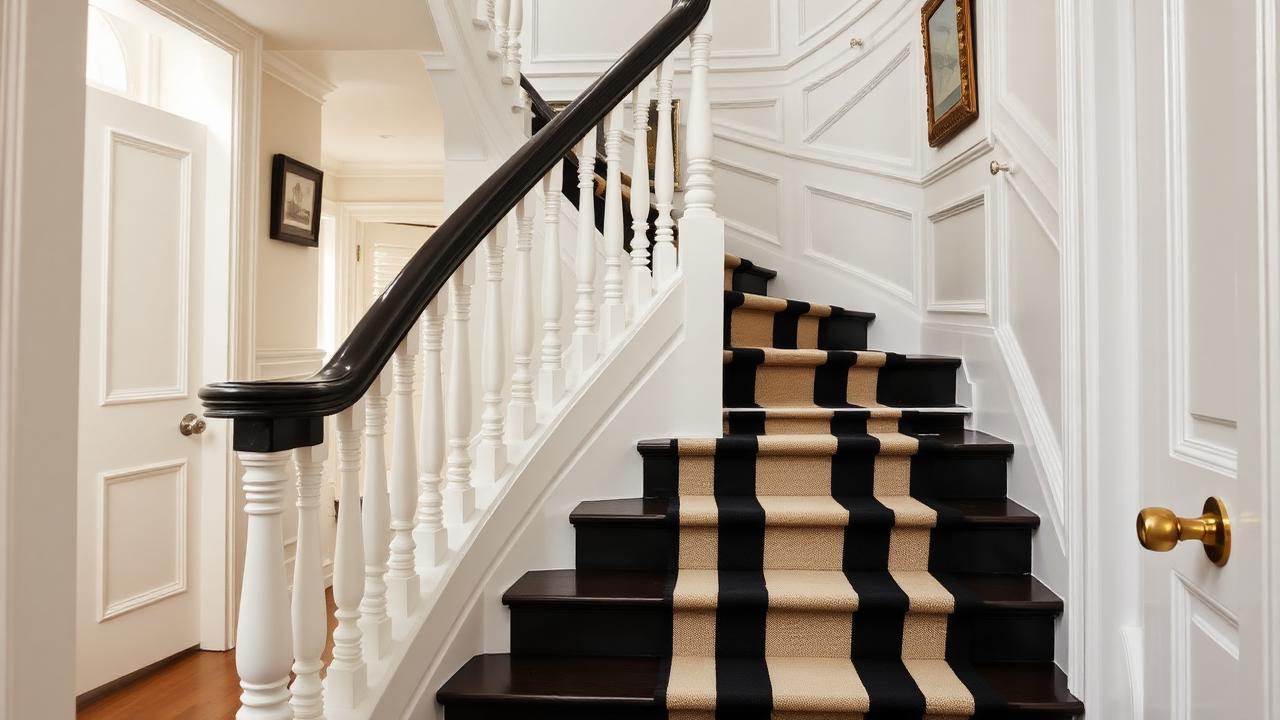
Straight flights follow the chart directly. Winder and turning staircases often need a slightly narrower runner than a straight flight of the same wall-to-wall width, because the pattern has to navigate the pie-shaped winder treads without overhanging their narrow inside edge. Open-string (cut-string) staircases, where treads project past the outer string with no riser board beneath, sometimes carry a narrower runner too, so the edge doesn't overhang the tread's exposed side. If your flight has any of these features, it's worth reading alongside the stair-runner-for-steep-or-narrow-stairs guide, which covers width choices for exactly these trickier layouts.
Buying to a non-standard width
If your ideal width sits between standard sizes, a hand-cut-and-bound broadloom runner can be finished to almost any width, at a higher per-foot cost than a factory-edged ready-made runner. This is often the better route on unusual stair widths, curved staircases, or where a specific margin is a hard design requirement rather than a rough preference - just budget extra lead time for the custom binding to be finished to spec.
Whatever you decide, get the numbers first: the stair runner calculator doubles as a stair runner length calculator, adding nosing wrap, landings, winders, pattern repeat and waste so you order the right length the first time.
Still deciding on material, width or pattern? Our hub on stair runners compares weaves, widths, backings and fitting styles side by side, then hands the numbers straight to the calculator.
Frequently asked questions
What is the most common stair runner width?
27 in (68 cm) and 30 in (76 cm) are the two most commonly chosen widths, because they suit the 33-39 in (84-99 cm) stair width range that covers a large share of standard residential staircases in both the US and UK.
How do I measure my stairs for the width chart?
Measure wall-to-wall or baluster-to-baluster at the narrowest point along the flight, not just at the top or bottom, since obstructions like newel posts can reduce the usable width partway down a run.
What margin should be left on each side of the runner?
Most homes look best with a 3-6 in (7.5-15 cm) margin of exposed tread on each side. Less than 2 in (5 cm) looks accidental, while more than 8 in (20 cm) can make the runner look narrow and lost on the stair.
Can I get a stair runner in a custom, non-standard width?
Yes, via a hand-cut-and-bound broadloom runner, which can be finished to almost any width. It costs more per foot than a factory-edged standard width and takes longer to have made and bound.
Do winder stairs need a narrower runner than straight flights?
Often yes, slightly, so the runner clears the narrow inside edge of the pie-shaped winder treads without overhanging. Check the narrowest point of any winder section before finalising your width.
Is a wider runner always better for a grand staircase?
Generally yes for proportion, since a narrow runner on a very wide staircase can look under-scaled. 36-42 in (91-107 cm) widths suit most feature and grand staircases over 48 in (122 cm) wide.
What happens if I choose a width that's too wide for my stairs?
It leaves too little margin, which can look cramped and, on stairs with balusters or wall protrusions, may not physically clear obstructions along the flight, causing fitting problems partway down.
Should width and length be measured together or separately?
Separately. Width comes from your stair's wall-to-wall or baluster measurement and your desired margin; length comes from adding the going and rise of every step. Both feed into the same overall order, but they're independent calculations.
Know your numbers in 30 seconds
Enter your step count, tread depth and riser height — the stair runner calculator gives you the exact length to order, in metres and feet, with waste included.
Find your ideal runner width and lengthReady for real prices?
Get quotes from vetted stair runner suppliers and fitters near you. Free, no account, no obligation.
Every guide is written from hands-on measuring and fitting experience, checked against the calculator’s own maths, and re-reviewed whenever prices or methods change. Read our editorial standards.