
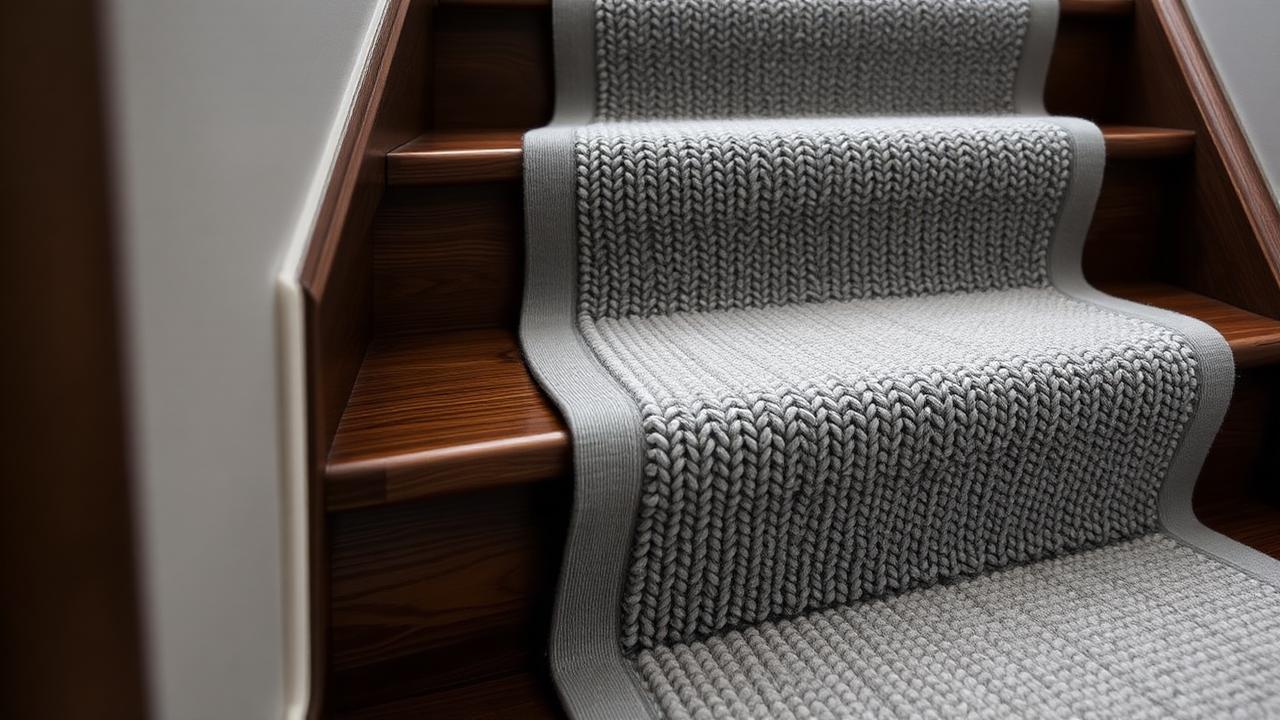
The Axminster Difference: Why It Matters on Stairs
When you are looking for a stair runner, the term “Axminster” often comes up as a mark of quality, but what does it actually mean for your home? Unlike modern tufted carpets, where the pile is punched into a pre-made backing and secured with latex, an Axminster is woven on a traditional loom. This process weaves the pile and the backing together in a single operation, creating a finished product that is incredibly stable. For a staircase, this stability is crucial. Every time someone walks up or down, they are applying force that tries to shift the carpet. A tufted runner can stretch and bow over time, leading to dangerous loose spots or unsightly wrinkles. An Axminster, however, holds its shape for decades.
Another massive benefit of Axminster construction is the lack of “grin-through.” If you have ever looked at a cheap runner on a rounded stair nosing and seen the white grid of the backing showing through the gaps in the pile, that is grin-through. Because Axminster tufts are woven deeply into the structure, the pile remains dense even when bent over a tight radius. This ensures that your chosen pattern looks consistent from the top landing all the way to the hall floor, without any unsightly gaps or thinning.
Pattern Definition and Aesthetic Versatility
Axminster is famous for its ability to handle complex, multi-coloured patterns. Because the loom can pick from a wide variety of yarns for each individual tuft, the level of detail is unmatched. Whether you want a traditional Victorian scroll, a bold geometric contemporary design, or a subtle tonal plaid, Axminster delivers sharp lines and vibrant colours that don't blur. On a staircase, where the runner is the focal point of the hallway, this visual clarity makes a huge difference. I’ve fitted hundreds of these, and the way a well-centered pattern draws the eye up the flight is one of the best ways to transform a narrow entryway.
In my experience, homeowners often underestimate how much the pattern affects the fitting process. With an Axminster, you have to be precise. If the pattern is off by even a quarter of an inch on one riser, it can look noticeably skewed by the time you reach the top of the flight. That’s why using a stair runner calculator is so important—it gives you the baseline measurements you need before you even think about pattern repeats. You also need to consider the “skew” of the weave; a high-quality Axminster will be perfectly square, but a cheaper imitation might have a slight curve that makes installation a nightmare for a DIYer.
How much runner do I need?
Calculating the length for an Axminster runner requires a bit more care than a plain flatweave because of the pattern matching requirements. Let’s look at a typical 13-step staircase. In the US, a standard step might have a 10 in tread run and a 7.5 in riser height. You must also account for the “wrap” around the nosing—usually about 0.75 in. This gives you a total of 18.25 in per step. Multiply 18.25 in by 13 steps, and you get 237.25 in, which is 19.77 ft. But you can't just buy 20 ft of carpet. You need to add a finishing allowance of at least 12 in at the top and 12 in at the bottom for turning under and securing to the subfloor. This brings you to 261.25 in, or 21.77 ft.
Now, for the Axminster factor: the pattern. Unless it's a solid colour, you will need a waste margin to ensure the pattern lines up at each nosing. A 10% margin is standard for most patterns, bringing the final order length to approximately 24 ft. If you have winders (triangular steps that turn a corner), you will need even more, as you have to cut and mitre the runner to keep the pattern flow consistent. Always err on the side of caution; it is much better to have two feet left over than to be six inches short at the top landing.
In the UK, we work in metric. That same 13-step flight would typically have a 25 cm tread run and a 19 cm riser, with a 1.9 cm nosing wrap. This totals 45.9 cm per step. Over 13 steps, that is 596.7 cm. Add your 60 cm finishing allowance (30 cm at each end) to get 656.7 cm. Applying the 10% waste margin for pattern matching, you land at 722.37 cm, or roughly 7.3 m. This extra length allows for the fitter to 'shift' the runner slightly on each step to ensure the pattern hits the nosing at the same point every time, creating that professional, balanced look.
| Step Component | US Measurement (in/ft) | UK Measurement (cm/m) |
|---|---|---|
| Tread run | 10 in | 25 cm |
| Riser height | 7.5 in | 19 cm |
| Nosing wrap | 0.75 in | 1.9 cm |
| Total per step | 18.25 in | 45.9 cm |
| 13 steps subtotal | 19.77 ft | 5.97 m |
| Finishing allowance | 21.77 ft | 6.57 m |
| Total with 10% waste | 24 ft | 7.3 m |
Know your numbers in 30 seconds
Enter your step count, tread depth and riser height — the stair runner calculator gives you the exact length to order, in metres and feet, with waste included.
Open the stair runner calculatorDurability and Materials: The 80/20 Rule
Most Axminster stair runners are made from a blend of 80% wool and 20% nylon. In the trade, we call this the 'contract spec' because it is tough enough for hotel corridors but luxurious enough for a master bedroom. The wool provides natural resilience—the fibres spring back after being stepped on—and it is naturally fire-retardant and stain-resistant. The nylon adds tensile strength, preventing the individual tufts from breaking or wearing down in the high-impact areas of the stair nosing. When you are choosing a runner, always check the label for this 80/20 split; anything with less wool will feel thinner and wear out faster, and anything with 100% wool might not have the longevity needed for a busy family staircase.

One thing to watch out for is shedding. New Axminster runners will shed a small amount of fibre for the first few months. Don't panic; this is just short fibres from the manufacturing process working their way out. Regular vacuuming with a suction-only setting (or a very light brush) will clear this up. Avoid using an aggressive beater bar on a woven runner, as it can snag the tufts and cause premature fuzzing. If you treat it right, a high-quality Axminster will look just as good in ten years as it does the day it’s installed.
Professional Fitting Tips
Fitting an Axminster is not a job for the faint-hearted. The backing is stiff, and the pattern is unforgiving. I always use a high-density crumb rubber underlay for Axminsters on stairs. It provides the firm support the weave needs and prevents the carpet from slipping. When tacking the runner down, I use a combination of staples and carpet tacks, ensuring every riser is pulled tight. If you are doing a 'Hollywood' fit (where the carpet is tacked under the nosing), the density of the Axminster pile is your best friend because it hides the staples perfectly.
- Check the pattern repeat length before you start; it determines how much extra you need.
- Use a sharp bolster to drive the carpet into the crotch of the stair (where the riser meets the tread) for a crisp finish.
- Always start from the bottom and work your way up, checking the centering every three steps.
- Use a knee-kicker sparingly; Axminster doesn't need to be stretched as much as tufted carpet, just pulled taut.
- If your stairs are narrow, consider a narrower runner to leave more of the wood showing on the sides—this makes the staircase feel wider.
Why You Should Use a Stair Runner Length Calculator
I cannot stress this enough: do not guess your measurements. Even experienced fitters use a stair runner length calculator to double-check their math. When you are dealing with a premium material like Axminster, which can cost significantly more than standard broadloom, a mistake of even half a yard can be an expensive error. By inputting your tread, riser, and number of steps into a calculator, you get a reliable figure that accounts for the physical realities of the flight. It also helps you communicate clearly with your supplier, ensuring they cut the roll to the right length for your specific home.
A Note on Stair Rods
If you are planning to add stair rods to your Axminster runner, remember that they are purely decorative. The runner must still be properly tacked and secured to the stairs. The rods sit in the corner of the step and add a touch of traditional elegance that perfectly complements the woven look of an Axminster.
Environmental Benefits and Indoor Air Quality
Because they are primarily made of wool, Axminster runners are a more sustainable choice than 100% synthetic options. Wool is a renewable resource that naturally biodegrades at the end of its life. Furthermore, wool fibres have a unique ability to absorb pollutants from the air and regulate humidity, contributing to a healthier indoor environment. In a home with children or pets, choosing a natural-fibre-heavy runner like a wool-rich Axminster is a smart move for long-term air quality. It doesn't off-gas the same way that many petroleum-based plastics do, making your hallway feel fresh and natural.
Finally, consider the acoustics. Stairs are notorious for echoing noise throughout the house. A dense Axminster weave, combined with a quality underlay, acts as a powerful sound insulator. It dampens the 'thud' of footsteps and prevents noise from travelling through the floor joists. If you have a busy household where people are constantly moving between floors, the quietude provided by a woven runner is worth every penny. It turns a clattery wooden staircase into a soft, hushed transition that improves the overall ambiance of your home.
Frequently asked questions
What is an Axminster stair runner?
An Axminster stair runner is a premium woven carpet where the pile and backing are created together on a loom. This makes it exceptionally stable and durable, perfect for high-traffic stairs where tufted carpets might stretch or show the backing.
Is Axminster better than tufted for stairs?
Yes, for stairs, Axminster is superior because it avoids 'grin-through'—the backing showing on the nosing—and offers much better structural stability, ensuring the runner doesn't shift or wrinkle over time.
What is the best fibre blend for an Axminster runner?
The industry standard is an 80% wool and 20% nylon blend. This provides the natural resilience and stain resistance of wool with the added strength of nylon for high-impact areas like the stair nosings.
How much extra should I order for pattern matching?
Typically, you should add a 10% waste margin to your total length to account for pattern matching. If your staircase has winders or complex turns, you may need 15% to ensure the design remains centered and aligned.
Can I install an Axminster runner myself?
While possible, it is challenging. The backing is stiff and the pattern requires precise alignment. Professional installation is highly recommended to ensure the runner is safely secured and visually perfect.
Do Axminster runners shed?
New Axminster runners will shed a small amount of fibre for a few months. This is normal and consists of loose fibres from the manufacturing process. Regular vacuuming with a suction setting will quickly resolve this.
Are Axminster stair runners worth the cost?
They are a long-term investment. While more expensive upfront than synthetic tufted runners, their 15–20 year lifespan and superior appearance make them more cost-effective over time for most homeowners.
How do I clean my Axminster stair runner?
Regular vacuuming is essential. For spills, blot immediately with a clean cloth. For deep cleaning, use a professional carpet cleaner who understands woven constructions, as excessive moisture can damage the backing.
Know your numbers in 30 seconds
Enter your step count, tread depth and riser height — the stair runner calculator gives you the exact length to order, in metres and feet, with waste included.
Size your Axminster runner with the stair runner calculatorReady for real prices?
Get quotes from vetted stair runner suppliers and fitters near you. Free, no account, no obligation.
Every guide is written from hands-on measuring and fitting experience, checked against the calculator’s own maths, and re-reviewed whenever prices or methods change. Read our editorial standards.