

Lifespan is a traffic problem, not just a material problem
When someone asks me how long a stair runner should last, my first question back is always how many people use that staircase every day, not what it's made from. I've pulled up wool runners after nine years on a family staircase that were genuinely tired at the nosings but perfectly serviceable elsewhere, and I've seen a synthetic runner on the same style of stair look flat and matted after eighteen months because it was the only route between a nursery and a kitchen used a dozen times a day. Fibre quality sets the ceiling on how long a runner can last, but traffic volume decides how quickly you actually reach it.
Stair runners fail from the middle of each tread outward, because that's where the ball of the foot lands on every single pass up and down. The edges and the risers barely see wear by comparison. That's why a runner can look fine from across the hall but be worn through to the backing in a 4-6 in (10-15 cm) band down the centre of each tread - if you're checking your own runner's condition, always look at that centre strip first, not the overall appearance.
Typical lifespan by material
Wool and wool-blend runners are the benchmark for longevity in stair applications because wool fibre naturally springs back after compression, resists soiling, and hides wear visually longer than most synthetics. On a moderately trafficked household flight, a good wool runner at 50-80 oz face weight commonly lasts 10-15 years before it needs replacing, and I've fitted wool runners that were still respectable at 18-20 years on lightly used secondary staircases. Nylon runners, particularly solution-dyed commercial-grade nylon, are the durability leader among synthetics and can match wool's lifespan on high-traffic stairs while costing less, typically running 8-12 years. Polypropylene and cheaper polyester blends are the budget end - they look fine on day one but crush and flatten fastest, usually needing replacement inside 3-6 years on a busy family staircase, sooner if there's a dog running up and down daily. Sisal and other natural plant fibres sit in an odd spot: extremely hard-wearing against abrasion, often lasting 10+ years structurally, but they show soiling and staining more visibly and can wear at the edges where fibres fray, so their practical lifespan on stairs is often shorter than their structural durability would suggest.
| Material | Typical lifespan (moderate traffic) | Typical lifespan (heavy traffic/pets) |
|---|---|---|
| Wool / wool-blend | 10-15 years | 6-9 years |
| Solution-dyed nylon | 8-12 years | 5-8 years |
| Polypropylene / polyester | 5-8 years | 3-6 years |
| Sisal / natural fibre | 8-12 years structurally | 4-7 years before visible wear |
Face weight matters more than brand name
Two runners in the same fibre can differ by years in lifespan purely because of face weight and pile density. Ask for the oz/sq yd (or g/m2) figure before buying, not just the fibre type - a dense 60 oz wool will outlast a sparse 40 oz wool by a wide margin on the same staircase.
How much runner do I need?
Getting the length right matters for lifespan too, because a runner cut short at the bottom step takes disproportionate wear right at the point people step off onto the hall floor. Take a 14-step US flight with 10.5 in tread run, 7.75 in riser height and a 0.75 in nosing wrap per step: per-step total is 10.5 + 7.75 + 0.75 = 19 in, multiplied by 14 steps gives 266 in (22.2 ft). Add a 24 in top-and-bottom finishing allowance for 290 in (24.2 ft), then apply an 8% waste margin for cutting and pattern alignment, landing at roughly 313 in, or about 26 ft to order.
In UK metric terms, the same flight is 14 steps at 27 cm tread run, 20 cm riser height and 1.9 cm nosing wrap, giving 48.9 cm per step. Across 14 steps that's 684.6 cm, plus 60 cm finishing allowance for 744.6 cm, then an 8% waste margin brings the total to roughly 8.04 m to order. On both sides of the Atlantic, ordering slightly generous rather than exactly to the calculated minimum gives you a spare offcut for future repairs at the wear points, which genuinely extends the practical life of the installation because you can patch rather than replace when the middle wears through years before the edges do.
Know your numbers in 30 seconds
Enter your step count, tread depth and riser height — the stair runner calculator gives you the exact length to order, in metres and feet, with waste included.
Open the stair runner calculatorWhat shortens a runner's life beyond normal wear
Grit and sand are the biggest silent killer of stair runner fibre. Every gritty particle tracked in on shoes acts like sandpaper against the pile every time someone walks over it, cutting fibres from the inside even when the surface looks clean. Households near a gravel drive or a beach wear through runners noticeably faster than households with a paved path and a good doormat, regardless of fibre choice. Direct sun on a landing or top few steps also fades and weakens fibre faster than interior stairs away from windows, and unlike wear, fading isn't repairable - it's a straight lifespan hit.
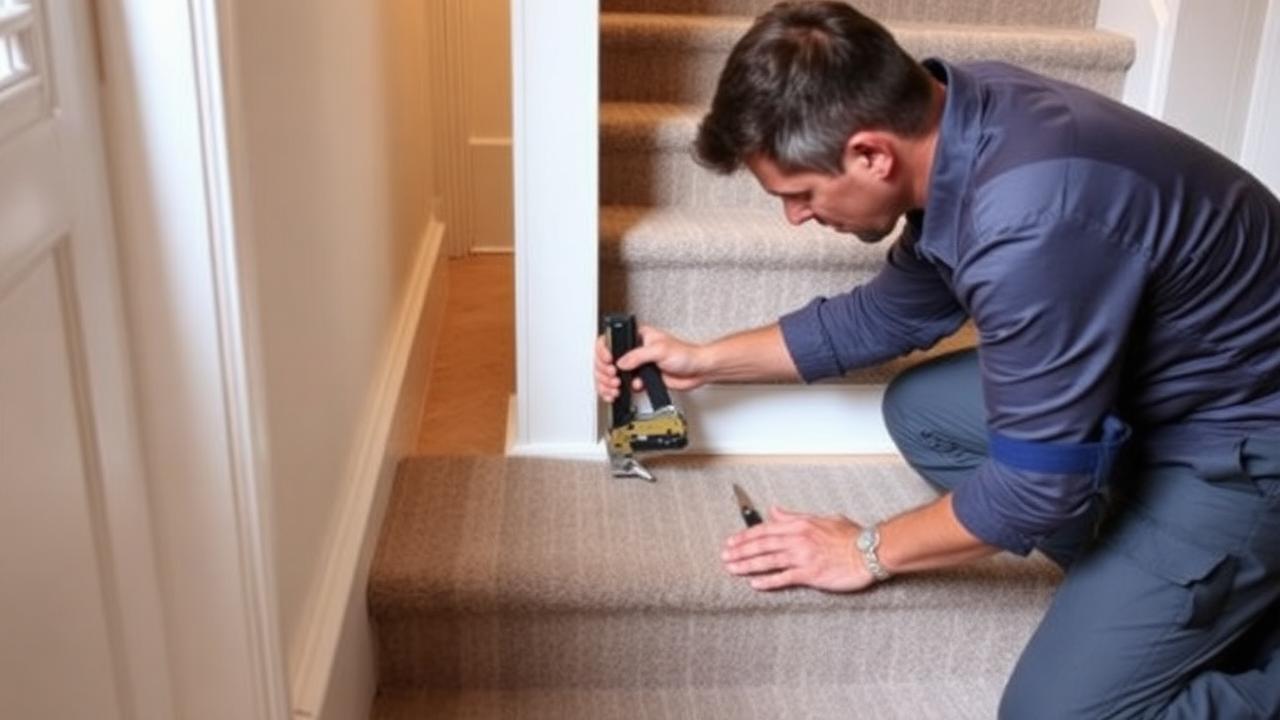
- Grit and sand tracked in from outside abrades fibre far faster than clean foot traffic alone.
- Direct sunlight on a top landing fades colour and weakens fibre with no way to reverse it.
- Pet claws on stairs accelerate pile crushing and can snag loop-pile constructions.
- Skipping regular vacuuming lets grit sit deep in the pile where it does the most damage.
- A poor-quality or missing pad underneath lets the backing flex and wear faster with every footstep.
Stretching the life you've got
A decent felt or rubber-backed pad underneath a stair runner does more for lifespan than almost any other single choice, because it absorbs impact that would otherwise go straight into the backing and pile fibres. Vacuuming twice a week on a busy staircase, rather than once a fortnight, removes the grit before it works its way down into the pile base. And rotating a runner isn't usually practical on stairs the way it is with a rug, but you can extend life by having a fitter periodically re-tension and re-tack the runner, which prevents the slight shifting that causes uneven, accelerated wear at the point where the runner has crept slightly off-centre.
If you're comparing several stair runners before buying and lifespan is your priority, use a stair runner calculator to work out the total length and area you need first, because face weight and fibre pricing scale with area - once you know the real square footage, comparing a genuinely dense wool runner against a lighter one becomes a fair like-for-like cost-per-year comparison rather than a straight sticker-price comparison that favours the shorter-lived option.
When the numbers stop adding up
If you're doing the maths and realise a cheap runner replaced every four years costs more over a fifteen-year window than a quality wool runner bought once, that's usually the moment to switch strategy on a busy family staircase. I've talked more than one client out of a third cheap polypropylene runner in six years and into a mid-range wool-nylon blend, and the total spend over the following decade came out lower even before counting the hassle of three separate installation visits. Stair runners aren't unique in this - it's the classic buy-cheap-buy-twice problem, just compressed into a shorter and more visible timeline because stairs get walked on constantly and the wear shows early.
Whatever you decide, get the numbers first: the stair runner calculator doubles as a stair runner length calculator, adding nosing wrap, landings, winders, pattern repeat and waste so you order the right length the first time.
Frequently asked questions
How long should a stair runner realistically last in a family home?
Expect 5-9 years for a busy family staircase with kids or pets using it daily, extending to 10-15 years for a wool or quality nylon runner on a more lightly used flight. Traffic volume affects lifespan more than almost any other single factor.
Does a more expensive stair runner always last longer?
Generally yes if the extra cost buys higher face weight and better fibre, but not always - some expensive runners are priced for pattern or brand rather than durability. Check the oz/sq yd face weight rather than assuming price alone tells you the lifespan.
Do stair runners wear out faster than flat carpet in the same house?
Yes, because every square foot of a stair tread gets stepped on with concentrated pressure from the ball of the foot, whereas flat carpet spreads footfall across a much larger area. Stairs are consistently the highest-wear carpeted surface in most homes.
Can a worn stair runner be repaired instead of replaced?
Sometimes - a fitter can sometimes swap in a spare offcut section at the worst-worn steps if you kept extra material from the original install, or re-lay the runner shifted slightly to move fresh fibre into the high-wear zone. This only works before the backing itself has failed.
Does pet traffic really shorten a stair runner's life that much?
Yes, noticeably. Claws catch and pull at loop-pile constructions and dogs running up and down stairs put repeated, uneven pressure on the same spots, typically cutting 30-40% off the lifespan you'd expect from the same runner in a no-pet household.
Is sisal a good long-term choice for stairs?
Sisal is structurally very hard-wearing against abrasion, often lasting 8-12 years, but it shows staining and soiling more visibly than wool or nylon and isn't recommended if the staircase gets wet feet or spills regularly, since it doesn't clean as forgivingly.
How do I know when my stair runner is actually due for replacement rather than just cleaning?
If the pile is flattened permanently even after vacuuming and steaming, if you can see backing or matting through the pile at tread centres, or if the edges are fraying or lifting, it's past cleaning and into replacement territory.
Does underlay or padding actually extend a stair runner's life?
Yes, meaningfully. A good felt or rubber pad absorbs impact and reduces flex in the backing on every footstep, and runners fitted over decent padding commonly last 20-30% longer than the same runner fitted directly onto bare wood treads.
Know your numbers in 30 seconds
Enter your step count, tread depth and riser height — the stair runner calculator gives you the exact length to order, in metres and feet, with waste included.
Work out your own runner length with the stair runner calculatorReady for real prices?
Get quotes from vetted stair runner suppliers and fitters near you. Free, no account, no obligation.
Every guide is written from hands-on measuring and fitting experience, checked against the calculator’s own maths, and re-reviewed whenever prices or methods change. Read our editorial standards.