

What is a Loop Pile Construction?
As the name suggests, loop pile is made by weaving or tufting yarn into loops that are left uncut. This creates a surface that is naturally springy and very good at recovering its shape. Unlike cut pile, where the individual fibres can be flattened over time, a loop pile structure supports itself, making it one of the best choices for stairs where people are constantly putting their weight on the same few square inches of the nosing. You'll often find loop piles in materials like wool, sisal, or synthetic blends, and they range from tight, low-profile weaves to large, chunky Berbers.
One of the main reasons my clients choose loop pile is the 'clean' look it provides. Because the fibres are looped, they don't 'shade' or show vacuum marks in the same way a velvet or plush cut-pile carpet does. If you want your stairs to look uniform and tidy even after a whole family has run up and down them, a loop pile is an excellent candidate. However, you need to be aware that the texture can vary significantly; a tight loop feels firm and durable, while a large, loose loop can feel softer but might be more prone to pulls.
The Pros and Cons for Stairs
The biggest advantage of loop pile on stairs is its resistance to tracking. On a staircase that leads directly from a front door, you will often see a 'path' worn into a cut-pile carpet within a couple of years. Loop pile resists this matting much better. However, the Achilles' heel of any loop pile is snagging. If you have a cat that likes to use the stairs as a scratching post, or a dog with long claws, a single snag can turn into a 'run' that ruins the look of the runner. If you have pets, I generally suggest a very tight, low-profile loop or a cut-pile alternative.
Another consideration is 'grin-through.' As I've mentioned in other guides, when you bend a carpet over a stair nosing, the gaps between the fibres can open up. Because loops are wider than individual cut tufts, a low-density loop pile can sometimes show the backing more clearly than a cut pile would. Always check a sample by bending it over your hand to see how it will look once installed on your steps.
How much runner do I need?
Measuring for a loop pile runner is straightforward, but you must account for the thickness of the loops. A chunky Berber loop will take up slightly more room as it wraps around the nosing than a thin flatweave. For a standard 13-step flight in the US (10 in tread, 7.5 in riser, 0.75 in wrap), you have 18.25 in per step. 13 steps equals 237.25 in (19.77 ft). Add 24 in for the top and bottom allowances for a subtotal of 261.25 in (21.77 ft). With a 7% waste margin, you are looking at approximately 23.5 ft total.
For a UK staircase with a 25 cm tread and 19 cm riser, the total per step is 45.9 cm. Across 13 steps, that is 596.7 cm. Add your 60 cm for finishing, and you're at 656.7 cm. A 7% waste margin brings you to roughly 7 meters. If you are choosing a loop pile with a pattern (like a ribbed or chevron effect), you might want to add a couple of extra feet just in case the pattern needs to be aligned more precisely at the nosings. Using a stair runner calculator is the best way to get a baseline before you start adding these margins.
| Measurement | US (in/ft) | UK (cm/m) |
|---|---|---|
| Tread depth | 10 in | 25 cm |
| Riser height | 7.5 in | 19 cm |
| Nosing wrap | 0.75 in | 1.9 cm |
| Total per step | 18.25 in | 45.9 cm |
| 13 steps subtotal | 19.77 ft | 5.97 m |
| Finishing allowance | 21.77 ft | 6.57 m |
| Order with 7% waste | 23.5 ft | 7 m |
Know your numbers in 30 seconds
Enter your step count, tread depth and riser height — the stair runner calculator gives you the exact length to order, in metres and feet, with waste included.
Open the stair runner calculatorTexture and Material Choices
Loop pile runners come in a vast array of textures. Wool is the most popular choice for its natural bounce and stain resistance. You can also find 'flatweave' style loops that mimic the look of natural sisal but are made of softer wool, giving you the rustic look without the scratchy feel. Synthetic loop piles, often made of polypropylene, are very affordable and stain-resistant but can feel a bit 'plastic' and won't bounce back as well as wool over time.
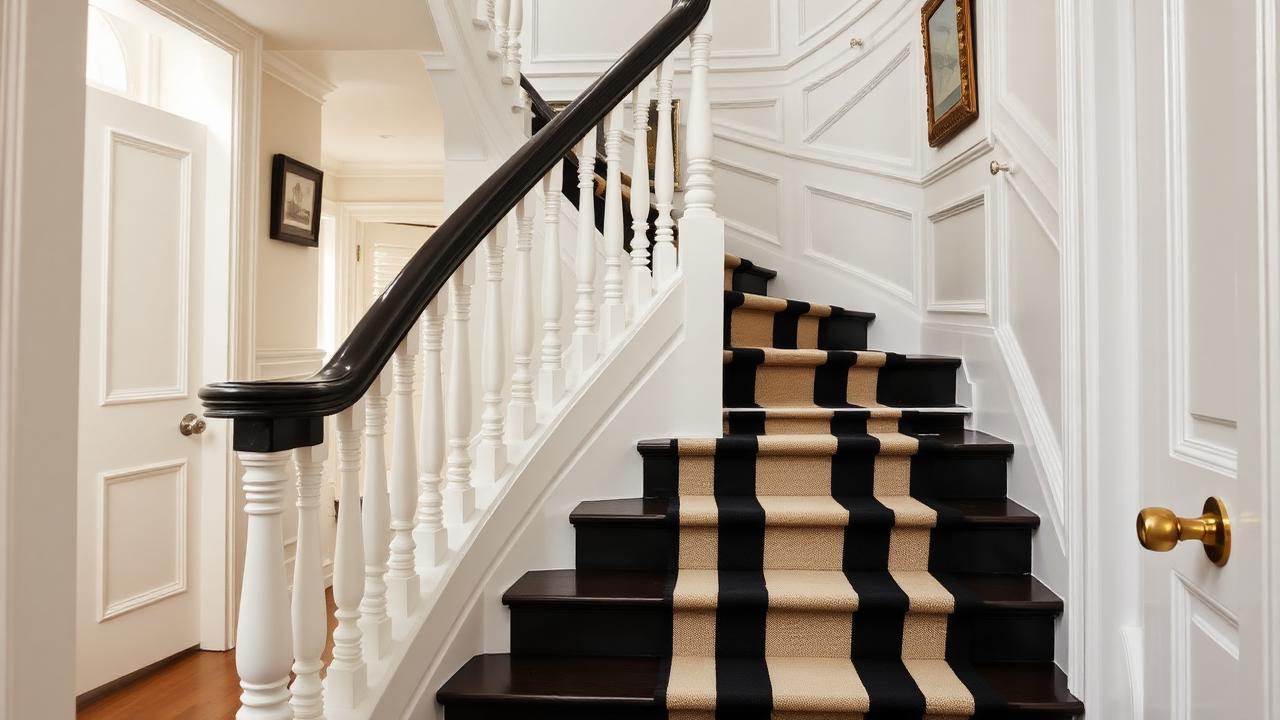
When choosing a texture, think about the 'grip.' A very smooth, tight loop can be slightly more slippery than a textured one, especially if you usually walk in socks. A slightly more textured loop, like a ribbed or high-low design, provides a bit more traction underfoot. As a fitter, I always prefer a mid-range density—if the loops are too close together, the carpet is stiff and hard to fit; if they are too far apart, it looks cheap on the nosings.
Fitting Loop Pile on Stairs
Fitting a loop pile runner requires a careful hand with the bolster and the stapler. You want to make sure you aren't crushing the loops when you drive the carpet into the crotch of the stair. I use a slightly wider bolster for loop piles to spread the pressure. Also, be very careful with your carpet staples; if you catch a loop and pull it, you can create a snag that runs the length of the step. I always separate the loops by hand before stapling to ensure the staple sits on the backing, not the pile.
- Use a high-quality, firm underlay to prevent the loops from being crushed from below.
- Avoid using a knee-kicker too aggressively, as it can distort the loop pattern.
- When cutting, always cut from the back to avoid slicing through the loops on the surface.
- Seal any cut edges immediately to prevent the loops from unraveling.
- For a waterfall installation, ensure the loops are aligned straight to maintain a clean vertical look.
The Pet Warning
If you have cats, be aware that a loop pile runner is basically one big scratching post. Consider a 'cut-pile' runner instead to avoid the heartbreak of seeing your new runner shredded within a week.
Cleaning and Maintenance
Loop pile is relatively easy to maintain, but you must use the right tools. Never use a vacuum with a beater bar or an aggressive rotating brush on a loop pile runner—it will eventually 'fuzz' the loops and can even pull them out. A suction-only vacuum is the safest bet. If you do get a snag (a loop that has pulled up), don't pull it! Simply snip it off level with the rest of the pile using a sharp pair of scissors. The structure of the carpet will hold the rest of the loop in place.
Overall, a loop pile runner is a stylish and durable choice for modern homes. It offers a clean, architectural look that complements wood and stone beautifully. Just make sure to measure accurately using a stair runner calculator, choose the right density for your household, and hire a fitter who knows how to handle woven textures without causing damage.
Whatever you decide, get the numbers first: the stair runner calculator doubles as a stair runner length calculator, adding nosing wrap, landings, winders, pattern repeat and waste so you order the right length the first time.
Still deciding on material, width or pattern? Our hub on stair runners compares weaves, widths, backings and fitting styles side by side, then hands the numbers straight to the calculator.
Frequently asked questions
Is loop pile good for stairs?
Yes, loop pile is very resilient to crushing and matting, making it ideal for high-traffic stairs. It also hides footprints and vacuum tracks better than cut pile.
Do loop pile carpets snag easily?
Yes, this is their main drawback. Pets with claws or high heels can snag the loops, which can lead to runs in the carpet if not handled carefully.
What is a Berber stair runner?
A Berber runner is a specific type of loop pile, usually featuring chunky, multi-coloured or tonal loops. It is known for its durability and rustic, natural appearance.
Can I use a vacuum with a brush bar on a loop pile?
It is not recommended. The rotating brush can fuzz the loops and cause them to pull out over time. Use a suction-only setting for the best results.
Is loop pile more slippery than cut pile?
It can be, depending on the material and the tightness of the weave. A textured loop generally provides good traction, but very tight, smooth loops can feel a bit slicker.
How do I fix a pulled loop in my runner?
Never pull it! Instead, use a sharp pair of scissors to snip the loop level with the rest of the pile. The surrounding weave will keep the yarn secure.
Does loop pile show the backing on stairs?
This is known as 'grin-through.' It depends on the density of the carpet. A high-density loop will show very little, while a cheaper, low-density one might show the backing on the nosings.
How do I measure for a loop pile runner?
Use a stair runner calculator to get the basic yardage for your treads and risers, then add a 7-10% waste margin to account for thickness and cutting.
Know your numbers in 30 seconds
Enter your step count, tread depth and riser height — the stair runner calculator gives you the exact length to order, in metres and feet, with waste included.
Work out your loop pile runner length with the calculatorReady for real prices?
Get quotes from vetted stair runner suppliers and fitters near you. Free, no account, no obligation.
Every guide is written from hands-on measuring and fitting experience, checked against the calculator’s own maths, and re-reviewed whenever prices or methods change. Read our editorial standards.