
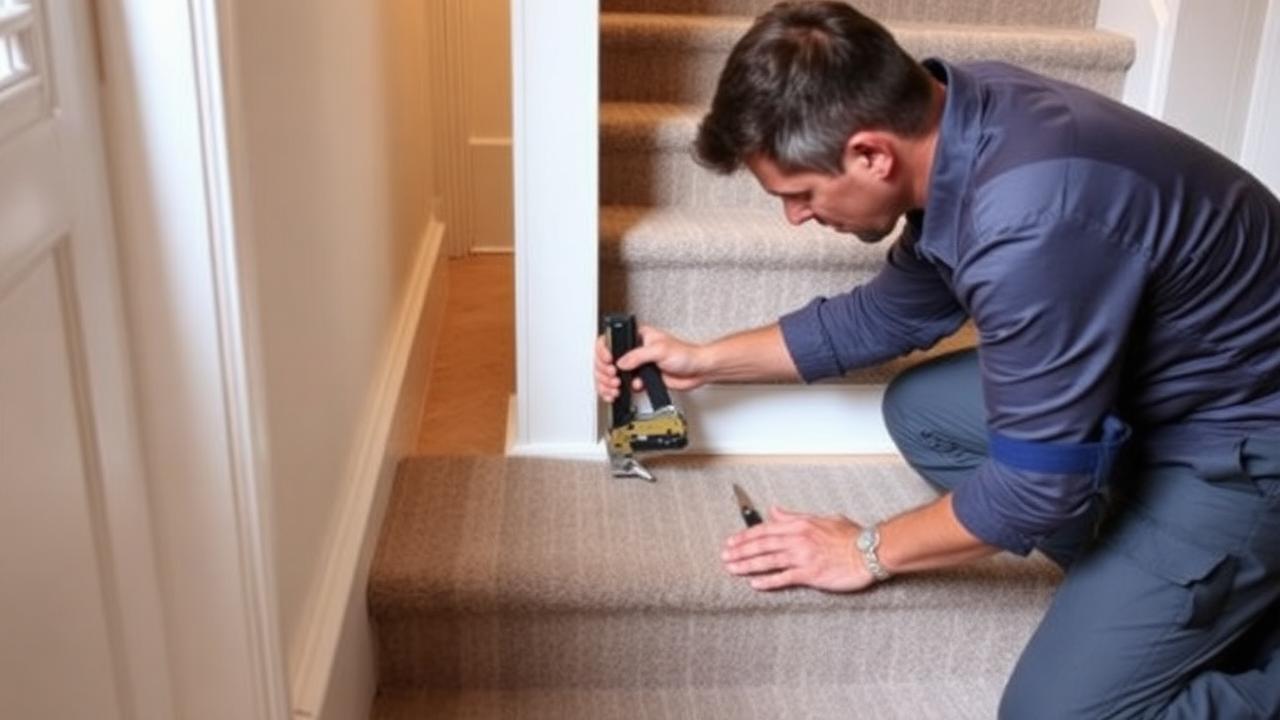
Specifying the carpet for stair duty
Stairs are the highest-wear surface in a house. Foot pressure concentrates on the nosing of every tread, which means the carpet is compressed and abraded on a strip perhaps 40mm wide, hundreds of times a day. A carpet that performs perfectly on a bedroom floor can flatten on a stair nosing within a year, so the specification matters more than in any other location.
| Property | Specify | Why |
|---|---|---|
| Wear rating | Heavy domestic or general contract | Nosing wear is 3-5x floor wear |
| Construction | Loop or dense low-pile cut | Holds shape over the nosing |
| Pile weight | 1,300 g/m2 or higher | Density resists crushing |
| Pile height | 6-9mm for loop, up to 12mm cut | Deep pile springs off the crease |
| Backing | Woven or action back | Takes staples and gripper without tearing |
| Fibre | 80/20 wool-nylon, solution-dyed nylon, or PP | Resilience plus stain performance |
| Width available | Sold as runner width or cut from broadloom | Determines binding requirement |
Avoid high-pile shag, long-pile saxony and very loose berbers on stairs. Shag hides the nosing line entirely, saxony marks and shades permanently at the crease, and loose berber loops snag and run when caught by a heel or a dog claw. Natural fibres are a mixed case: sisal is hard-wearing but slippery and can be brittle at the crease; wool sisal and jute-wool blends are the usual compromise; coir is too coarse for most staircases underfoot.
Binding: the finish that defines a runner
Every runner cut from broadloom must be finished on both long edges. There are three standard treatments, and the choice affects both appearance and cost.
| Edge finish | Look | Typical cost | Best for |
|---|---|---|---|
| Cotton or linen binding tape | Crisp, contrasting or matched band | £4-8 per m / $4-8 per ft | Wool and flat weaves |
| Whipping / serging | Yarn wrapped over the edge, soft | £5-9 per m / $5-9 per ft | Natural fibres, sisal, jute |
| Leather or faux-leather binding | Statement, heavy, tailored | £12-25 per m / $12-25 per ft | High-end wool runners |
| Latex sealed cut edge | Raw, minimal | £2-4 per m | Budget or temporary fits only |
Binding is not optional
A raw cut edge on a staircase frays faster than anywhere else because every descending foot brushes the side of the runner. Latex sealing slows it; it does not stop it.
Installation standards: what good looks like
There is no single legal standard for a domestic runner installation, but the trade conventions below are what a professional job is measured against, and they are worth using as a snagging list when a fitter hands the job over.
- Reveal identical on both sides of every step, within about 3mm across the whole flight.
- No visible fixings on any face that can be seen from the hall or the landing.
- Gripper set 15-18mm back from the internal angle, cut short of the runner edge by 25-30mm.
- Underlay wrapped over each nosing and terminated on the riser face, not run continuously.
- Every crease tight enough that hand pressure on the tread does not lift the nosing edge.
- Pattern position repeated identically on every tread.
- Bottom edge folded and fixed just above floor level; top edge tucked or wrapped, never raw.
- No trip hazard at either terminal step; no proud fixings.
Fixing systems compared
| System | Holding power | Reversible | Substrate | Notes |
|---|---|---|---|---|
| Gripper (tackless) strip + staples | Highest | With effort | Timber | Trade standard for carpet runners |
| Staples only | High | With effort | Timber | Acceptable, slightly less tension retention |
| Adhesive | High | No | Concrete, stone | The option where staples cannot bite |
| Rods and brackets | Moderate | Yes | Timber | Decorative plus mechanical pinch |
| Runner clips / grip pads | Moderate | Yes | Timber | Renter-safe; needs regular re-checking |
| Double-sided tape | Low | Yes | Any | Short-term only; not a safe permanent fix |
Gripper plus staples is the trade standard because it does two jobs at once: the opposed gripper pins hold tension between steps, and the staples fix the carpet mechanically at the points where tension is highest. On concrete or stone stairs, where nothing can be nailed, a flooring adhesive compatible with the carpet backing is the correct answer, applied to the tread and the top third of the riser only so the crease can still be worked.
Underlay specification
Underlay for stairs is specified differently from room underlay. Thicker is not better: over about 11mm the runner loses definition at the nosing and the crease softens, which both looks wrong and accelerates wear because the carpet moves against the timber. The right specification is dense rather than thick.
| Type | Thickness | Density | Suitability |
|---|---|---|---|
| PU foam | 8-11mm | 100-140 kg/m3 | Best all-round choice for runners |
| Crumb rubber | 6-9mm | High | Excellent for heavy traffic and sound |
| Sponge rubber | 8-10mm | Medium | Traditional, good under wool |
| Felt | 8-10mm | Medium | Suits natural fibre runners |
| Combination felt/rubber | 9-11mm | High | Contract-grade stair specification |
| Thick 12mm+ foam | 12mm+ | Low | Not suitable — crease collapses |
Safety considerations
Falls on stairs are among the most common serious accidents in the home, and a badly fitted runner is a direct contributor. Three specific risks apply to runner installation rather than to carpet in general.
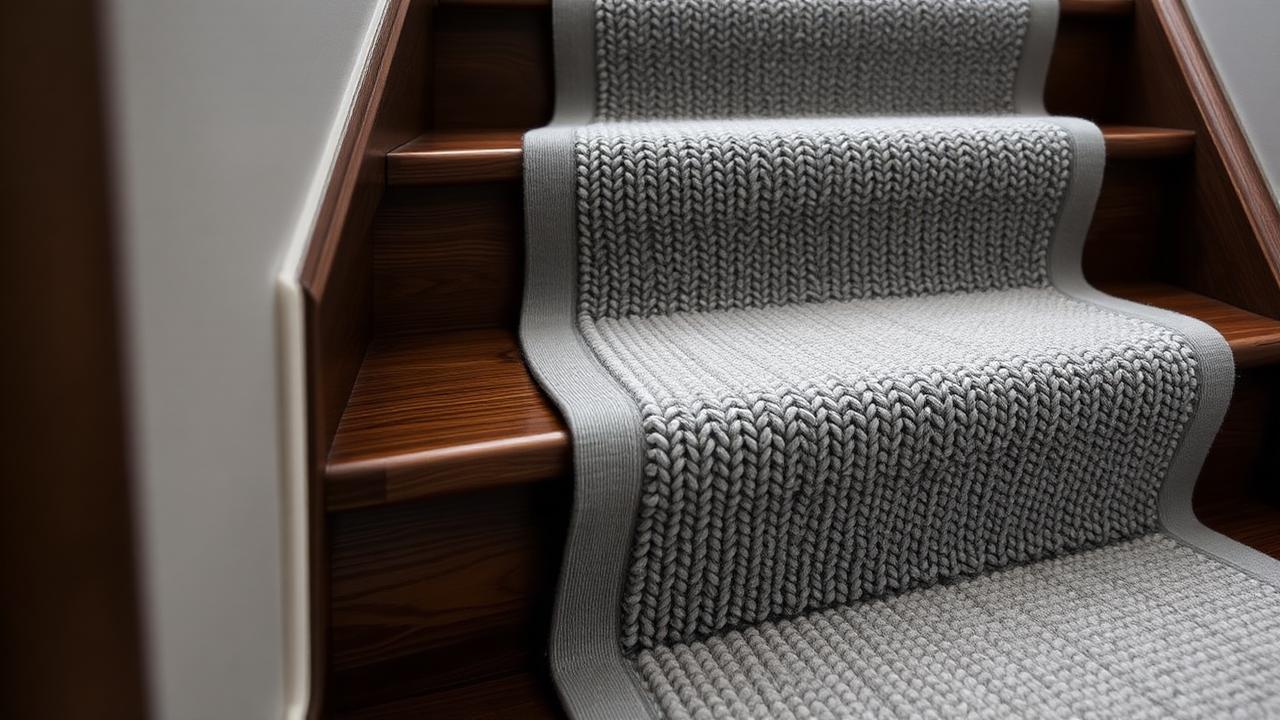
- Loose covering: any runner not mechanically fixed to the treads can slide underfoot. Anti-slip underlay is not a fixing method on a staircase.
- Edge trip: a runner whose bound edge lifts, or which is too narrow to sit flat, creates a raised line right where a foot may land off-centre.
- Nosing definition: a runner so thick or soft that the nosing line disappears removes the visual cue people use to judge step depth, which particularly affects older users and anyone with limited vision.
Contrast the nosing if visibility matters
Where accessibility is a concern, specify a runner whose colour contrasts with the timber, or add a contrasting binding tape. Keeping the step edge visually readable is a genuine safety measure, not a styling choice.
What a professional installation costs
| Component | UK | US |
|---|---|---|
| Carpet, heavy domestic wool blend | £38-75 per linear m | $45-90 per linear yd |
| Binding both edges | £4-9 per m | $4-9 per ft |
| Underlay, PU 100-140 kg/m3 | £5-9 per m2 | $0.8-1.5 per sq ft |
| Gripper, staples, sundries | £20-40 | $25-50 |
| Labour, straight 13-step flight | £180-350 | $250-500 |
| Labour, flight with winders | £300-600 | $400-800 |
| Uplift and disposal of old carpet | £40-90 | $60-140 |
| Typical total, straight flight | £650-1,300 | $900-1,800 |
Prices vary by region and by carpet, but the split is fairly stable: material and binding are usually 55-65% of the total, labour 30-40%, and sundries the rest. If a quote is dramatically below that range, check what has been left out — underlay grade and binding are the two lines most often quietly dropped. The stair runner cost calculator prices the same components against your own step count so you can compare like with like.
Know your numbers in 30 seconds
Enter your step count, tread depth and riser height — the stair runner calculator gives you the exact length to order, in metres and feet, with waste included.
Open the stair runner calculatorLead times and site conditions
- Stock runner, bound to length: typically 1-2 weeks from order.
- Broadloom cut and bound to order: 2-4 weeks.
- Bespoke pattern or custom binding: 4-8 weeks.
- Site: staircase clear, decorating finished and cured, power available for a stapler.
- Access: fitters need somewhere to lay out and cut a 6-7m length — usually a landing or a hallway.
- Acclimatisation: leave wool runners in the house for 24-48 hours before fitting.
Aftercare that protects the installation
A correctly installed runner still needs a settling-in period. Wool sheds loose fibre for the first few weeks — vacuum lightly rather than aggressively, and use a suction-only head on loop pile so the beater bar does not pull loops. Check the tension at the bottom three steps after a month, because that is where the highest traffic concentrates. If you specified rods, re-tighten the brackets after the first month; timber moves and screws bed in.
Longer term, the wear pattern on a runner is entirely predictable: the bottom three treads and the top two take a disproportionate share. On some installations it is possible to have the runner lifted, turned end for end and refitted at around the seven-year point, which redistributes the wear and can add several years of life. Ask at specification stage whether your chosen carpet and finish allow it — a runner with directional pattern or asymmetric binding will not turn.
Specifying and quoting as a trade installer
Trade quotes for stair runner carpet installation should always list carpet, binding type and length, underlay grade, gripper, fixings, labour, uplift and disposal as separate lines. Clients compare totals when the detail is hidden and compare specification when it is shown, and a specified quote wins more often at a higher price. Riser for pros builds this itemised quote from the measurements, applies wastage and roll planning, and produces a branded PDF the client can accept online.
For homeowners, the same list is your checklist when comparing. If two installers quote very differently, work down the components and find which one is missing — nine times out of ten it is underlay grade, binding, or an uncounted set of winders rather than the labour rate.
Whatever you decide, get the numbers first: the stair runner calculator doubles as a stair runner length calculator, adding nosing wrap, landings, winders, pattern repeat and waste so you order the right length the first time.
Frequently asked questions
What is stair runner carpet installation?
It is the specification and fitting of a narrow carpet down the centre of a staircase over gripper and underlay, tensioned step by step, with a defined reveal of bare tread left on each side and both long edges bound or serged.
What carpet is best for a stair runner installation?
Heavy domestic or general contract grade, dense loop or low cut pile at 1,300 g/m2 or more, on a woven or action backing. An 80/20 wool-nylon blend or solution-dyed nylon performs best over nosings.
Do you need underlay for a stair runner installation?
Yes, and it should be dense rather than thick — 8-11mm PU at 100-140 kg/m3, or 6-9mm crumb rubber. Anything over about 12mm softens the crease at the nosing and shortens the carpet's life.
How much does professional stair runner carpet installation cost?
A straight 13-step flight typically totals £650-1,300 in the UK or $900-1,800 in the US including carpet, binding, underlay and labour. Winders or a landing add £120-250 or $150-300.
How long does a runner installation take?
A professional fitter needs two to three hours for a straight flight and five to six with winders. Lead time from order is usually one to two weeks for a stock bound runner and two to four for broadloom cut and bound to order.
Can a stair runner be installed on concrete stairs?
Yes, using a flooring adhesive suitable for the carpet backing, or a rod-and-bracket system fixed with masonry plugs. Staples and gripper pins will not hold in concrete.
How do I check the installation was done properly?
Look for an equal reveal within about 3mm across the flight, no visible fixings, tight creases that do not lift when you press the tread, identical pattern placement on every step, and neat, secure finishes at the top and bottom.
Should the old carpet be removed first?
Yes. Old carpet compresses unevenly, prevents proper tensioning and stops staples biting into the timber. Uplift and disposal is usually £40-90 or $60-140 on a quote.
Know your numbers in 30 seconds
Enter your step count, tread depth and riser height — the stair runner calculator gives you the exact length to order, in metres and feet, with waste included.
Price my installationReady for real prices?
Get quotes from vetted stair runner suppliers and fitters near you. Free, no account, no obligation.
Every guide is written from hands-on measuring and fitting experience, checked against the calculator’s own maths, and re-reviewed whenever prices or methods change. Read our editorial standards.