

What a waterfall stair runner actually is
In a waterfall fit the runner is laid over the tread, allowed to run off the nosing, and left to fall straight down the face of the riser below without being pushed into the crease at the back of the step. The carpet forms a soft, slightly rounded curve at the front of each tread rather than a crisp right-angle fold. Seen from the side, the runner reads as a continuous ribbon draped over the stair profile, which is where the name comes from: it cascades from step to step like water running over a series of ledges.
This is one of three standard ways a stair runner is fitted, and it sits at the relaxed end of the spectrum. A Hollywood or cap-and-band fit, by contrast, pulls the carpet tightly around the nosing and into the angle of every tread, so the stair's own profile shows clearly through the carpet — sharp treads, sharp risers, a tailored look. A fully upholstered fit goes further still, padding out the nosing with extra underlay or a wrapped pad so the whole staircase reads as one continuous, cushioned form, closer to a piece of furniture than a floor covering.
| Fit | Profile at the nosing | Material use per step | Typical look |
|---|---|---|---|
| Waterfall | Soft curve, no crease pulled tight | Least (or equal-least) | Relaxed, traditional, forgiving |
| Hollywood | Sharp, tight crease around the bullnose | Adds roughly the nosing depth | Tailored, crisp, shows step lines |
| Upholstered | Padded, rounded bullnose profile | Most, plus extra underlay/padding | Luxurious, furniture-like |
Why fitters choose waterfall
Waterfall is the default recommendation for most domestic staircases because it is quicker to lay, more tolerant of small measuring errors, and kinder to certain fibres. Because the carpet is not forced into a hard right-angle at every nosing, there is less mechanical stress concentrated at that single line, which matters most with looped and textured piles that can pull or flatten when creased sharply. It also suits staircases with a pronounced bullnose or a rounded nosing profile, where trying to force a tight Hollywood crease would leave visible gapping.
It is also the more common choice on stairs with winders or an open-plan half-turn, because a soft waterfall drape is far more tolerant of the small width and angle variations that appear across a winder tread. A Hollywood fit on the same winder needs the fitter to work harder to keep the crease crisp and even, and any inconsistency shows immediately because the eye is drawn to a sharp line.
How much extra length a waterfall fit needs
The counterintuitive point is that waterfall generally uses slightly less runner per step than Hollywood, not more, because the carpet is not being pulled around the full depth of the nosing and back into the crease — it simply carries on to the next surface. On an average domestic step of 250mm (10in) tread and 190mm (7.5in) riser, a waterfall allowance is close to the tread-plus-riser figure alone, roughly 440mm (17.3in) per step, while a Hollywood fit typically adds another 20-40mm (0.75-1.5in) per step to wrap the nosing properly.
Where waterfall does need more length overall is at the very top and bottom of the flight, and on any tread with a pronounced bullnose overhang, because the drape needs enough slack to fall cleanly rather than sitting flush and taut. Most suppliers recommend adding a 40-60mm (1.5-2.5in) tucking allowance at each end regardless of fit style, and a further 5% contingency across the whole flight if the treads are not perfectly uniform. Always run the actual step count and depths through a stair runner calculator rather than relying on an average, since even a 10mm variance per step compounds across a 13-16 riser flight into several centimetres of shortfall.
| Flight length | Tread+riser only | Waterfall allowance (+tucking) | Hollywood allowance (+tucking) |
|---|---|---|---|
| 12 risers | 5.3m / 17.4ft | 5.5m / 18.0ft | 5.8m / 19.0ft |
| 14 risers | 6.2m / 20.3ft | 6.4m / 21.0ft | 6.8m / 22.3ft |
| 16 risers | 7.0m / 23.0ft | 7.3m / 24.0ft | 7.7m / 25.3ft |
Know your numbers in 30 seconds
Enter your step count, tread depth and riser height — the stair runner calculator gives you the exact length to order, in metres and feet, with waste included.
Open the stair runner calculatorWear patterns to expect
Because a waterfall runner is not pulled tight into the back angle of the tread, that crease sees less direct crushing than it would in a Hollywood fit, which is one reason waterfall runners in wool loop pile often outlast the same fibre laid Hollywood on a busy family staircase. The trade-off is that the nosing edge — the leading curve where the carpet turns from tread to riser — takes slightly more abrasion from feet and shoe heels catching the front edge, since it is not anchored as firmly at that point.
In practice this means waterfall runners benefit even more than Hollywood fits from a dense 8-11mm underlay directly under the nosing, and from a stair runner that includes a reinforced or double-woven leading edge if the manufacturer offers one. On heavy-traffic UK homes with children or large dogs, expect visible flattening at the nosing after 3-5 years in a mid-range wool-blend runner; a similar Hollywood-fitted runner in the same fibre often shows the wear a season or two later but concentrated more tightly in the crease line itself.
Best fabrics for a waterfall fit
- Wool loop pile — the classic waterfall material; the loop structure drapes cleanly and resists the flattening that a cut pile shows at a soft curve.
- Wool-synthetic blends (80/20 wool-nylon) — hold shape well over the nosing while adding wear resistance for stairs.
- Textured cut-and-loop patterns — the mixed pile height hides the slight compression at the drape point better than a flat cut pile.
- Flatweave wool or wool-blend runners — drape naturally with almost no bulk, a common choice for narrower period staircases.
- Avoid very thick, dense cut-pile saxony runners for waterfall — they resist draping and tend to spring away from the riser, leaving a visible gap.
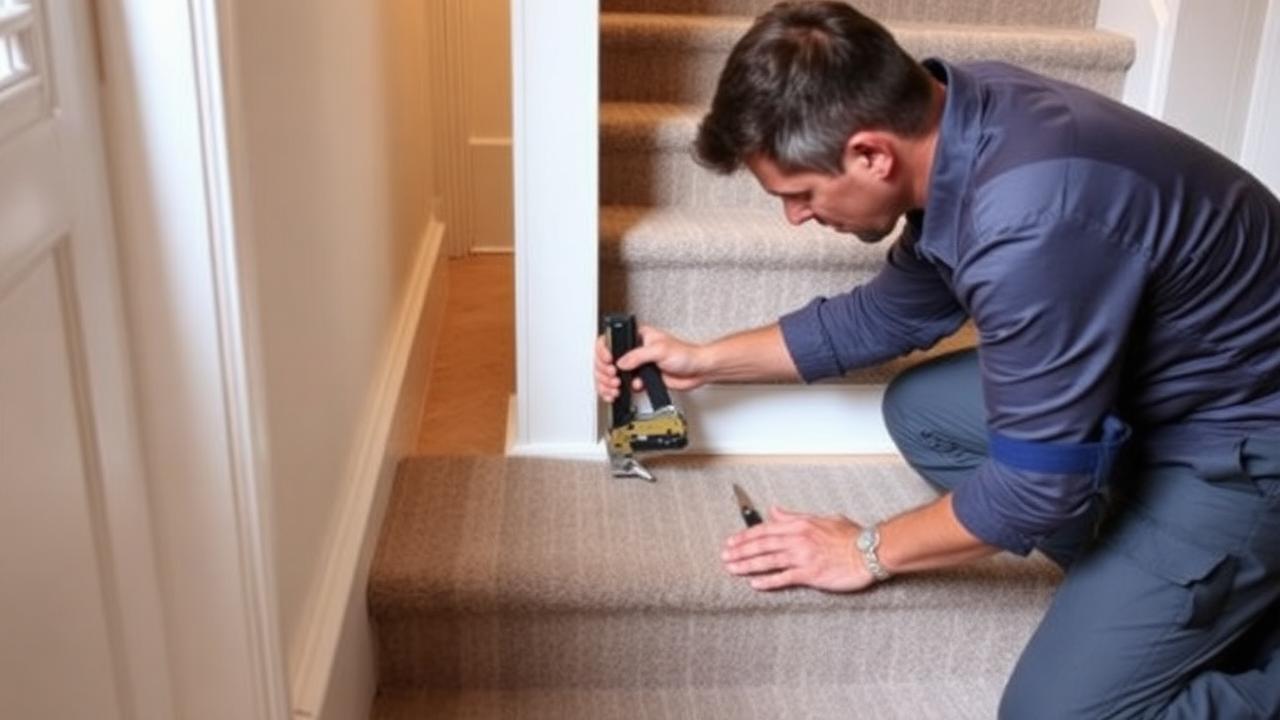
How to fit a waterfall stair runner
- Fit gripper strip in the angle of every tread as normal, plus a strip at the base of each riser to anchor the drape.
- Lay underlay across the full tread and let it wrap slightly over the nosing to cushion the leading edge.
- Start at the bottom riser, staple the hemmed end, and work upward one step at a time.
- Lay the runner over the tread and let it fall naturally down the riser below rather than pulling it into the back crease.
- Use the knee kicker to tension the runner across the width of the tread only — not into the nosing crease.
- Staple at the base of each riser into the gripper, keeping the drape curve consistent step to step.
- Check the drape depth against the previous step every time; an uneven curve is the most common waterfall fitting fault.
Check the nosing profile first
Waterfall suits stairs with a rounded or moulded nosing best. On very square, sharp-edged modern treads a waterfall drape can look slightly loose; a Hollywood fit usually reads better on that profile instead.
Waterfall vs Hollywood vs upholstered: which to choose
Choose waterfall for family homes, winders, rounded nosings, and any loop-pile or textured fibre where a soft finish suits the staircase and the household wants an easier, faster fit. Choose Hollywood for striped or geometric patterns where a crisp line at every nosing keeps the motif looking tailored, and for staircases with sharp, square-edged modern treads. Choose upholstered padding only for grand, formal staircases where the extra material and labour cost — typically 15-25% more than a standard waterfall fit in both the UK and US — is justified by the furniture-like result the client wants.
UK Building Regulations Approved Document K and the US IRC R311.7 do not distinguish between fitting styles; both simply require the finished nosing to be non-slip and to not create a trip hazard, so any of the three fits is compliant provided the carpet is securely fixed and does not bunch or lift at the edge.
Whatever you decide, get the numbers first: the stair runner calculator doubles as a stair runner length calculator, adding nosing wrap, landings, winders, pattern repeat and waste so you order the right length the first time.
Still deciding on material, width or pattern? Our hub on stair runners compares weaves, widths, backings and fitting styles side by side, then hands the numbers straight to the calculator.
Frequently asked questions
What is a waterfall stair runner?
A waterfall stair runner is laid so the carpet falls straight off the nosing and down the riser below, without being pulled tightly into the angle at the back of the tread. It creates a soft, curved drape at each step rather than a crisp fold, and is the most common and forgiving fitting style for domestic staircases.
Does a waterfall fit use more or less carpet than Hollywood?
A waterfall fit usually uses slightly less runner per step than a Hollywood fit, because the carpet is not pulled around the full nosing depth into a tight back crease. Expect roughly 20-40mm (0.75-1.5in) less material per step, though both styles need the same tucking allowance at the top and bottom.
Is a waterfall stair runner harder wearing?
The back crease of each tread wears more slowly in a waterfall fit because it is not crushed as tightly as in a Hollywood fit, but the leading nosing edge takes slightly more abrasion. Overall wear depends more on fibre and underlay quality than on fitting style alone.
Can any fabric be laid waterfall?
Most wool, wool-blend and flatweave runners drape well in a waterfall fit. Very thick, dense cut-pile carpets resist draping and can spring away from the riser, leaving a visible gap, so a Hollywood or upholstered fit usually suits those denser fabrics better.
Do I need different underlay for a waterfall runner?
Use the same 8-11mm PU foam or crumb rubber underlay as any other fit, but make sure it wraps slightly over the nosing to cushion the leading curve, since that edge carries more abrasion in a waterfall fit than in a Hollywood fit.
Is waterfall the cheapest fitting style?
It is usually the least expensive to fit because it needs marginally less material and takes less labour time than Hollywood or upholstered fits. On a typical 13-15 riser flight the saving is modest, often 5-10% of the material cost, but the labour time saving can be more significant for a professional fitter.
Know your numbers in 30 seconds
Enter your step count, tread depth and riser height — the stair runner calculator gives you the exact length to order, in metres and feet, with waste included.
Calculate my runner lengthReady for real prices?
Get quotes from vetted stair runner suppliers and fitters near you. Free, no account, no obligation.
Every guide is written from hands-on measuring and fitting experience, checked against the calculator’s own maths, and re-reviewed whenever prices or methods change. Read our editorial standards.